

Make Your Website Redesign Work for Inbound Marketing
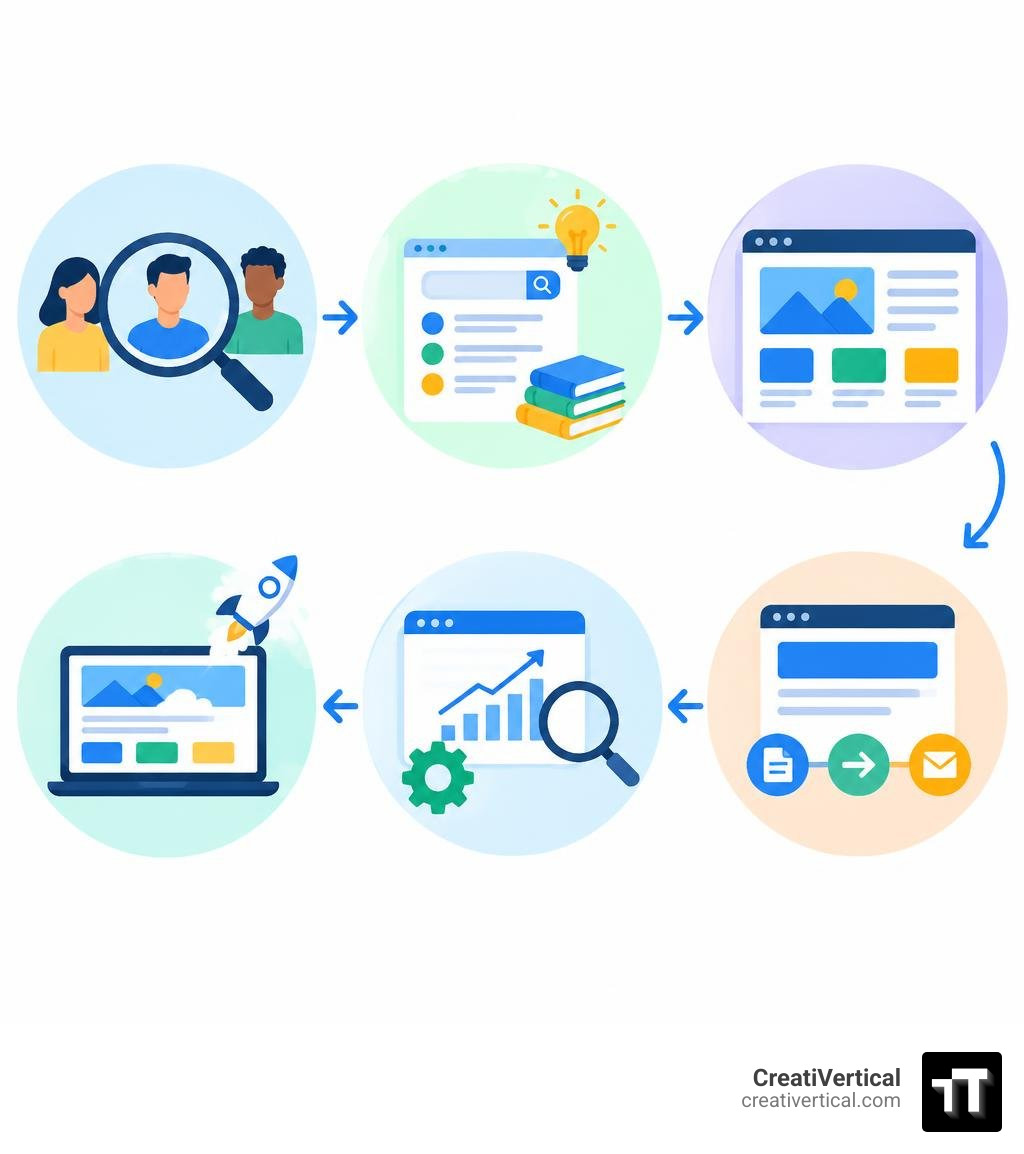
A website redesign for inbound marketing should start with the people you need to reach, not a new look. Map what they search for, what they need to learn, and what would make them ready to contact you. Then build clear pages for those needs, connect each page to a useful next step, and protect existing search traffic when the site goes live.
That matters in high-touch B2B sales. An engineer may need specifications, while a procurement lead needs proof that you can deliver. A strong redesign helps both find answers and gives your team a way to see which paths lead to qualified enquiries.
I’m Nicholas Cunha, founder of CreatiVertical, and I’ve spent more than twenty years working on digital projects for businesses and institutions, including clients in the British Virgin Islands. I bring that hands-on web development and SEO experience to website redesign for inbound marketing, with a focus on useful content, search visibility, and measurable leads.
Explore more about website redesign for inbound marketing:
Core Architectural Principles of a Website Redesign for Inbound Marketing
When complex B2B buyers evaluate your firm, your website functions as your primary 24/7 technical consultant. A cosmetic refresh that ignores underlying technical systems leaves marketing teams stranded.
A high-performing inbound platform relies on sound corporate web design and redesign principles for growing mid-market companies. It pairs structured content schemas with flexible administrative controls so non-technical staff can publish high-value resources without filing internal engineering tickets. For instance, a facilities management provider centralized complex multi-sector services into an intuitive, modular structure, generating over 700 enquiries, 120+ marketing-qualified leads (MQLs), and 35+ sales-qualified leads (SQLs).

Eliminating Developer Bottlenecks with Reusable Components
Marketing agility stalls when team members wait days or weeks for developer support to deploy landing pages or publish fresh case studies. We solve this by implementing atomic design systems. By assembling websites from modular UI blocks—hero sections, structured resource grids, spec tables, and contextual conversion bars—marketers can easily level up landing pages for new campaigns in minutes while maintaining brand consistency.
Technical Infrastructure and Performance Foundations
Performance and accessibility form the baseline for search discovery and conversion. Modern B2B buyers frequently conduct preliminary evaluations on mobile devices outside regular office hours. Your infrastructure must deliver rapid page speeds and meet Core Web Vitals standards.
Following a detailed guide to the website redesign process ensures your back-end architecture remains secure, clean, and fast. Case studies in technical sectors highlight this impact: one life sciences software provider improved page load times by 32.8% during a rebuild, which supported a 30% increase in website traffic, a 46% rise in pageviews, and a 300% lift in webinar engagement.
Aligning Site Structure with Complex B2B Buyer Journeys
B2B sales cycles in high-touch verticals rarely follow a straight line. Multiple stakeholders—ranging from technical evaluators and compliance officers to executive sponsors—review your digital presence. Your site structure must guide each persona through their distinct decision-making stages.
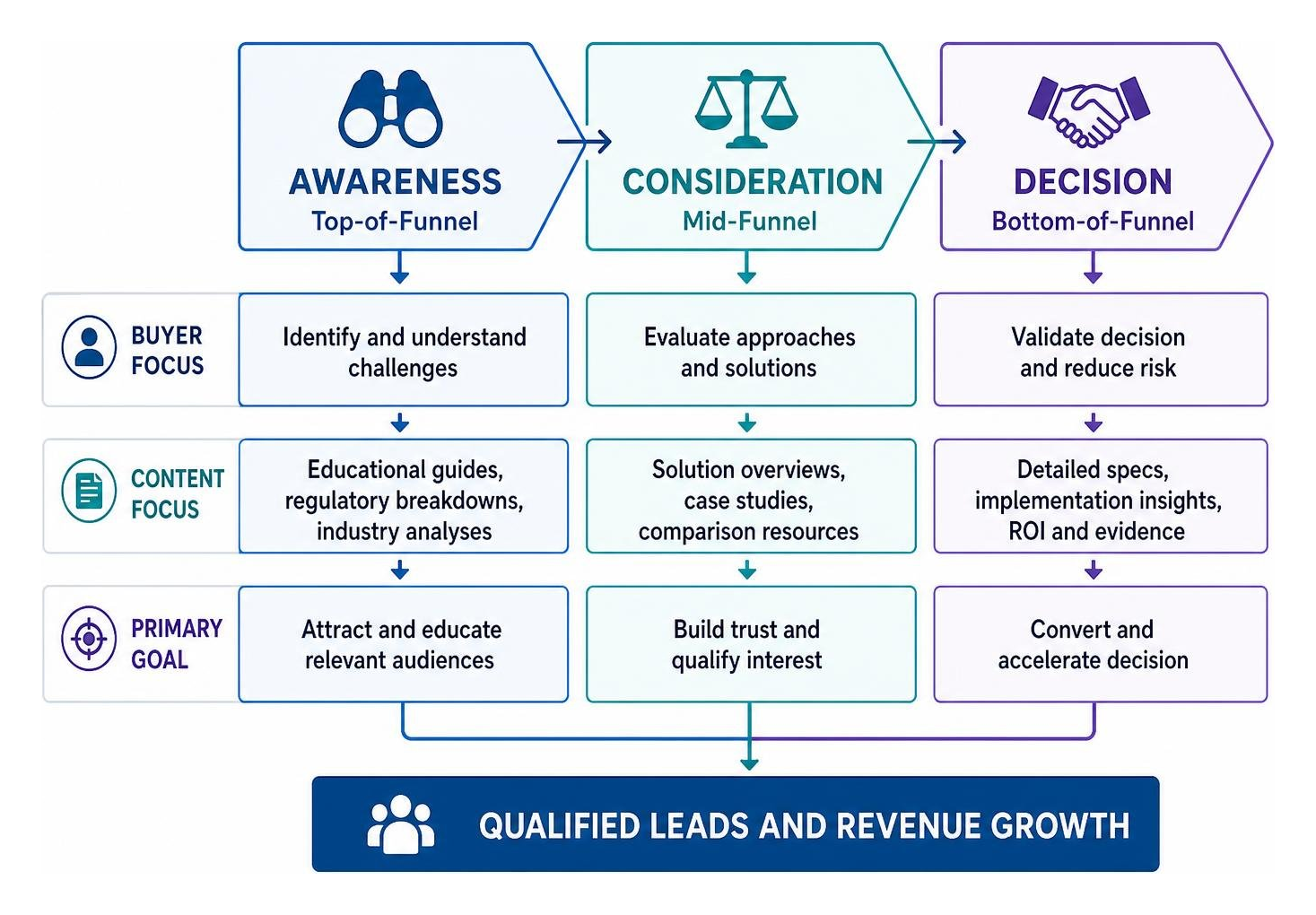
Mapping the Buyer’s Journey During a Website Redesign for Inbound Marketing
By applying proven lead generation marketing methods, your site architecture can directly address the three critical stages of buyer intent:
- Top-of-Funnel (Awareness): Educational guides, regulatory breakdowns, and industry analyses that solve immediate technical challenges.
- Middle-of-Funnel (Consideration): Deep technical documentation, interactive product catalogs, and detailed comparison matrices that build confidence.
- Bottom-of-Funnel (Decision): Comprehensive case studies, ROI calculators, integration overviews, and direct pathways to consultation.
Connecting keyword targeting to intent is essential; adopting buyer journey SEO ensures that every published asset matches specific search criteria. When a global wireless technology provider unified its digital presence with localized content filtering and persona-driven navigation, the company saw a 50% increase in inbound leads and a 63% jump in new web-generated contacts within the first year.
High-Converting Touchpoints and Dynamic Lead Routing
A standard “Contact Us” form rarely serves high-touch B2B buyers effectively. Instead, incorporate contextual conversion points throughout your content ecosystem. Use progressive profiling to collect information gradually, offer gated technical whitepapers or spec sheets where appropriate, and route inquiries directly into your CRM for rapid sales follow-up. Optimized post-conversion thank-you pages should guide prospects to relevant next steps, such as exploring related implementation guides or viewing customer stories.
Protecting SEO Equity and Expanding AI Search Visibility During a Relaunch
A common pitfall during a website overhaul is losing hard-won organic rankings due to poorly managed URL migrations. According to industry research, 93% of companies using inbound marketing generate more leads and sales, but those gains require maintaining search equity during design changes.
| Migration Phase | Critical Audit Requirements | Primary Objective |
|---|---|---|
| Pre-Launch | Crawl legacy site; catalog top-performing URLs; identify AI-cited entities; build 1:1 301 redirect map | Preserve established domain authority and indexation equity |
| Staging | Verify content parity (headings, tables, FAQs); validate schema markup; check noindex settings | Ensure rendering accuracy and prevent premature staging indexation |
| Launch Day | Execute redirect rules; verify robots.txt; submit clean XML sitemaps; validate analytics tracking | Confirm search engine access and real-time event measurement |
| Post-Launch (90-Day) | Monitor Google Search Console crawl errors; track Core Web Vitals; audit AI search engine citations | Identify ranking fluctuations and maintain technical health |
Reviewing the ultimate guide to maintaining SEO rankings during a site redesign helps avoid sudden drops in visibility. For example, one B2B integration platform paired a full-funnel site rebuild with structured SEO optimization to produce a 10:1 LTV-to-CAC ratio, 313% more inbound revenue, and a 584% increase in inbound pipeline.
Technical SEO Migration and Redirect Safeguards
Preserving visibility requires careful planning. Follow these essential migration steps:
- Run a full crawl of your existing site to identify all ranking pages and backlink targets.
- Create explicit, one-to-one 301 redirects rather than routing legacy links broadly to the homepage.
- Maintain content parity on core commercial pages; research shows full technical and content rebuilds can gain 28% in impressions, while removing structured content or reducing copy depth can lead to significant visibility losses.
- Ensure staging environments are properly shielded until launch, then verify that live robots.txt and canonical tags permit immediate indexing.
Reviewing our framework on website redesign and SEO planning for modern B2B brands provides additional detail on keeping your organic search footprint intact.
Structuring Content for Generative Engine Optimization (GEO)
Modern search visibility extends beyond traditional search results. Generative AI tools like ChatGPT and Perplexity pull directly from well-structured, authoritative web pages to answer technical queries.
Understanding AI website redesign realities for B2B marketing teams helps you structure information for both traditional search bots and generative AI answer engines. Implement structured data (such as Organization, Service, BreadcrumbList, and FAQPage schemas), use clear semantic HTML headings, and present data in clean tables to make your expertise easy for AI models to parse and cite.
Growth-Driven Design: Shifting from Monolithic Overhauls to Continuous Iteration
Traditional website redesigns often operate as prolonged, high-risk projects that remain static for years after launch. In contrast, an agile approach treats your site as an evolving platform that adapts to buyer feedback and conversion analytics.
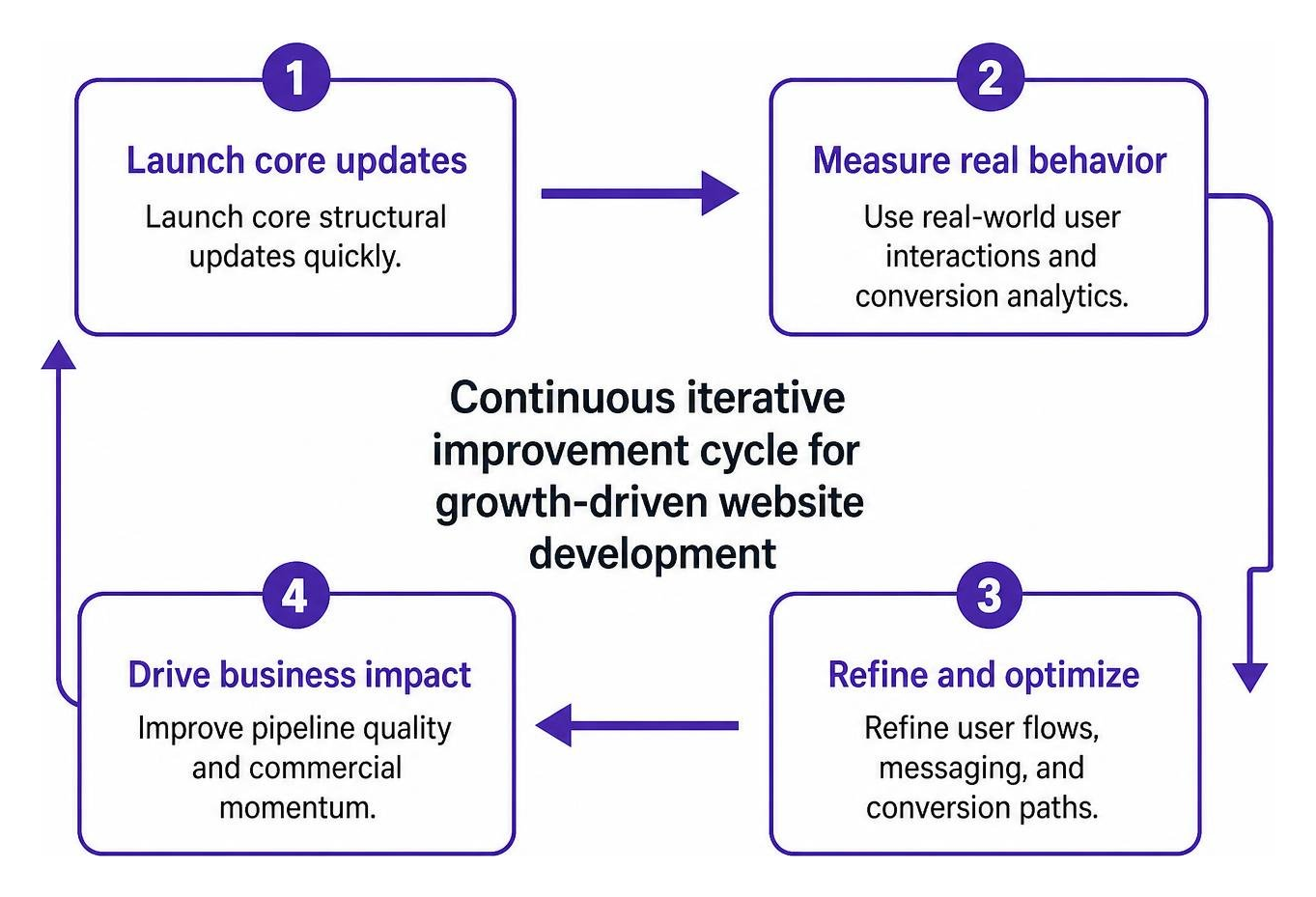
Embracing evolutionary site redesign allows your marketing team to launch core structural updates quickly, using real-world user interactions to refine user flows, messaging, and conversion paths over time.
Measuring Revenue Impact After a Website Redesign for Inbound Marketing
Evaluating a redesign goes beyond surface metrics like raw traffic volume. High-touch B2B organizations need to measure pipeline quality and commercial momentum. Follow a clear B2B website redesign roadmap to connect your analytics directly to business outcomes:
- Sales Pipeline Influence: Tracking qualified opportunities sourced directly from organic search and inbound landing pages.
- MQL-to-SQL Velocity: Measuring how quickly educational content accelerates pipeline progression.
- Conversion Efficiency: Tracking increases in consultation and demo requests; case studies like Circle show demo conversions jumping by 500% following structured inbound overhauls, while ShowReady saw a 2.9x lift in organic traffic, a 47% rise in organic leads, and a 23% reduction in cost per lead.
- Customer Acquisition Balance: Monitoring improvements in customer lifetime value relative to acquisition costs.
Frequently Asked Questions About Inbound Website Redesigns
How long does it take to recover organic rankings after a website relaunch?
When a migration uses meticulous 1:1 redirect maps, maintains content parity, and provides a clean technical foundation, search rankings generally stabilize within four to eight weeks. During this window, search engines recrawl your URLs and update their index. If URL redirects are missing or core content is heavily reduced, recovery can take considerably longer.
What is the most critical mistake B2B brands make during an inbound redesign?
The most common mistake is treating the redesign purely as a visual branding project while neglecting technical migration requirements and content depth. Removing technical comparison tables, dropping structured FAQ sections, or neglecting 301 redirects often leads to sharp declines in organic discovery and qualified inbound inquiries.
How do growth-driven redesigns differ from traditional website builds?
Traditional redesigns usually follow lengthy development cycles that deliver static assets every few years. Growth-driven design focuses on building a clean, modular foundation that launches efficiently. From there, marketing teams use ongoing conversion data, user behavior analysis, and search trends to make regular, continuous improvements.
Conclusion
A successful website redesign transforms your primary digital property into a reliable engine for qualified inbound pipeline. By aligning your site’s architecture with complex buyer journeys, eliminating administrative bottlenecks with modular components, and protecting search equity, you turn your digital presence into an active growth driver.
At CreatiVertical, we serve as an ongoing growth partner for Kansas City businesses, Caribbean and offshore fiduciary providers, specialized industrial manufacturers, and government-facing technology vendors. We build unified digital systems that integrate custom development, search visibility, and workflow automation. If you are preparing to upgrade your digital foundation, explore our custom website development and inbound systems to build a platform that supports your long-term inbound growth.