

What Is Lead Generation Marketing — and Why It Matters in 2026
Lead generation marketing is the process of attracting potential buyers, capturing their contact details, and moving them toward a sale.
Here’s the short version, optimized for quick reference:
| Term | What It Means |
|---|---|
| Lead | A person or company that has shown interest and shared contact info |
| Lead generation | The system of attracting, capturing, and qualifying those people |
| Inbound | Buyers find you (SEO, content, webinars) |
| Outbound | You find buyers (cold email, LinkedIn, calls) |
| MQL | Marketing Qualified Lead — engaged but not yet sales-ready |
| SQL | Sales Qualified Lead — vetted and ready for a sales conversation |
| PQL | Product Qualified Lead — already using a free or trial version |
| Lead nurturing | The process of educating leads until they’re ready to buy |
The core challenge hasn’t changed: most buyers don’t purchase the first time they find you. In B2B especially, products are complex, prices are high, and buyers self-educate for weeks or months before ever talking to a salesperson. Nearly 95% of B2B website visitors never fill out a form. And in 2026, a growing share of that research happens inside AI tools like ChatGPT and Perplexity — before a buyer ever visits your site.
That makes lead generation both more important and more difficult than it was even three years ago. Nearly 70% of B2B marketers are increasing their lead generation budgets, according to LinkedIn’s B2B Marketing Benchmark — keeping it the top investment area across marketing teams.
This guide covers the full system: inbound and outbound channels, lead qualification, landing page optimization, AI-powered automation, and strategies for specialized sectors like industrial manufacturing, offshore professional services, and government contracting.
I’m Nicholas Cunha, founder of CreatiVertical — a Kansas City-based agency where I’ve spent over twenty years building lead generation marketing systems for clients ranging from BVI government bodies to B2B manufacturers and local businesses. This guide reflects what actually works across those very different markets, not just what sounds good in a slide deck.

Inbound vs. Outbound: Building a Modern Lead Generation Marketing System
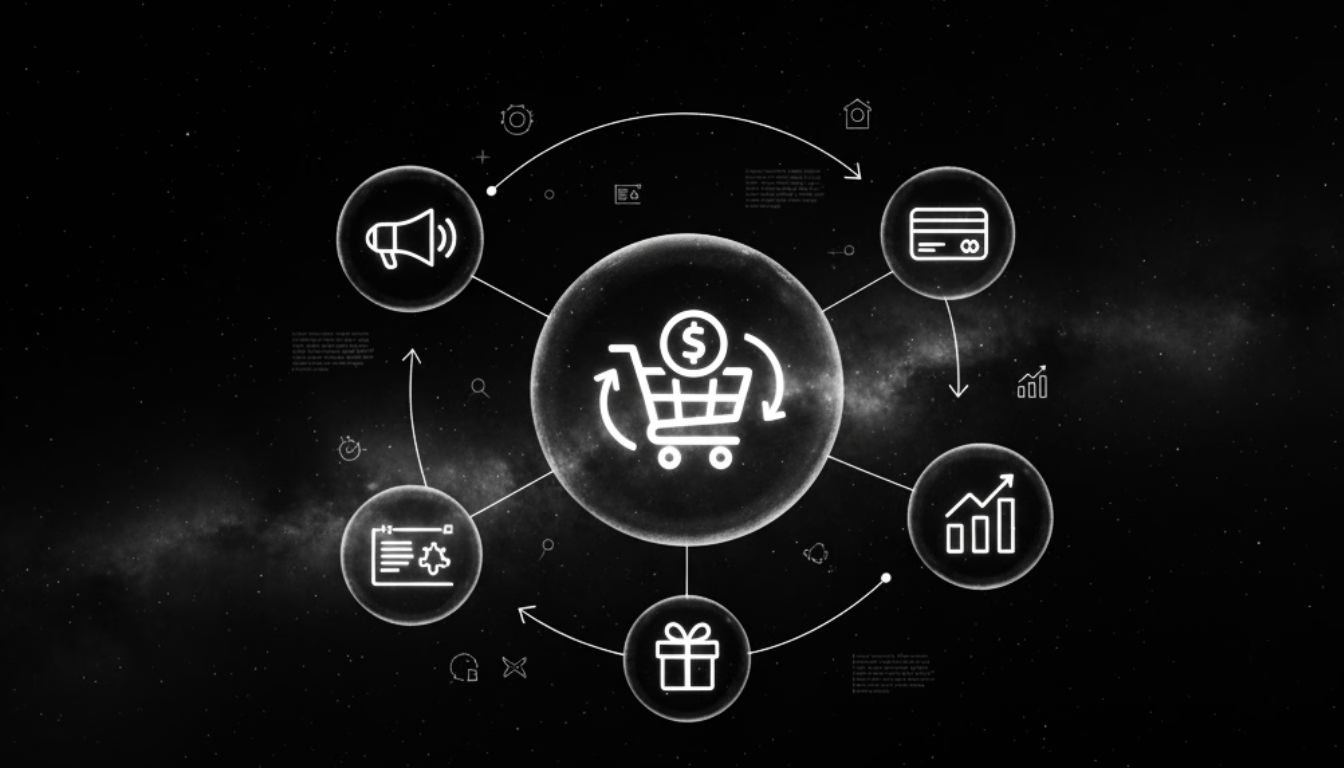
The line between inbound and outbound marketing is no longer as clear-cut as it once was. Historically, marketers treated them as competing philosophies: you either waited passively for searchers to find your blog (inbound) or aggressively blasted cold emails to scraped lists (outbound).
In 2026, the most successful companies run a hybrid model. They recognize that inbound and outbound are two sides of the same coin. Your outbound campaigns are significantly more successful when supported by a strong inbound brand presence. This synergy is known as the “halo effect.” For example, a prospect who receives a cold outreach message on LinkedIn is far more likely to respond if they have already seen your helpful organic content or search ads in their feed.
To build a high-velocity revenue engine, you must understand how to balance both approaches. You can learn more about how we structure these campaigns in our guide on the Best Marketing Strategies in 2024, or explore the comprehensive breakdown of modern outbound integration in Lead Generation in 2026: The Complete B2B Playbook.
Inbound Lead Generation Marketing Channels That Drive High-Intent Traffic
Inbound lead generation is about creating valuable resources that draw qualified prospects to your brand. Rather than interrupting their day, you position your business as the obvious solution when they actively search for help. The most effective inbound channels include:
- Search Engine Optimization (SEO): Traditional Google search still drives approximately 58% of organic web traffic for most businesses. By targeting high-intent, bottom-of-funnel keywords (such as comparison and alternative queries), you capture buyers when they are closest to making a purchase decision.
- Content Marketing: High-quality articles, technical briefs, and case studies build trust. Instead of publishing generic, shallow content, focus on deep, authoritative pieces that address specific industry pain points.
- Organic Social and Personal Branding: Platforms like LinkedIn have massive organic reach. When founders and executives share transparent, real-world experiences, they build human-to-human credibility that naturally attracts inbound business inquiries.
- Webinars and Live Events: Hosting educational sessions allows you to engage prospects in real-time. Webinars typically last between thirty minutes and an hour, giving you ample time to demonstrate your expertise and answer complex technical questions.
- Podcasts: Whether hosting your own show or appearing as a guest on industry podcasts, this medium allows you to build deep authority and reach highly targeted audiences.
- Online Communities: Participating genuinely in niche forums, Slack channels, and Reddit subreddits helps you establish your brand as a helpful resource without pitching prematurely.
Outbound Lead Generation Marketing Tactics for Direct Outreach
Outbound lead generation involves identifying your ideal buyers and initiating direct contact. While inbound takes time to build momentum, outbound allows you to test messaging and generate pipeline quickly. The modern outbound playbook relies on highly targeted, personalized outreach rather than mass broadcasting:
- Cold Email: Modern cold email requires strict technical hygiene and hyper-relevant messaging. To protect your domain reputation, you must keep email bounces below 3% and limit sends to fewer than 50 emails per inbox per day.
- Cold Calling: Highly targeted cold calls still work when focused on specific pain points and executed by well-prepared representatives.
- LinkedIn Outbound: Utilizing tools like Sales Navigator to find qualified buyers, you can build relationships by sending personalized, non-commercial connection requests. It is critical to stay under platform thresholds, typically keeping connection requests below 80 to 100 per week.
- Multichannel Sequences: Combining email, LinkedIn touches, and phone calls over a 10-to-14-day window is highly effective. Multichannel sequences routinely book 24% to 40% more meetings than single-channel, email-only campaigns.
- Account-Based Marketing (ABM): ABM treats high-value target accounts as markets of one. You coordinate personalized marketing and sales outreach specifically tailored to the decision-makers within those specific target organizations.
The Economics of Lead Quality: Qualification and Scoring Frameworks

Many marketing teams fall into the trap of celebrating raw lead volume. However, a pipeline packed with low-intent, unqualified contacts is incredibly expensive. It wastes valuable sales hours and drags down your team’s efficiency. The true cost of a lead must account for the time your sales representatives spend trying to qualify or disqualify them.
To optimize your customer acquisition costs (CAC), you must implement a robust qualification and scoring framework. This begins with a clear definition of your Ideal Customer Profile (ICP). Your ICP outlines the exact characteristics of the businesses that get the most value from your product or service, including their industry, company size, geographic location, and technical stack.
Once your ICP is defined, you can apply qualification frameworks like BANT:
- Budget: Does the prospect have the financial resources to purchase your solution?
- Authority: Are you speaking with a decision-maker who has the power to sign the contract?
- Need: Does your product solve a critical, active pain point for their business?
- Timing: Is there a near-term business trigger driving them to make a decision?
To automate this qualification process, modern revenue teams use lead scoring and lead grading. Lead grading measures how well a prospect matches your ICP (demographic and firmographic fit), while lead scoring measures their behavioral engagement (actions they take on your website).
For a complete look at how enterprise systems handle this automation at scale, explore B2B Lead Generation Software | Salesforce.
Defining the Lead Taxonomy: MQLs, SQLs, and PQLs
To keep marketing and sales teams aligned, you must establish a shared, written taxonomy for your pipeline. Without clear, agreed-upon definitions, marketing will continue to pass cold contacts to sales, and sales will complain about lead quality.
- Marketing Qualified Lead (MQL): An MQL is a lead that fits your target buyer profile and has shown active interest by engaging with your marketing content (such as downloading a technical whitepaper or attending a webinar).
- Sales Qualified Lead (SQL): An SQL is a lead that has been vetted by a human or an automated scoring model and is determined to be ready for a direct sales conversation. A healthy conversion rate from MQL to SQL typically ranges between 25% and 40%.
- Product Qualified Lead (PQL): Common in software-as-a-service (SaaS) and product-led growth models, a PQL is a user who has signed up for a free trial or basic version of your product and has crossed specific usage thresholds that indicate a strong intent to buy.
- Service Qualified Lead: This category represents existing customers who express interest in upgrades, additional features, or expanded services during their interactions with your customer support or account management teams.
Establishing strict conversion thresholds and automated routing rules ensures that leads are handed off to the right team at the exact moment they are ready to take the next step.
Optimizing the Capture Layer: Landing Pages and Lead Magnets
Your landing pages represent the critical transaction point of your lead generation marketing campaigns. This is where an anonymous website visitor decides whether your offer is valuable enough to trade for their personal contact information.
High-converting landing pages require absolute clarity and distraction-free design. The layout must feature a clear, benefit-driven headline, the core offer positioned above the fold, strong social proof (such as client testimonials or industry certifications) near the call to action (CTA), and a single, repeated CTA. Furthermore, mobile optimization is non-negotiable; pages must load in under two seconds to prevent user drop-offs.
To maximize your conversion rates over time, you must commit to continuous A/B testing. By testing different headlines, form placements, and CTA language, you make data-driven decisions that eliminate guesswork. You can explore our deep-dive strategies for building high-performance pages in our guide to Level Up Landing Pages.
High-Impact Lead Magnets That Earn First-Party Data
The generic, thin 12-page PDF or “ultimate guide” that merely summarizes basic search results is no longer effective. Modern B2B buyers have downloaded enough of these low-value assets to spot a bait-and-switch instantly.
To earn valuable first-party data, you must offer an incentive that provides immediate, undeniable value. The most successful lead magnets in 2026 are highly interactive and practical:
- Interactive Tools and ROI Calculators: Replacing static ebooks with custom calculators that help prospects solve a specific business math problem can double your actual sales conversations, even if total downloads decrease.
- Gated Industry Benchmarks and Analyst Reports: High-value, proprietary data that cannot be found elsewhere remains highly effective.
- Free Micro-Courses or Email Series: Structured, multi-day educational content that helps buyers solve a specific problem step-by-step.
- Product Trials and Free Audits: Giving prospects a low-friction taste of your actual product or service.
The primary rule of a great lead magnet is simple: it must address a highly specific pain point, deliver real value in under five minutes, and align naturally with the core product or service you actually sell.
Form Field Benchmarks and Conversion Rates
When designing lead capture forms, you must balance your need for qualification data with the user’s desire for a quick, frictionless experience. Every additional form field you require directly correlates with a drop in conversion rates.
| Number of Form Fields | Average Completion Rate | Best Use Case |
|---|---|---|
| 3 Fields | ~25% | Newsletter signups, basic lead magnets |
| 5 Fields | ~20% | Webinar registrations, high-value whitepapers |
| 7 Fields | ~15% | Detailed trial signups, industry reports |
| 10+ Fields | <10% | Complex enterprise demo requests, custom quotes |
To mitigate this friction, you can use progressive profiling, which uses smart forms to ask for different information across multiple visits. Additionally, utilizing platform-native lead forms (like LinkedIn Lead Gen Forms) allows you to pre-populate fields with a user’s professional profile data. This eliminates manual typing on mobile screens and significantly boosts your conversion rates.
Finally, you must put privacy front-and-center. Making your privacy policy highly visible at the exact moment of form submission builds crucial trust and ensures compliance with modern data protection standards.
The AI-Agentic Frontier: Automation and Search Visibility

In 2026, the role of artificial intelligence in marketing has evolved far beyond simple copy generation. We have entered the era of “agentic marketing,” where autonomous AI agents handle complex, multi-step workflows with minimal human intervention.
These AI agents work 24/7 to monitor inbound traffic, engage visitors in real-time via conversational web chat, qualify them based on your pre-determined ICP and BANT criteria, and instantly schedule meetings on your sales reps’ calendars. This eliminates manual follow-up delays and ensures that high-intent leads are captured while they are most engaged.
Furthermore, predictive analytics tools analyze vast datasets of historical customer behavior to identify patterns and predict which accounts are most likely to buy, allowing your team to focus their outreach efforts where they will yield the highest return.
Optimizing for AI Search Engines (AEO and GEO)
One of the most significant shifts in modern digital marketing is how buyers find information. Traditional search engines are no longer the sole gatekeepers of web traffic. Today, platform-native searches (on YouTube, Reddit, and TikTok) and AI search engines (like ChatGPT, Claude, and Perplexity) capture between 30% and 42% of modern search behavior.
To maintain visibility, your lead generation marketing strategy must include optimization for these AI-driven environments:
- Answer Engine Optimization (AEO): Focuses on structured data, technical schema markup, and clear
llms.txtdirectives that allow large language models to easily crawl, understand, and cite your website content. - Generative Engine Optimization (GEO): Focuses on optimizing the shape and substance of your content. This involves using entity-rich phrasing, clear topic sentences, and authoritative, factual statements that align with how AI models synthesize information.
- Optimizing for Citations: AI engines rely heavily on third-party validation. To get cited as a recommended brand in a ChatGPT or Perplexity answer, you must build a strong footprint of reviews, mentions, and structured data across authoritative industry directories, Reddit discussions, and platforms like G2.
Ignoring this AI-engine layer means leaving a massive portion of your potential search traffic on the table.
Scaling Lead Generation for Multi-Location and Specialized B2B Sectors
Scaling lead generation introduces unique operational challenges, particularly for multi-location brands and franchise networks. Shockingly, only 16% of multi-location businesses report “very consistent” lead quality across all of their locations.
The primary failure point is fragmentation — different local branches running disjointed marketing playbooks, resulting in inconsistent brand messaging and wasted ad spend. To scale successfully, you need a centralized strategy paired with localized execution:
- Maintain Local Directory Accuracy: Ensure consistent Name, Address, and Phone number (NAP) data across your Google Business Profile and local directories to protect your local map rankings.
- Deploy Localized Landing Pages: Create unique, high-performing landing pages for each location, complete with local customer reviews, specific service offerings, and local phone numbers.
- Implement Automated Lead Routing: Set up intelligent routing rules within your CRM to instantly send inbound inquiries to the correct local office within minutes.
To explore top-tier localized partners in your region, you can review the Best Lead Generation Companies in Missouri 2026. If you are looking for a dedicated local partner to build these systems, learn more about our B2B Marketing Agency in Kansas City.
Lead Generation for Highly Regulated and Industrial Niches
While generic B2C marketing often relies on broad emotional appeals, highly specialized B2B and regulated sectors require a completely different level of precision. At CreatiVertical, we specialize in three highly technical areas where standard marketing playbooks fail:
- Industrial and B2B Manufacturing: Buyers of precision equipment, industrial lubricants, machined parts, and chemicals are not looking for flashy ads. They need highly detailed technical specifications, CAD drawings, compliance documentation, and clear case studies. The lead generation process here is slow and relationship-driven, requiring deep educational content that proves technical capability.
- Offshore Professional Services: For law firms and company-formation/fiduciary providers in jurisdictions like the British Virgin Islands (BVI) and Cayman Islands, trust and compliance are paramount. Marketing in these sectors requires careful, non-promissory language, absolute accuracy regarding international regulatory frameworks, and a focus on security.
- Government-Facing Technology Vendors (GovTech): Selling software or IT services to public-sector buyers requires strict adherence to federal compliance standards. Your lead capture systems and marketing assets must demonstrate a deep understanding of security frameworks like FedRAMP and FISMA.
In these specialized fields, a single high-quality, fully compliant SQL is worth infinitely more than thousands of unqualified contacts.
Frequently Asked Questions
What is the difference between lead generation and demand generation?
To use a simple metaphor, demand generation is like shouting to a crowd, while lead generation is a quiet, one-on-one conversation. Demand generation focuses on building broad brand awareness, trust, and interest upstream without forcing users to share their contact information. Lead generation is the specific conversion layer that captures contact details via targeted forms, gated offers, and direct outreach sequences once that interest has been established.
Why is speed-to-lead so critical for conversion rates?
In modern sales, minutes matter. Leads that are contacted within five minutes of submitting a form are roughly nine times more likely to qualify and convert than those contacted after thirty minutes. Despite this, the average B2B response time exceeds 42 hours. Implementing automated lead routing and instant AI-agent notifications ensures your team never misses this critical window of peak buyer intent.
How do you prevent lead scoring model drift over time?
A lead scoring model is not a set-it-and-forget-it tool. Over time, buyer behaviors and market dynamics shift, causing your scoring system to lose accuracy — a phenomenon known as model drift. To prevent this, you must set up regular feedback loops between your sales and marketing teams. Conduct quarterly audits of your closed-won and closed-lost sales data to verify that your high-scoring leads are actually converting into revenue, and recalibrate your point values accordingly.
Conclusion
Building a high-performing lead generation engine is not a one-time project. It is an ongoing, systematic process that requires continuous optimization, technical alignment, and adaptation to emerging technologies like AI search engines and autonomous agents.
At CreatiVertical, we don’t believe in disjointed, tactical campaigns that leave you with a database full of cold, unvetted contacts. We operate as your dedicated growth partner, delivering complete, performance-focused digital systems — from web design and SEO to AI search visibility and custom workflow automation. Whether you are a local Kansas City business or a specialized B2B firm operating in highly technical, offshore, or government-regulated markets, we build the systems that turn anonymous interest into predictable revenue.
Ready to build a predictable, high-velocity pipeline? Launch your high-velocity lead generation system with CreatiVertical.
For additional resources, tools, and local profiles, you can connect with our community profiles on CreatiVertical and CreatiVertical | Lake Tapawingo MO. For further reading on lead capture structures, see the Lead Generation Guide: The Complete Playbook 2026.