
When Custom PHP Website Development Makes More Sense Than a Template
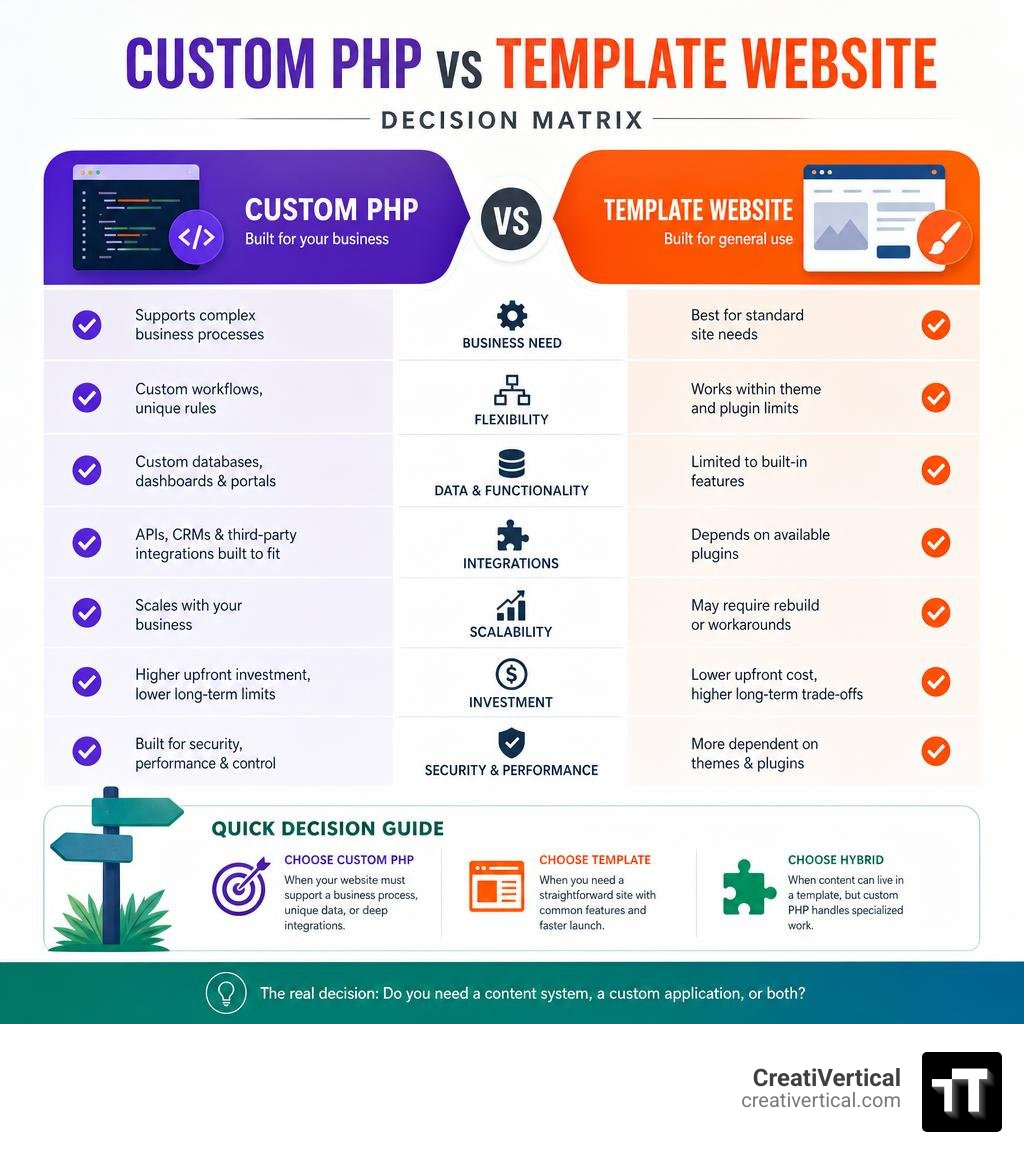
Choose custom PHP website development when your website must support a business process, not just publish pages. It is a strong fit for projects that need custom lead flows, CRM connections, customer portals, secure dashboards, tailored databases, API integrations, or rules that a standard WordPress theme and plugin stack cannot handle cleanly.
A practical starting point:
- Use a CMS template for a straightforward marketing site, blog, or editorial site with common features.
- Use custom PHP when your team needs software-like functions, unique data, or deep integrations.
- Use a hybrid approach when WordPress handles content well but a custom PHP plugin or separate application handles specialized work.
PHP remains widely used for server-side web development, including the technology behind WordPress. Modern PHP frameworks such as Laravel and Symfony provide structure for building maintainable applications, rather than relying on a collection of plugins or one-off code. The real decision is not “PHP or WordPress.” It is whether your business needs a content system, a custom application, or both.
I am Nicholas Cunha, founder of CreatiVertical, with more than 20 years of agency and project experience across government, institutional, B2B, and professional-services work in the Caribbean and Kansas City. I approach custom PHP website development as part of a wider system: the website, search visibility, lead handling, automation, and the tools your team uses after a prospect submits a form.
Custom php website development terms simplified:
Custom PHP vs. CMS Templates: Understanding the Difference
Off-the-shelf content management systems and commercial templates are built to serve the broadest possible audience. To achieve that mass appeal, traditional CMS platforms rely on generic, monolithic architectures that bundle extensive layout engines, multipurpose database tables, and hundreds of third-party plugins. While this model works well for standard editorial publishing, it creates severe memory overhead and technical constraints when your organization requires specialized business logic.
When evaluating The Complete Guide to Outsourcing Web Application Development, the primary technical distinction comes down to data structure and architectural intent. A pre-built CMS forces every unique piece of data into generic key-value storage schemes (like wp_postmeta), running multiple recursive database queries just to assemble a single dashboard screen or lead intake record.
Custom PHP development bypasses this generic abstraction entirely. Instead of adapting your operational workflows to fit a rigid template, custom development engineers bespoke relational database schemas and optimized execution paths designed specifically around your operational processes.
| Architectural Dimension | Custom PHP Application (e.g., Laravel / Symfony) | Monolithic CMS Template (e.g., Standard WordPress) |
|---|---|---|
| Primary Architecture | Model-View-Controller (MVC) or Decoupled/Headless API | Monolithic CMS core with procedural hooks and filters |
| Database Schema | Normalized, domain-specific relational tables (PostgreSQL/MySQL) | Generic entity-attribute-value tables (wp_posts, wp_postmeta) |
| Code Execution Path | Lean, explicit routing directly to domain controllers | Broad chain of generic core actions, filters, and plugin hooks |
| Third-Party Footprint | Explicit, strictly audited Composer packages | Bundled commercial themes and disparate third-party plugins |
| Scalability & Queues | Native background worker queues (Redis, Laravel Horizon) | Cron-based simulation executing during user page requests |
| Security Surface Area | Minimal surface; strict inputs, parameterized queries, custom routing | Broad surface; public endpoints, common plugin attack vectors |
Architectural Foundations of Custom PHP Website Development
Modern custom PHP development relies on strict architectural patterns rather than arbitrary script collections. By organizing codebases using the Model-View-Controller (MVC) design pattern or domain-driven design, engineering teams cleanly decouple the data access layer, business logic processing, and presentation templates.
At CreatiVertical, we treat Website Development as a discipline of engineering clarity. Object-oriented programming (OOP) principles ensure that every system component—from a custom payment gateway handler to a multi-stage B2B lead intake router—operates as an isolated, testable service. This modular architecture allows systems to evolve over years without risking the structural degradation common in legacy codebases.

The Operational Trade-Offs of Off-the-Shelf CMS Platforms
Off-the-shelf platforms offer clear advantages for fast content deployments, but they introduce compounding operational liabilities when stretched beyond their intended use case. When a business relies on dozens of independent plugins to handle custom calculators, secure member portals, or intricate ERP data synchronization, each additional plugin introduces potential update conflicts, performance bottlenecks, and security vulnerabilities.
For standard marketing sites, our WordPress Web Design Kansas City solutions provide clean, tailored theme architectures that avoid generic marketplace bloat. However, when an enterprise requires complex role-based permissions, bespoke financial ledgers, or high-volume transactional data pipelines, forcing those workflows into a standard CMS theme frequently results in severe query bloat and ongoing maintenance fragility.
Core Benefits of Custom PHP Website Development vs. Off-the-Shelf Templates

PHP continues to power a large share of websites with a known server-side programming language. The language has undergone continuous structural modernization through active releases. Modern runtimes such as PHP 8.3 and PHP 8.4 support improved performance, stronger typing practices, readonly classes, and other language features that help developers build maintainable applications while retaining rapid deployment cycles.
For businesses balancing infrastructure overhead with performance, custom PHP applications can often run efficiently on lean hosting environments compared with heavier enterprise stacks. Engineering teams using modern frameworks like Laravel and Symfony can deploy lightweight containerized services designed to handle meaningful business traffic without unnecessary platform overhead.
Execution Speed and Technical SEO Advantages
Search engines evaluate web performance through user-centric metrics such as Core Web Vitals, rewarding pages that render cleanly and respond instantly. Template-based websites often carry megabytes of unused CSS, redundant JavaScript libraries, and slow database queries that degrade server response times (Time to First Byte).
Custom PHP allows developers to emit clean semantic HTML without an ounce of framework bloat. Eliminating unnecessary plugin overhead allows database queries to execute quickly against indexed relational tables. Applying these technical efficiencies forms the baseline for capturing durable search visibility, an approach detailed in our analysis of Organic Traffic Growth Secrets Your Competitors Hope You Never Find.
Granular Security, Data Sovereignty, and Compliance Control
Commercial off-the-shelf templates represent widespread, high-value targets for automated vulnerability scanners. When a vulnerability is discovered in a popular commercial plugin, thousands of installations using that plugin are exposed simultaneously.
Custom PHP applications engineered from the ground up mitigate these systemic risks by adhering directly to OWASP Top 10 standards:
- Strict Input Validation & Escaping: All incoming request payloads are typed, validated, and sanitized prior to controller execution.
- Parameterized Queries: Native use of PHP Data Objects (PDO) and framework ORMs eliminates SQL injection vulnerabilities.
- CSRF & Token Authentication: Cross-Site Request Forgery protections and cryptographic tokens are enforced across all state-changing endpoints.
- Controlled Surface Area: Custom routing ensures that unauthenticated administrative entry points, generic XML-RPC routes, or exposed file directories do not exist on the production server.
For organizations operating in regulated environments or public-sector technology ecosystems, adhering to Secure by Design Best Practices for FedRAMP Compliance Web Design ensures full control over data sovereignty, encryption at rest, and audit logging.
Modern PHP Frameworks and Technology Stack Selection
Building custom PHP applications no longer involves writing raw procedural scripts from scratch. Modern enterprise development relies on structured, battle-tested frameworks that enforce strict coding standards (such as PSR-12) and robust package management via Composer.
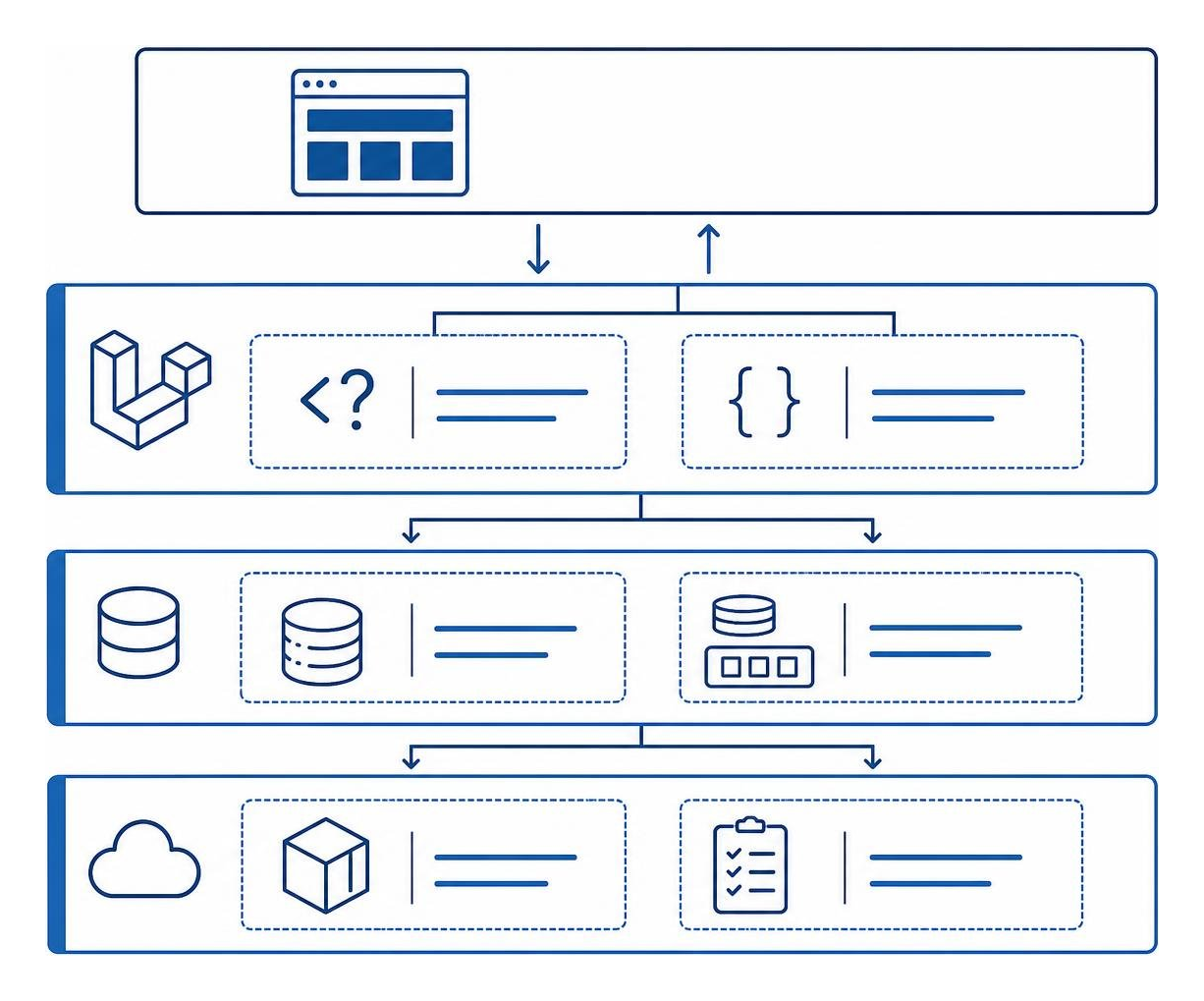
Ensuring these applications run smoothly over the long term requires selecting an infrastructure environment configured for PHP-FPM optimization, OPcache memory tuning, and strict process isolation, as outlined in our In-Depth Guide to Managed Hosting.
Laravel vs. Symfony vs. Native Custom Engines
Selecting the appropriate PHP framework depends directly on your application’s operational complexity, integration scope, and long-term maintenance requirements:
- Laravel: The modern standard for rapid web application development and custom SaaS platforms. With over 300,000 production applications globally, Laravel offers a mature ecosystem including the Eloquent ORM, built-in queue workers, native authentication scaffolding, and powerful admin packages like Filament and Nova, providing an optimal balance between rapid time-to-market and enterprise maintainability.
- Symfony: The architectural benchmark for large-scale enterprise systems, government applications, and highly complex microservices. Symfony’s decoupled reusable components provide extreme architectural flexibility and long-term stability. In fact, major platforms like Drupal and even Laravel itself rely extensively on foundational Symfony components.
- Micro-Frameworks (Slim / Native PHP 8.4): Reserved for lightweight microservices, single-purpose REST endpoints, or embedded lead-routing webhooks where full framework scaffolding would introduce unnecessary overhead.
Relational Database Engineering and Enterprise Caching
A custom PHP backend is only as scalable as the database architecture supporting it. While monolithic CMS platforms rely on generic entity schemas, custom web applications utilize fully normalized relational database structures across MySQL or PostgreSQL.
For platforms handling high-concurrency traffic or complex reporting:
- Relational Integrity: PostgreSQL is frequently selected for its advanced indexing, JSONB document storage capabilities, and strict concurrency controls.
- High-Speed In-Memory Caching: Redis is integrated to handle session storage, API rate-limiting, and hot-query caching, preventing repetitive database load.
- Asynchronous Queue Workers: Time-intensive operations—such as sending customer notifications, processing PDF reports, or synchronizing third-party CRM records—are offloaded to background queue workers via tools like Laravel Horizon.
This architecture ensures your primary user interface remains snappy and responsive, even under peak transactional volumes. Aligning these systems with rigorous hosting standards is essential, particularly when following A Practical Guide to FedRAMP Compliant Web Hosting.
Sourcing Strategy: Freelancer, Internal Team, or Specialized Agency

Choosing the right development partner directly dictates your software’s structural longevity and total cost of ownership. Organizations navigating custom builds generally evaluate three primary delivery models:
- Solo Freelancers: While offering low initial entry rates, solo contractors represent a single point of failure. Freelance codebases frequently lack rigorous documentation, automated test suites, or standardized architectures, creating severe technical debt when the developer moves on.
- In-House Engineering Teams: Building an internal PHP engineering team provides deep organizational focus, but requires significant capital expenditure, recruiting overhead, and ongoing management resources.
- Specialized Digital Engineering Agencies: An experienced development firm delivers a multidisciplinary team—combining system architects, backend PHP engineers, UI/UX designers, and technical SEO specialists—operating under established software engineering standards.
For an exhaustive breakdown on evaluating technical competency and reviewing candidate portfolios, reference our Detailed Guide to Hiring a PHP Website Developer.
Managing Costs and Timelines for Custom PHP Website Development
Software development costs reflect project complexity, integration requirements, database scale, and compliance mandates. In the broader web development market, pricing models generally follow distinct scopes:
- Isolated Custom Scripts & Integrations: Targeted API connections, custom lead webhooks, or standalone reporting views commonly range within entry-level project tiers.
- Mid-Tier Custom Applications & Portals: Bespoke customer portals, multi-role lead management systems, or proprietary SaaS MVPs generally involve multi-week discovery, interface design, build, and QA cycles spanning several thousand dollars to larger phased investments.
- Enterprise Platforms & Legacy Modernizations: Multi-tenant architectures, large-scale data migrations, and high-security compliance systems require comprehensive discovery sprints, continuous integration pipelines, and dedicated post-launch support retainers.
Understanding these market dynamics helps organizations budget realistically, as explored in our guide on What Should a New Website Cost.
PHP Developer vs. WordPress Developer Skill Sets
A common hiring mistake is assuming that any WordPress site builder possesses the engineering background required to architect a custom PHP application. The technical disciplines differ substantially:
- WordPress Site Builders: Primarily focus on theme configuration, site builder interfaces (Elementor/Gutenberg), plugin installations, and basic CSS styling within an existing CMS ecosystem.
- Professional PHP Software Engineers: Focus on software architecture, object-oriented design patterns, database normalization, RESTful/GraphQL API engineering, automated unit testing with PHPUnit, static code analysis via PHPStan, and automated CI/CD deployment pipelines.
Demanding high technical standards protects your investment from brittle implementations, a topic we cover extensively in Stop Settling for Bad Code Your Guide to KCs Top Web Developers.
The End-to-End Custom PHP Engineering Lifecycle
Delivering a reliable web application requires an orderly, milestone-driven development process. At CreatiVertical, every custom build follows a clear four-phase engineering framework:
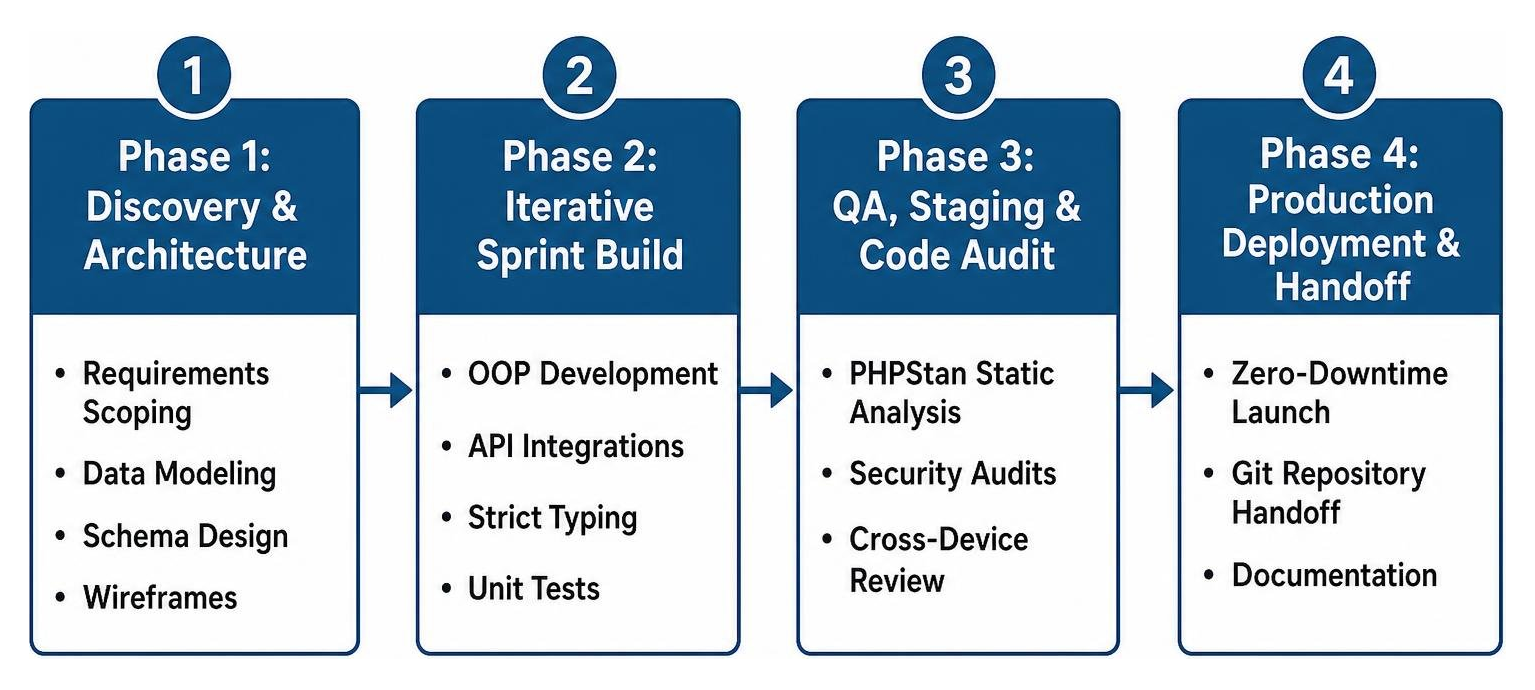
- Discovery & Architectural Planning: We establish exact user stories, map relational database schemas, define external API integration requirements, and approve technical wireframes before writing code.
- Modular Build & Automated Testing: Development proceeds in structured sprint milestones. Engineers enforce strict type definitions, PSR-12 style rules, and comprehensive PHPUnit test suites to validate business logic.
- Staging Environment & Security Audit: Applications are deployed to private staging environments for client review, performance profiling, and vulnerability audits against OWASP standards.
- Zero-Downtime Deployment & Code Ownership: The production release is orchestrated with automated database migrations and SSL configuration. Clients receive complete Git repository ownership, database runbooks, and thorough system documentation.
For organizations vetting prospective development partners, our guide on 5 Tips for Choosing a Website Development Company provides a dependable framework for verifying agency capabilities.
Frequently Asked Questions about Custom PHP Website Development
Is PHP still relevant and secure for web development in 2026?
Yes. PHP remains a foundational pillar of modern web infrastructure, powering over 77% of all server-side websites. With active release cycles (such as PHP 8.3 and PHP 8.4), the language offers first-class type safety, match expressions, readonly classes, and JIT compilation gains. When written according to modern standards, PHP provides top-tier execution speed, rock-solid security, and highly efficient server resource utilization.
How does custom PHP prevent common technical debt and spaghetti code?
Technical debt is prevented by enforcing modern software engineering practices: using established frameworks (like Laravel or Symfony), maintaining strict PSR-12 coding standards, enforcing static code analysis (PHPStan at Level 8 or 9), implementing automated test suites (PHPUnit), and conducting peer code reviews. Furthermore, demanding full Git repository ownership ensures your codebase remains clean, documented, and transferable.
When is a CMS like WordPress preferable over a custom PHP build?
A CMS like WordPress is ideal when the primary goal is rapid editorial publishing, standard blogging, or straightforward corporate brochure websites where non-technical marketing teams require intuitive daily content management. Custom PHP is preferable when the website functions as an operational application—requiring custom data models, specialized lead routing, deep API integrations, or multi-role member dashboards that exceed standard CMS capabilities.
Conclusion
Custom web architecture is an investment in operational stability and long-term scalability. While off-the-shelf templates and commercial site builders offer quick fixes for basic marketing needs, growing enterprises require digital systems that adapt directly to their unique business processes.
Whether your organization requires a tailored lead-management portal, a secure B2B customer dashboard, or a complete backend refactor, our team at CreatiVertical engineers high-performance web systems built to scale. Explore how our end-to-end Website Development services can transform your web infrastructure into a reliable engine for long-term growth.