

Paid Search That Helps Federal Buyers Verify Your Claims
FedRAMP compliant vendor PPC should help federal buyers confirm eligibility, not just discover a product. Target searches for the cloud service and authorization level you actually hold. State the authorized offering clearly in your ads, then link to a page where buyers can check its FedRAMP Marketplace listing and request security documents. Keep claims tied to the authorized product and its scope; a vendor’s other products or marketing tools do not inherit that status.
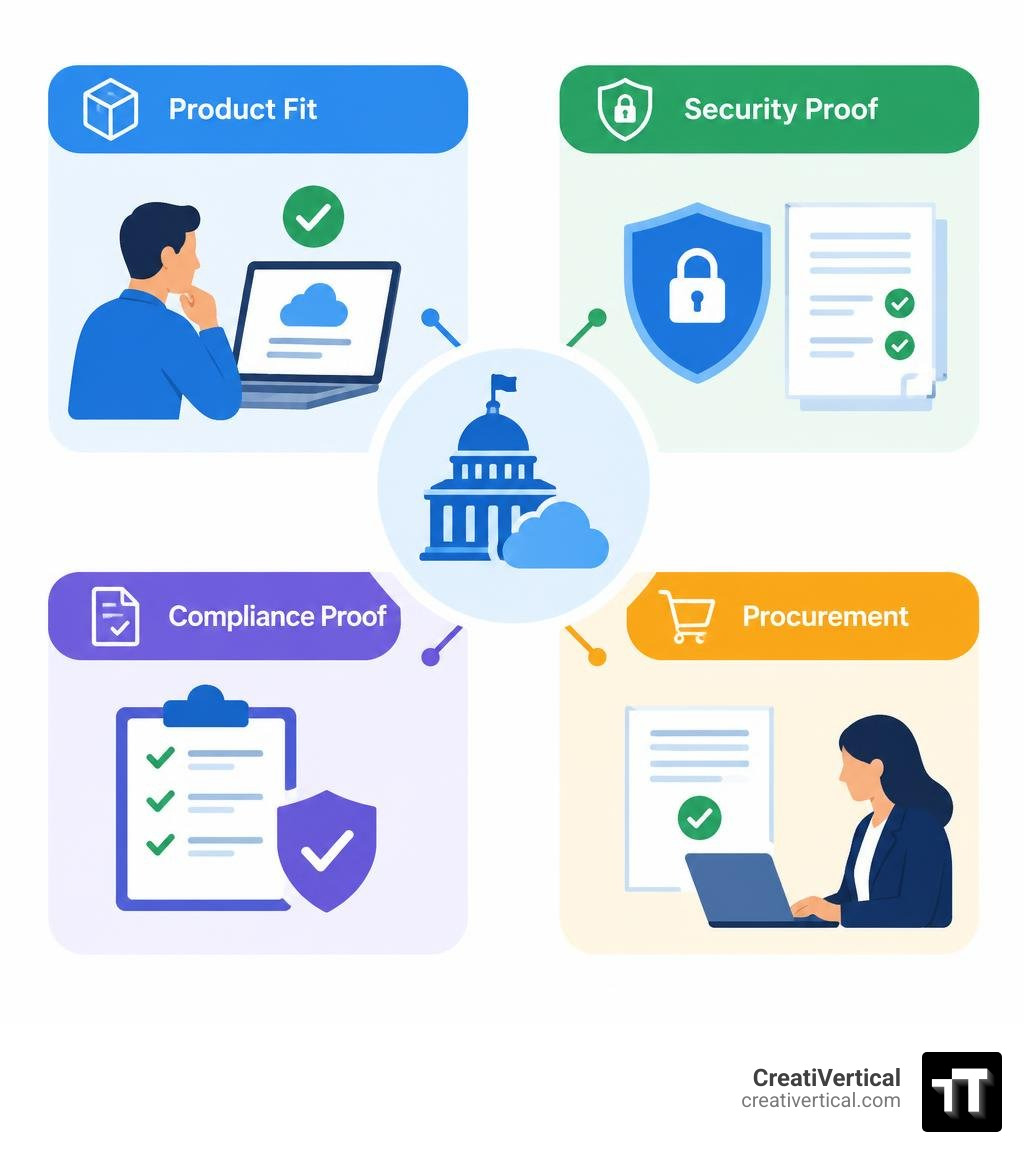
That approach serves the people behind a federal purchase. A CISO may need security evidence, while a compliance lead needs to check controls and a procurement team needs a path to buy. Your ads and landing pages should make each next step easy to find.
I’m Nicholas Cunha, founder of CreatiVertical. My public-sector project work and hands-on PPC experience inform how I approach FedRAMP compliant vendor PPC: with clear claims and useful paths for buyers to verify them.
FedRAMP compliant vendor PPC word guide:
The Compliance Gating Imperative in Public Sector Paid Search
In commercial B2B SaaS, paid search campaigns often lead with flashy feature comparisons, free trials, or interactive product demos. In public sector technology procurement, that playbook fails immediately. For federal agencies, defense contractors, and heavily regulated enterprises, compliance frameworks are not optional evaluation criteria—they are absolute evaluation gates.
When a government IT program manager or enterprise security architect conducts a search, a solution lacking documented compliance is discarded before technical capabilities are ever weighed. In regulated technology auctions, vendors without prerequisite certifications like SOC 2 Type II or FISMA alignment routinely lose prospective pipeline during the initial security review stage alone.
To run effective paid search campaigns targeting public sector buyers, your ad creative and landing page experiences must lead with verified compliance credentials based on official authorization standards. Bidding on high-intent terms without putting your authorization level front and center results in expensive clicks that bounce the second a security officer realizes the solution cannot operate in their data environment. Navigating these requirements demands purpose-built federal PPC campaign management strategies that align ad delivery directly with procurement stages.
| FedRAMP Impact Baseline | Typical Data Environment & Risk Level | Primary Ad Copy Proof Points | Late-Funnel Security Offer |
|---|---|---|---|
| Low | Publicly accessible data; low impact on agency operations | Low Baseline Authorized, NIST SP 800-53 controls, SOC 2 Type II | Downloadable Security Whitepaper & System Architecture |
| Moderate | Controlled Unclassified Information (CUI); serious adverse impact | Moderate Authorization, FIPS 140-3 cryptography, FISMA Moderate | Security Attestation Letter & Control Implementation Summary |
| High | Highly sensitive CUI, emergency services, law enforcement, healthcare | High Baseline Authorized, IL4/IL5/IL6 readiness, Zero Trust posture | Dedicated CISO Review Package & FedRAMP Marketplace Package ID |
Messaging Strategies for Authorized Providers
Leading public sector vendors structure their ad messaging around verified milestones rather than vague security promises. Highlighting exact authorization levels allows buyers to self-qualify instantly in search engine results pages (SERPs).
For instance, enterprise platforms like Palantir highlight their FedRAMP High Baseline Authorization across their product suite—an authorization granted in December 2024—alongside Department of Defense Impact Level 5 and 6 (IL5/IL6) readiness, HIPAA, and SOC 2 alignment. Similarly, customer experience providers such as Genesys actively feature their FedRAMP certification in targeted campaigns. By emphasizing intelligent virtual agents, real-time analytics, and pre-negotiated contract vehicles, they help federal agencies solve operational challenges while maximizing budget efficiency before the fiscal year closes.
Security milestones on the path to full authorization also serve as powerful proof points. Bitwarden achieved FIPS 140-3 validation for its cryptographic module, demonstrating compliance with updated NIST standards while progressing toward FedRAMP Class D (High) certification. Calling out these technical benchmarks in ad copy captures demand from agencies that require validated cryptographic architectures for immediate procurement.
Integrating Trust Signals and Landing Page Architecture
Once a buyer clicks an ad, the landing page must immediately validate the claims made in the SERP. In public sector marketing, trust signals carry far more weight in the final stages of the funnel than user reviews or feature lists.
Every paid search landing page should incorporate concrete compliance assets:
- Direct links to your active listing on the FedRAMP Marketplace
- Readily available SOC 2 Type II and ISO 27001 audit attestation summaries
- Clear indications of NIST SP 800-53 control coverage
- Recognizable logos of existing public sector or regulated industry deployments
Building these pages requires strict adherence to secure web design principles, ensuring zero third-party tracking scripts leak sensitive visitor metadata. Furthermore, hosting your conversion funnels on dedicated FedRAMP compliant web hosting architecture assures cautious compliance officers that your organization practices the rigorous operational hygiene it advertises.
Structuring a FedRAMP Compliant Vendor PPC Campaign for Federal Procurement
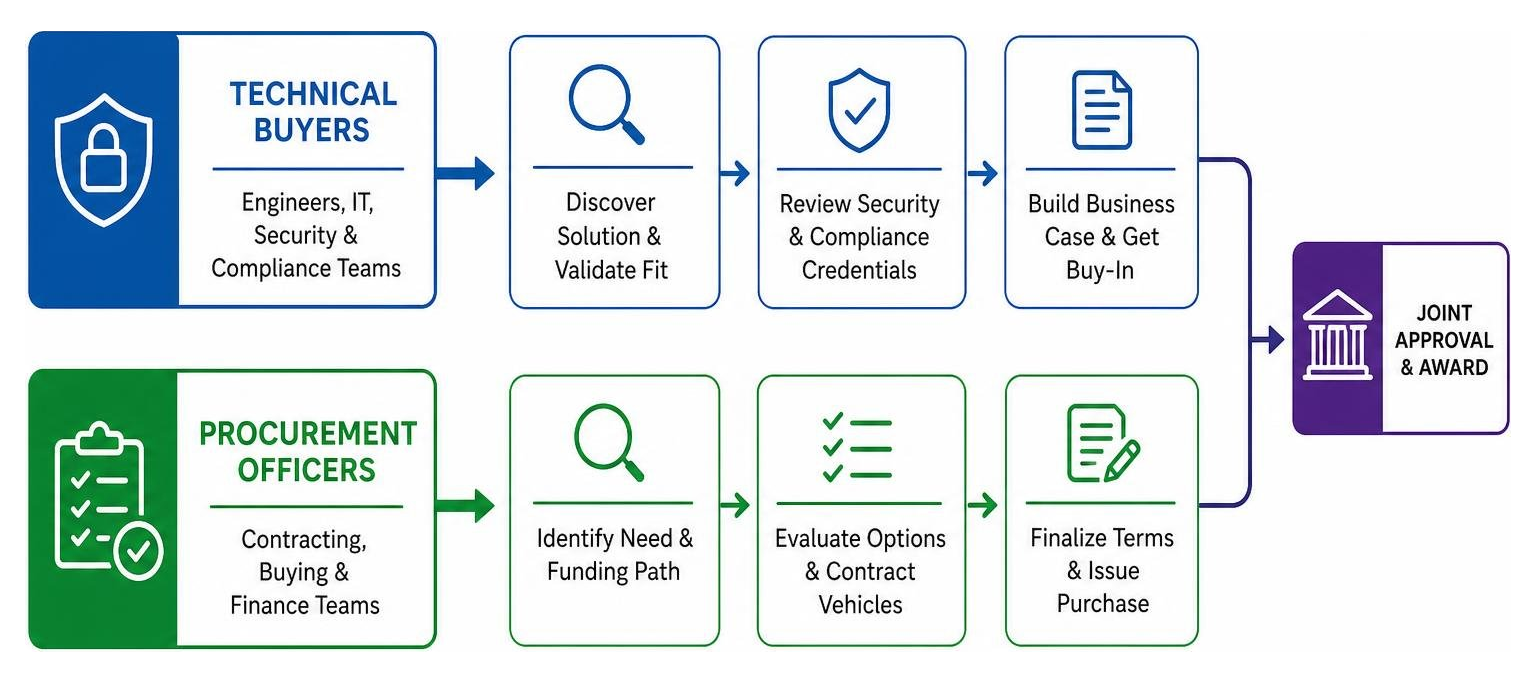
Federal procurement operates on distinct, parallel tracks. A technical end-user might discover a tool to solve an immediate workflow bottleneck, but the purchase cannot advance without explicit sign-offs from both the compliance review team and the contracting officer.
Structuring paid search campaigns requires aligning keyword discovery with how government buyers search across these tracks. Public sector buyers routinely reference official contract vehicles, specific mandate numbers, and agency data tiers. To uncover these high-intent query patterns, analyzing historical award patterns on federal contract award data portals reveals the exact terminology, GSA schedules, and agency sub-offices funding software modernization.
High-intent search themes for government software buyers typically fall into four distinct categories:
- Direct Certification Queries: Searches pairing category software with compliance terms (e.g.,
FedRAMP moderate case management software,FISMA compliant zero trust SIEM) - Agency Mandate Queries: Terms targeting specific federal directives (e.g.,
M-22-09 zero trust architecture tools,NIST 800-207 compliant identity management) - Contract Vehicle Searches: Queries combining products with procurement mechanisms (e.g.,
GSA Multiple Award Schedule cloud backup,SEWP V authorized collaboration tools) - Security Assessment Queries: Technical searches focused on validation (e.g.,
FIPS 140-3 validated cryptographic storage,FedRAMP High authorized data analytics)
Audience Segmentation in FedRAMP Compliant Vendor PPC
Public sector paid media requires granular audience segmentation across Google Search and professional networks like LinkedIn. The Chief Information Security Officer (CISO) and Chief Compliance Officer (CCO) operate as ultimate gatekeepers. They are naturally skeptical of standard marketing collateral and actively filter out vendor noise.
While CISO-targeted cost-per-leads (CPLs) on professional networks can run into the hundreds of dollars, pipeline economics remain attractive because public sector Annual Contract Values (ACVs) frequently span from $100,000 to well over $2,000,000.
To maximize engagement with these executive gatekeepers:
- Run thought leadership ads featuring verified technical leaders rather than corporate brand handles.
- Direct traffic toward compliance attestation packs and architecture briefs rather than generic sales demos.
- Integrate search visibility with unified compliance branding and search visibility initiatives across both traditional SERPs and emerging AI search engines.
A growing share of B2B buyers now use AI tools like ChatGPT and Perplexity to research enterprise software, and many initiate vendor discovery on AI platforms as often as traditional search engines. Ensuring your authorized status is clearly documented across public repositories allows AI platforms and search engines alike to cite your solutions accurately.
Navigating the Security Review and Compliance Review Funnels
Standard enterprise sales cycles run between 4 and 9 months. Within that timeline, the procurement process fractures into distinct sub-phases:
- Feature & Capability Evaluation: 60 to 120 days
- Security Review Phase: 30 to 90 days
- Compliance Review Phase: 15 to 45 days
- Contracting & Procurement: 15 to 45 days
Your PPC campaign architecture must serve tailored collateral for each stage. While top-of-funnel ads capture initial interest with capability-led messaging, mid-to-late funnel retargeting should focus exclusively on simplifying security reviews. Providing self-serve access to SOC 2 summaries, FedRAMP package IDs, and data residency documentation helps internal agency champions escort your software through security evaluation gates weeks faster.
Economics, Timing, and Negative Keyword Governance
Cybersecurity and public sector cloud search auctions are among the most competitive in digital marketing. Category keywords such as endpoint security, SIEM platform, zero trust, and vulnerability management regularly command cost-per-clicks (CPCs) between $30 and $80+.
Because individual clicks represent a substantial investment, campaign timing is critical. Federal procurement operates on strict budgetary cycles. During the federal fiscal year-end (Q4, ending September 30), agencies experience a “use-it-or-lose-it” budget compression. Procurement cycles that normally take six months can compress into 30 to 60 days as contracting officers rush to obligate expiring funds. Aligning your paid media spend to peak between July and late September captures urgent, fully-funded agency demand.
Industry trade shows also serve as key pipeline accelerators for government-facing vendors. Running geotargeted and intent-driven paid search campaigns around major industry gatherings—such as RSA Conference with its 45,000+ attendees or Black Hat USA—allows vendors to capture in-market buyers while technical evaluation teams are actively researching market solutions.
Eliminating Non-Buyer Waste with Negative Keyword Lists
In high-CPC auctions, negative keyword management is your primary defense against budget waste. A substantial portion of search volume for terms like “FedRAMP” comes from job seekers, certification students, and developers looking for open-source tools.
To safeguard ad spend, implement comprehensive negative keyword lists across every campaign:
- Employment and Clearance Queries:
jobs,careers,salary,security clearance requirements,hiring,internships,remote work - Educational and Training Terms:
training,exam,study guide,certification cost,practice questions,bootcamp,tutorial,PDF download - Consumer and Academic Intent:
free,open source,github,reddit,homework,research paper,template,DIY - General Regulatory Research:
what is FedRAMP,FedRAMP vs FISMA definition,history of FedRAMP,compliance checklist template
Reviewing search term reports daily ensures irrelevant variations are neutralized before consuming capital.
Budget Guardrails and Bidding for FedRAMP Compliant Vendor PPC
Running broad match campaigns without disciplined budget guardrails in public sector PPC can deplete monthly budgets in hours without generating a single qualified sales lead.
Modern bidding strategies should rely on offline conversion imports. Rather than optimizing algorithms for raw form fills—which frequently produce low-value vendor inquiries or student downloads—connect your CRM directly to Google Ads. By feeding verified pipeline milestones (such as Completed Security Reviews, Qualified Pipeline Stages, and Technical Approvals) back into your bidding models, automated bidding algorithms optimize toward high-value agency opportunities rather than cheap, unqualified clicks. When executing these high-stakes campaigns, vetting specialized government digital agencies ensures your media team understands the intricate balance between regulatory constraints and bid optimization.
Governed AI Automation and Human-in-the-Loop Ad Operations
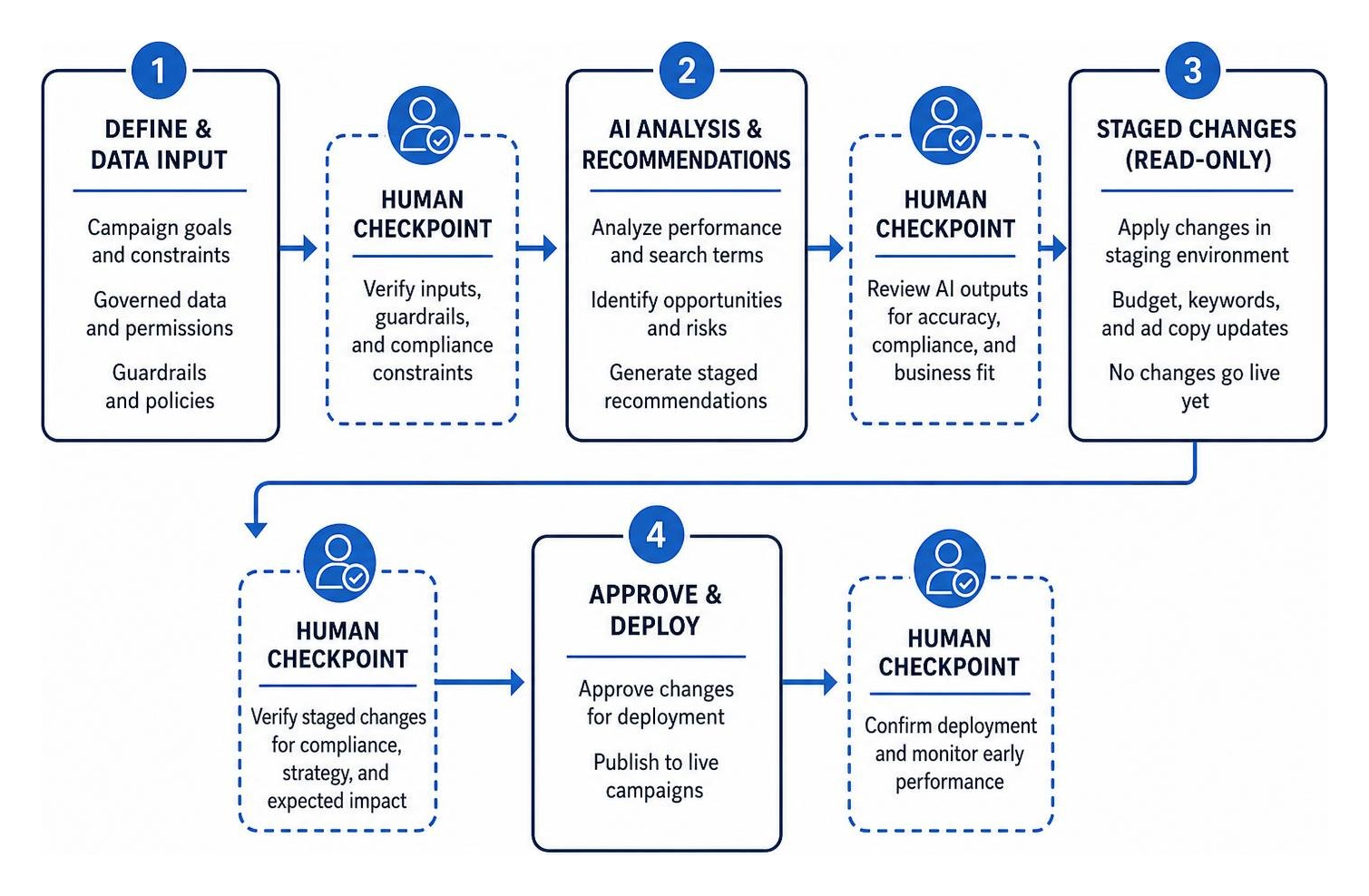
The integration of artificial intelligence into paid media management offers substantial operational efficiency, but in government-facing sectors, ungoverned AI introduces severe compliance risks. Autonomous tools that automatically rewrite ad copy or adjust budget allocations without oversight can inadvertently generate unapproved compliance claims, misstate authorization boundaries, or violate federal advertising guidelines.
Governed data layers and strict human-in-the-loop workflows provide the solution. Marketing platforms operating in regulated spaces must maintain complete auditability for every algorithmic action. For example, enterprise partnerships like Zeta Global rearchitecting data operations on Palantir Foundry illustrate how governed data platforms allow marketing automation to inherit FedRAMP High, IL5/6, HIPAA, and SOC 2 baselines, enabling compliant data execution across regulated environments.
When utilizing ad automation and connected API environments, regulated vendors must maintain strict control. Ad management software must operate in read-only or staged-approval modes, ensuring experienced media buyers verify every keyword change, budget reallocation, and ad copy iteration before deployment. Before rolling out automated tools, review best practices for deploying compliant AI services to ensure security teams retain full visibility over data handling.
Multi-Agent Workflows vs. Uncontrolled AI Ad Execution
Autonomous ad tools that adjust live campaigns without verification present unacceptable operational risks for public sector contractors. Regulated PPC operations require structured agent workflows that enforce policy guardrails at every layer.
Staged execution frameworks ensure that AI models handle data aggregation, search term mining, and anomaly detection in real time, while all structural account adjustments are held in an auditable staging queue.
Key technical requirements for compliant PPC automation include:
- Immutable Audit Logs: Every suggested keyword bid, ad copy tweak, and negative match addition must be logged with timestamped change attribution.
- Strict API Scope Restrictions: Connected tools should utilize role-based access controls (RBAC) with read-only permissions for diagnostic bots.
- Real-Time Spend Anomaly Alerts: Automated monitoring routines should flag sudden spend spikes or unusual search query patterns instantly, preventing budget overruns during off-peak auction hours.
- Human-Verified Copy Approvals: AI-generated responsive search ad combinations must be manually reviewed to confirm all regulatory designations and baseline claims remain factually precise.
Frequently Asked Questions About FedRAMP Paid Search
Why are cybersecurity and FedRAMP PPC keywords so expensive?
Cybersecurity and FedRAMP search terms represent some of the highest CPCs in digital marketing ($30 to $80+) due to high auction density and massive contract values. Government enterprise software contracts regularly carry Annual Contract Values ranging from $100,000 to over $2,000,000. With such high pipeline value at stake, well-funded enterprise vendors bid aggressively on high-intent terms like zero trust cloud security or FedRAMP moderate database, driving up competitive clearing prices across Google Ads auctions.
How do regulatory deadlines affect federal PPC campaign timing?
Federal regulatory deadlines and budgetary cycles heavily compress purchasing timelines. Under the federal fiscal calendar ending September 30, government agencies face strict spending deadlines to obligate remaining budgets. Procurement timelines that typically require 4 to 9 months frequently compress into 30 to 60 days during Q4 (July through September). Aligning paid search budgets to peak during this window captures fully-funded procurement teams actively seeking authorized solutions to deploy before fiscal year-end.
What compliance credentials should lead PPC ad copy for government buyers?
Ad copy should always lead with the specific authorization baseline your solution currently maintains. For federal audiences, explicitly stating your FedRAMP status (High, Moderate, or Low Baseline Authorized) alongside supporting standards like SOC 2 Type II, FISMA Moderate, or FIPS 140-3 cryptographic validation immediately qualifies your offering. Aligning ad copy with exact search intent filters out unqualified commercial traffic while giving public sector buyers the compliance verification they require to initiate evaluation.
Conclusion
Succeeding in public sector paid search requires a fundamental departure from commercial SaaS playbooks. For federal and regulated enterprise buyers, compliance is not a secondary feature—it is the initial gate that determines whether your solution is considered or immediately disqualified. By structuring your paid media around verified FedRAMP authorization levels, engineering secure landing pages with clear trust signals, implementing strict negative keyword governance, and maintaining human-in-the-loop oversight over AI automation, you position your brand to win high-value government contracts.
At CreatiVertical, we engineer complete digital systems that bridge technical precision with measurable performance. As an ongoing growth partner for government contractors, industrial manufacturers, and professional service providers, we combine secure custom public sector web development, high-intent paid search management, applied AI enablement, and search visibility to help organizations navigate complex, highly regulated markets. If your team is ready to scale its public sector pipeline with disciplined, compliance-first paid search campaigns, explore our digital solutions to chart your path forward.