
What is Federal PPC Campaign Management?
Federal PPC campaign management is the practice of running paid search and display ads specifically to reach government buyers, procurement officers, and agency decision-makers — and it works very differently from standard B2B advertising.
Quick answer — what federal PPC campaign management involves:
- Keyword targeting — bidding on high-intent search terms that government employees and contractors actually use when researching vendors
- Compliant ad copy — messaging that speaks to procurement requirements, contract vehicles, and security credentials (FedRAMP, FISMA)
- Custom landing pages — purpose-built pages that match ad intent and include clear calls to action like “Request a Proposal”
- Platform mix — Google Search, Microsoft Bing, LinkedIn Ads, and programmatic placements in industry publications where procurement officials spend time
- Conversion tracking — measuring cost per qualified lead, pipeline value, and offline conversions tied back to actual contract opportunities
- Ongoing optimization — weekly search term reviews, bid adjustments, negative keyword management, and monthly strategic analysis
The federal market is genuinely competitive. The FY2026 federal budget sits at $4.8 trillion, with $1.69 trillion in discretionary spending — and government contractors are fighting for a share of that through every channel available, including paid search. The challenge is that a government agency searching for “cybersecurity compliance contractor” or “IT services FedRAMP authorized” isn’t a typical B2C buyer. The sales cycle is long, the decision-makers are multiple, and a generic PPC campaign built for lead volume will burn your budget without ever reaching the right desk.
That’s the core problem federal PPC campaign management solves: getting your firm in front of the right people at the right moment in the procurement process — before the RFP even drops.
I’m Nicholas Cunha, founder of CreatiVertical, and I’ve spent more than twenty years running digital projects for government and institutional clients — including direct work for BVI government bodies and public-sector organizations in an offshore market where compliance and credibility aren’t optional. That background shapes how we approach federal PPC campaign management for government-facing technology vendors today. In the sections below, I’ll walk you through exactly how to build, run, and optimize a B2G PPC program that generates real pipeline.
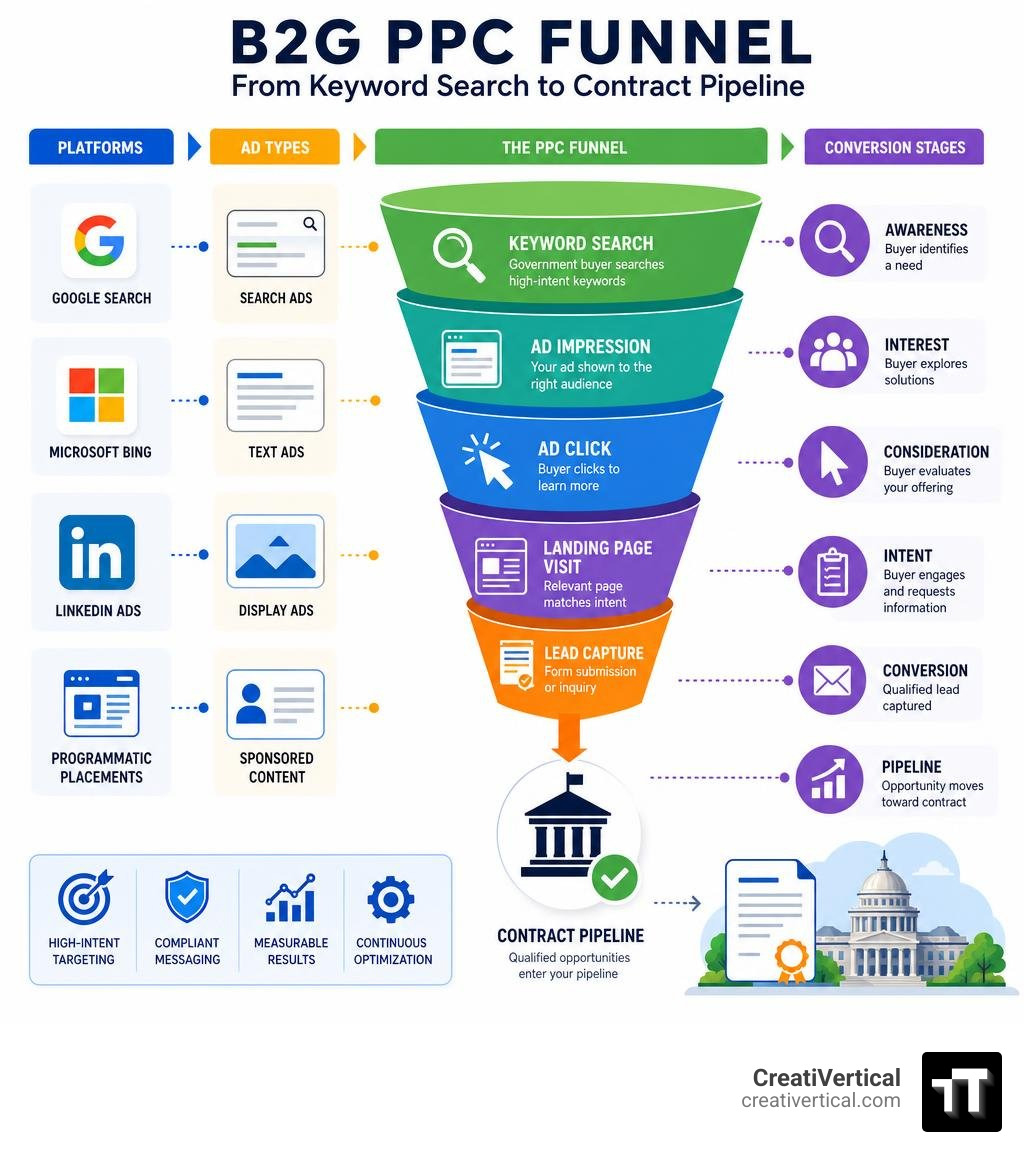

At its core, federal PPC campaign management is the strategic deployment of paid digital advertising to capture search demand from public-sector decision-makers. Unlike commercial B2B campaigns that target corporate procurement teams, federal campaigns must navigate the highly structured, heavily regulated world of government acquisition.
When we manage these campaigns, we aren’t just looking for high click-through rates or cheap leads. We are positioning our clients to be discovered during the early market-research phase of a federal procurement cycle. Government buyers are legally mandated to conduct thorough market research before issuing a Request for Proposal (RFP). They use search engines, read industry publications, and consult specialized databases to see who has the capabilities, security clearances, and past performance to fulfill their agency’s needs.
Because of this unique buyer journey, campaigns must be structured with absolute precision. While we often analyze localized search trends and regional contractor density, federal campaigns require a unified national strategy that zeroes in on the specific agencies, military branches, and prime contractors you want to win over.
Key Differences in Federal PPC Campaign Management
The differences between standard commercial PPC and federal PPC come down to three major factors: the sales cycle, the audience, and compliance.
- Extremely Long Sales Cycles: A typical B2B software sale might take three to six months. A federal contract can take twelve to eighteen months—or longer. Your PPC campaigns cannot be judged on immediate, last-click revenue. Instead, they must be measured by how well they feed your long-term pipeline.
- The RFP and RFI Process: Government buyers rarely click an ad and purchase a service on the spot. Instead, they use search to find vendors who can respond to a Request for Information (RFI) or to shape the requirements of an upcoming RFP. Your landing pages must reflect this, offering resources that help them write their requirements.
- Complex Buying Committees: A single federal purchase decision can involve program managers, technical evaluators, contracting officers (COs), and compliance auditors. Each of these stakeholders has different pain points, requiring a multi-layered ad group strategy.
To navigate this complexity, partnering with a specialized paid search and PPC marketing agency that understands the nuances of the public sector is critical.
Why Government Contractors Need Paid Search
If federal procurement is so heavily governed by portals like SAM.gov, why should a contractor spend money on search engines?
The reality is that by the time an RFP is posted publicly on SAM.gov, it is often too late to build a winning relationship. The contractors who win have usually spent months educating the agency on what is possible. Paid search allows you to capture the attention of program managers when they are first identifying a problem and searching for a solution.
By bidding on high-intent terms, you build brand visibility and establish immediate credibility. When the RFI is issued, your name is already familiar to the evaluators. This proactive positioning is one of the Best Marketing Strategies in 2024 and remains the gold standard for modern B2G growth.
Targeting High-Intent B2G Keywords and Audiences

The foundation of any successful federal ppc campaign management program is a highly refined keyword strategy. In the B2G space, broad terms are budget killers. Bidding on “cybersecurity services” will match you with thousands of small businesses and residential users looking for antivirus software.
Instead, we focus on long-tail, high-intent keywords that only a government buyer or prime contractor would type into a search bar. Examples include:
- FISMA compliant cloud hosting
- FedRAMP certified RPA software
- tactical communication systems DoD
- government bridge construction contractors
To build this list, we look at historical search term reports and regional search behaviors. For example, when structuring campaigns in our home state of Missouri, we utilize deep local insights to understand how military bases (like Fort Leonard Wood) and federal offices in Kansas City search for technical solutions.
Equally important is a proactive negative keyword system. Before a single ad goes live, we build master negative lists to exclude terms like “jobs,” “salaries,” “degrees,” “training,” and “free.” This ensures your budget is reserved exclusively for procurement-minded searches.
Bidding Strategies for High-Value Federal Keywords
Because B2G keywords are highly specialized, search volume is low but keyword costs can be exceptionally high. In competitive technical niches, a single click can cost upwards of $30 to $50. Managing these costs requires a ruthless focus on Quality Score.
Google’s algorithm rewards relevance. If your ad copy and landing page are perfectly aligned with the search query, your Quality Score increases, which lowers your actual cost-per-click (CPC).
Furthermore, you must diversify your search engine mix. While Google dominates the market, Microsoft Bing holds a significant 13.73% share of the US search engine market. Crucially, Bing is the default search engine on millions of federal government and military desktop computers. Because competition is lower on Bing, CPCs are typically 20% to 35% lower than on Google, making it an indispensable channel for B2G campaigns.
Keeping up with these platform shifts is a core part of our Digital Marketing Tips for 2025 Trends and Predictions, where we emphasize cross-platform bidding agility.
Leveraging Programmatic Advertising and LinkedIn for GovCons
While search engines capture active demand, programmatic advertising and paid social allow you to create demand by targeting specific decision-makers.
LinkedIn Ads are highly effective for B2G targeting because they allow you to filter audiences by specific federal agencies (e.g., Department of Homeland Security), job titles (e.g., Chief Information Officer, Procurement Specialist), and military branches. While LinkedIn has some of the highest CPCs in paid media—often ranging from $8 to $15 per click—the lead quality is exceptionally high because you are reaching the exact individuals on the buying committee.
To scale these efforts, we deploy automated, algorithmic frameworks. By looking at programmatic models like the PPC Strategist Agent Framework, we can automate ad-buying across specialized defense and aerospace industry publications. This programmatic approach places your brand in front of procurement officials when they are reading industry news, even if they aren’t actively searching on Google that day.
Crafting Compliant, High-Converting Ad Copy and Landing Pages
Getting the click is only half the battle. If your ad copy and landing pages do not immediately project trust, security, and compliance, government buyers will bounce instantly.
Federal buyers operate under strict guidelines. They cannot risk working with unverified vendors. Therefore, your digital assets must prominently display your credentials, contract vehicles, and past performance.
Writing Ad Copy for Government Decision-Makers
When writing ad copy for B2G audiences, leave the flashy marketing speak at the door. Federal buyers want clear, direct, and factual information. Your copy should focus on:
- Contract Vehicles: If you are on GSA Schedule, SEWP, or have specific set-aside statuses (SDVOSB, 8(a), HUBZone), state it clearly in your headlines.
- Compliance Standards: Use terms like “FedRAMP Moderate,” “NIST SP 800-171,” “FISMA Compliant,” or “HIPAA Certified” to instantly signal that you meet their technical baseline.
- Past Performance: Highlight your experience with other federal agencies (e.g., “Trusted by DoD & NASA”).
For more on structuring high-impact search ads, refer to our guide on Paid Advertising PPC.

Designing Custom Landing Pages for Federal PPC Campaign Management
Sending high-cost PPC traffic to your standard corporate homepage is a recipe for wasted budget. You need custom, dedicated landing pages that are tailored to the exact intent of the ad group.
A high-converting B2G landing page must include:
- A Clear, Secure Interface: The page must load instantly, be fully mobile-responsive, and feature secure HTTPS protocols.
- Immediate Credibility Signals: Place your CAGE code, UEI (Unique Entity ID), and GSA contract numbers in the header or hero section.
- Frictionless Calls to Action (CTAs): Instead of “Buy Now,” use CTAs like “Download Capabilities Statement,” “Request a Technical Consultation,” or “Speak with a FedRAMP Expert.”
- No Extraneous Navigation: Remove main menu links to prevent users from wandering away from the primary conversion action.
You can visualize this clean, focused layout in our example on PPC Ads.
Monitoring, Optimizing, and Measuring B2G PPC Performance
Because of the high cost of B2G keywords, you cannot afford a “set it and forget it” mentality. Active, manual optimization is required to protect your capital and maximize ROI.
To understand how B2G campaign metrics differ from traditional B2C or commercial B2B campaigns, review the comparison table below:
| Metric | Commercial PPC | Federal B2G PPC |
|---|---|---|
| Primary Conversion | Direct Sale / Lead Form | Capabilities Download / RFI Request |
| Average CPC | $2.00 – $7.00 | $15.00 – $50.00+ |
| Sales Cycle Length | 1 – 90 Days | 6 – 18 Months |
| Target Audience | Broad Demographics / Job Titles | Specific Agencies, CAGE Codes, Clearances |
| Success Measure | Immediate ROAS / Cost-Per-Lead | Pipeline Value / Contract Wins |
To maintain this level of control, we tie our reporting directly to backend systems. Using advanced programmatic setups like the Google Ads API Campaign Configuration, we can track campaign performance, monitor budget pacing, and adjust bidding thresholds programmatically to ensure we never overspend on low-performing terms.
Essential Metrics for B2G Campaign Success
While platform-level metrics like CTR (Click-Through Rate) and Quality Score are important for campaign health, they do not tell you if you are actually winning business. To measure true success, we track:
- Cost Per Qualified Lead (CPQL): The cost to acquire a lead that matches your ideal government buyer profile (e.g., a program manager with a valid
.govor.milemail address). - Impression Share: The percentage of searches your ads appeared on compared to the total available searches. For high-priority brand terms, we aim for a 90%+ impression share.
- Offline Conversions: Integrating your Google Ads account with your CRM (like Salesforce) to track when a PPC lead progresses to an active RFP bid or a signed contract.
Integrating PPC with SEO and Content Marketing
PPC should not live in a silo. The search term data generated by your paid campaigns is an invaluable source of real-time market intelligence.
When we identify high-performing search terms in Google Ads, we immediately feed those keywords into our organic SEO and content marketing strategies. If a specific technical query is driving highly qualified traffic, we write detailed whitepapers, case studies, and blog posts around that topic to capture organic search real estate over time.
This holistic approach is the foundation of our Digital Marketing Services in Kansas City. By combining paid search with custom web design and organic optimization, we build complete digital systems that establish our clients as undisputed authorities in their niche. For businesses looking for comprehensive regional support, we detail these integrated programs on our Advertising Services Kansas City MO page.
Frequently Asked Questions about Federal PPC
How does federal PPC differ from commercial B2B PPC?
Federal PPC targets public-sector decision-makers, meaning campaigns must account for extremely long procurement cycles, strict compliance standards (like FedRAMP or FISMA), and multiple stakeholders on the buying committee. The keywords are highly specialized, and the landing pages must focus on trust signals, contract vehicles, and past performance rather than direct, immediate sales.
What platforms work best for government contractor PPC?
Google Search is excellent for capturing active, high-intent searches. Microsoft Bing is equally critical because it is the default search engine on many federal and military networks. For proactive targeting, LinkedIn Ads allow you to target users by specific federal agencies, job titles, and military branches, while programmatic display networks can place your ads on trusted industry and defense publications.
How do you handle compliance and security in federal campaigns?
We ensure all landing pages are hosted on secure, compliant servers and feature clear data privacy protocols. All ad copy and content are written to accurately reflect your actual compliance certifications (such as NIST or FISMA) and contract vehicles, ensuring full alignment with federal advertising guidelines.
Conclusion
Winning federal contracts in June 2026 requires more than just excellent capabilities; it requires being visible to the right decision-makers before the bidding process even begins. Federal PPC campaign management is the engine that drives that visibility, turning search intent into measurable pipeline.
At CreatiVertical, we don’t believe in one-off marketing projects. We act as an ongoing growth partner, building complete, high-performance digital systems that combine secure web design, precision SEO, applied AI enablement, and expert paid search management. Whether you are a local Kansas City contractor or a highly specialized technology vendor operating under strict federal compliance frameworks, we have the experience to help you navigate this complex landscape.
Ready to position your firm for the next major procurement cycle? Let’s chart your course. Launch Your Federal Growth Strategy with us today.