

Why FedRAMP Compliance SEO Is Your Gateway to the Federal Market
FedRAMP compliance SEO is how government-facing technology vendors turn a hard-won federal security authorization into measurable search visibility, enterprise backlinks, and qualified leads from public-sector buyers.
If you’re short on time, here’s the core of it:
What FedRAMP compliance SEO means in practice:
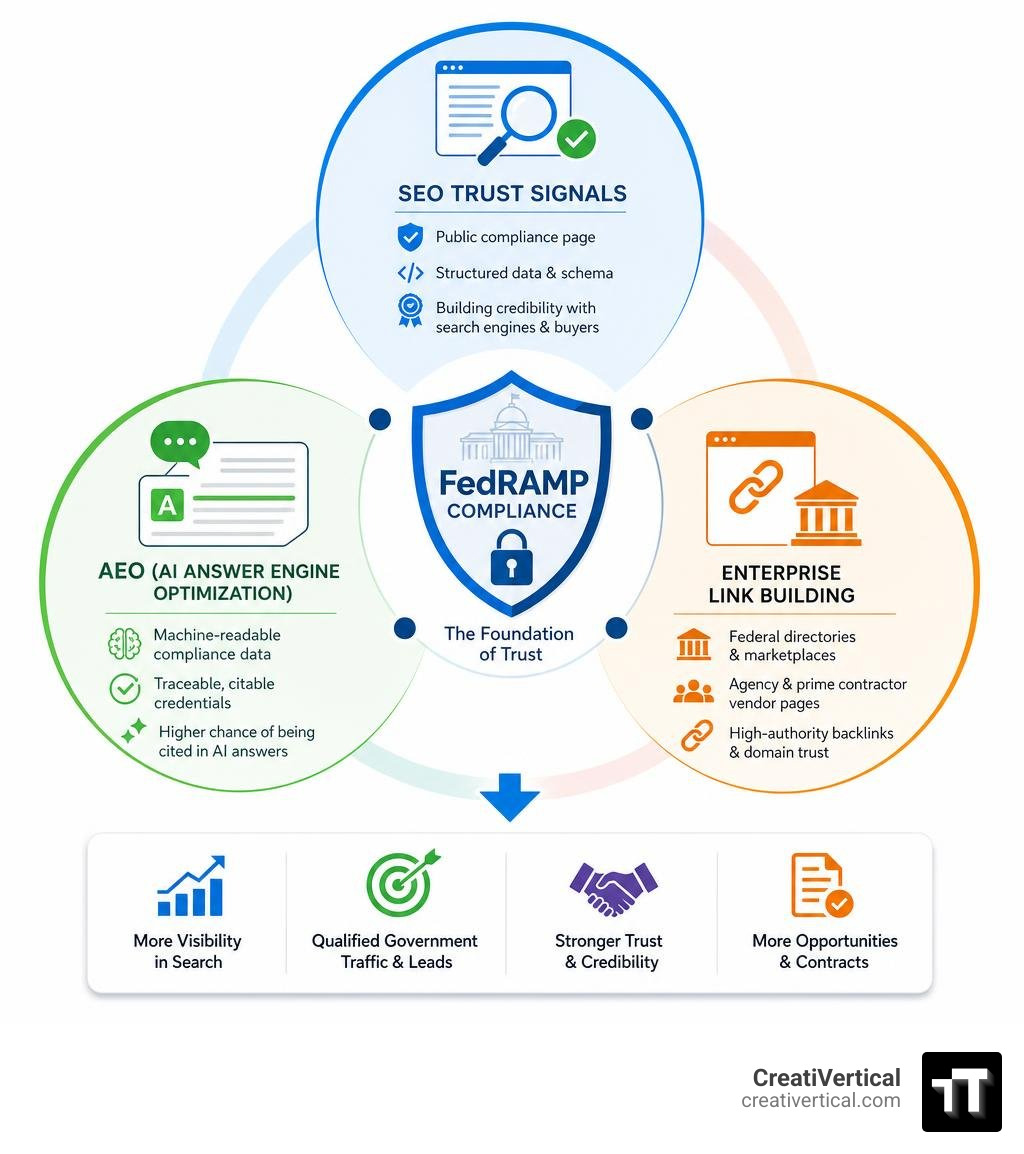
- Publish your authorization publicly — a dedicated compliance hub with human- and machine-readable data (JSON-LD, hasCredential schema) so government buyers and AI answer engines can find and cite you
- Treat your Trust Center as an SEO asset — not a PDF behind a form, but a crawlable, structured page that signals credibility to search engines and procurement teams alike
- Build links through federal wins — prime contractor directories, GSA portals, and agency vendor pages are high-authority link sources that your FedRAMP status unlocks
- Optimize for AI answer engines — tools like ChatGPT and Perplexity increasingly cite sources with traceable credentials; structured compliance data improves your chances of being that source
- Measure what matters — organic sessions from government buyers, backlinks from procurement domains, and how often your brand appears in AI-generated answers about federal cloud services
The stakes are real. FedRAMP authorization is the gateway to a $50 billion federal cloud marketplace — but authorization alone doesn’t make you discoverable. Most vendors stop at the press release. The ones winning federal contracts are also winning the search results page.
This guide is for government-facing technology vendors — AI automation, RPA, compliance, and IT services companies — who have either achieved FedRAMP authorization or are actively pursuing it, and want to make sure their compliance investment pays off in pipeline, not just paperwork.
I’m Nicholas Cunha, founder of CreatiVertical, and my background spans over twenty years of digital work for government and institutional clients — including direct project delivery for public-sector bodies in the British Virgin Islands — which gives me a grounded, practical lens on FedRAMP compliance SEO and what actually moves the needle for compliance-driven vendors. Let’s get into it.
The Federal Cloud Gateway: Why Compliance is Your Strongest Trust Signal

For any cloud service provider (CSP) looking to secure federal contracts, compliance is not just a checkbox; it is the fundamental barrier to entry. Under the FedRAMP Authorization Act, federal agencies are legally mandated to select cloud offerings that have achieved a standardized security baseline.
Historically, these baselines were determined strictly by FIPS 199 impact levels: Low, Moderate, and High. However, under the 2026 Consolidated Rules (known as CR26), the framework has shifted toward a more streamlined, data-driven approach. This overhaul introduces Certification Classes A through D:
- Class A: Maps to the legacy FedRAMP Ready baseline, serving as the initial validation step.
- Class B: Covers Li-SaaS (Lightweight SaaS) and Low-impact systems, typically containing around 125 controls.
- Class C: Equivalent to the legacy Moderate baseline—where the vast majority of enterprise SaaS applications live—encompassing roughly 325 controls.
- Class D: Corresponds to the High-impact baseline, governing highly sensitive, unclassified data with over 420 rigorous controls.
Achieving authorization at any of these levels requires a substantial commitment. For instance, the total initial investment for a Class C (Moderate) authorization typically ranges from $400,000 to over $1,200,000, with ongoing annual 3PAO assessments and continuous monitoring costs. Given this level of investment, letting your certification sit silently in a private repository is a massive missed opportunity.
When government buyers, procurement officers, and prime contractors search the web for secure solutions, they are looking for immediate, verifiable proof of compliance. Implementing a rigorous FedRAMP compliance checklist is the first step toward security, but translating that status into public-facing trust signals is what drives organic discovery.
By structuring your public assets correctly, you make it incredibly simple for procurement officers to verify your status. This is especially critical as agencies look to adopt newer technologies; for example, understanding How to Adopt FedRAMP Compliant AI Services Without Giving Your Security Officer a Panic Attack highlights how security and discoverability must go hand in hand to ease the public-sector buying process.
Technical FedRAMP Compliance SEO: Schema, Security, and Site Architecture

To turn your compliance status into a search engine asset, you must build a clean, crawlable site architecture that search engines can easily index. Many government contractors make the critical error of keeping their compliance documentation locked inside gated PDFs or behind complex portals that search engine crawlers cannot access.
Your site architecture should feature a highly visible, top-level “Trust Center” or “Compliance Hub.” This area of your site must be optimized for crawlability, ensuring that search engines can read, understand, and index your security assertions without friction. This approach is highly compatible with modern search standards, as outlined in our FedRAMP & Gov-Ready Site Search (2026 Guide).
Additionally, if you are planning to restructure your site to accommodate these compliance pages, it is vital to keep your existing search footprints intact. Utilizing The Ultimate Guide to Maintaining SEO Rankings During a Site Redesign will help ensure you do not lose valuable organic traffic when deploying your new trust-focused architecture.
Implementing JSON-LD and hasCredential Schema for FedRAMP Compliance SEO
To make your FedRAMP status explicitly clear to search engine crawlers, you should implement structured data. Using JSON-LD schema allows you to speak directly to search engines in a machine-readable format, declaring your precise credentials without relying solely on standard text.
Because standard markdown formatting rules prohibit the use of fenced code blocks in this guide, we will break down the essential key-value pairs you should include in your JSON-LD Organization and hasCredential schema. You can work with a team specializing in Adaptive SEO Services to write and deploy this code directly onto your compliance pages.
Your structured data should define your organization and nest a “hasCredential” property containing the following elements:
- Type: Declare the credential type as an “EducationalOccupationalCredential” or a generic “Credential.”
- Name: Set this to your exact authorization level, such as “FedRAMP Class C (Moderate) Joint Authorization Board P-ATO” or “FedRAMP Class B Agency ATO.”
- Credential Category: Define this as “Government Security Authorization.”
- Recognized By: This should point to an Organization object representing the “Federal Risk and Authorization Management Program (FedRAMP).”
- Valid In: Specify the “United States.”
- Credential ID: Input your unique FedRAMP Marketplace package ID (e.g., FRXXXXXXXX).
- Url: Provide the direct, absolute link to your official listing on the FedRAMP Marketplace.
By placing this structured data on your homepage and your primary compliance hub, you provide search engines with an unambiguous, verifiable connection between your website and the official federal database.
Hardening Technical SEO Signals: From security.txt to Core Web Vitals
Federal buyers expect the highest levels of security, and search engines use technical security configurations as core ranking signals. To align your technical SEO with your compliance stance, implement the following protocols:
- Publish a security.txt File: Place a standardized security.txt file in your site’s root directory (/.well-known/security.txt). This file tells security researchers how to responsibly disclose vulnerabilities, demonstrating a proactive security posture that search crawlers recognize.
- Enforce TLS 1.3 and HSTS: Ensure your site fully supports TLS 1.3 and implements HTTP Strict Transport Security (HSTS) with preloading. This guarantees that all connections to your site are encrypted and secure.
- Optimize Core Web Vitals: Government networks can often be slow or highly restricted. Your compliance pages must load quickly and perform reliably. Monitor your Largest Contentful Paint (LCP), Cumulative Layout Shift (CLS), and Interaction to Next Paint (INP) to ensure a flawless user experience.
- Expose a Public /health Endpoint: For advanced API integrations, keeping a lightweight, public-facing machine-readable health endpoint helps validate system uptime and reliability to both automated scrapers and technical buyers.
Keeping your technical signals completely up to date is essential, particularly when major search engines roll out platform updates. Keeping an eye on Everything You Need to Know About Google’s New Algorithm Update will help you maintain your technical edge.
Optimizing for AI Answer Engines (AEO) and 2026 Trust Centers
In 2026, the search landscape has shifted dramatically. Government buyers are no longer just typing queries into traditional search bars; they are asking complex, conversational questions to AI answer engines like ChatGPT, Claude, and Perplexity. This shift makes Answer Engine Optimization (AEO) a critical component of your overall digital strategy.
To be cited as a trusted source by these AI models, your compliance data must be easily accessible. AI engines do not guess; they look for authoritative, structured, and verifiable facts. Under the 2026 Consolidated Rules, specifically the guidelines on Certification Data Sharing – FedRAMP Consolidated Rules for 2026, certified providers are encouraged to share their compliance and certification data through dedicated, compatible Trust Centers.
These Trust Centers serve as centralized hubs where buyers, auditors, and AI scrapers can verify security credentials without friction. Utilizing the Best AI Tools for SEO 2025 can help you audit how effectively AI engines are reading and interpreting these centralized assets.
Machine-Readable Certification Data and AEO Visibility
The 2026 rules mandate that FedRAMP Certification Data be published in both human-readable formats and machine-readable JSON formats. This transition from long, narrative-based security descriptions to standardized Key Security Indicators (KSIs) makes it incredibly easy for AI answer engines to parse and retrieve your compliance details.
When an AI model is asked, “Which RPA tools are currently certified at a FedRAMP Moderate level?” it scans the web for structured JSON data, Trust Centers, and official marketplaces. If your site offers programmatic access to your certification data—including your FedRAMP ID, active Class status, and current assessment boundaries—the AI engine can confidently cite your platform as a compliant solution.
This level of structured clarity mirrors the approach taken by major cloud infrastructure leaders, as detailed in the overview of FedRAMP Compliance | Google Cloud.
High-Value Enterprise Link Building Through Federal Wins
Achieving a FedRAMP certification is a major milestone that unlocks some of the most authoritative link-building opportunities on the internet. Because federal domains (.gov and .mil) and highly trusted enterprise spaces hold immense backlink authority, securing links from these networks will dramatically boost your site’s overall search rankings.
Once your authorization is active, you should systematically target the following high-value link sources:
- The FedRAMP Marketplace: Ensure your listing is fully optimized, complete with direct, do-follow or high-authority links back to your primary compliance hub and product pages.
- Agency Procurement Portals: When an agency grants you an Authority to Operate (ATO), work with their digital communications or procurement teams to secure a link on their active vendor lists or public-service directories.
- Prime Contractor Partner Directories: Large federal integrators and prime contractors maintain extensive directories of certified SaaS partners. Proactively provide these partners with a clean, one-page technical brief that includes your target URLs to secure contextual backlinks from their highly trusted domains.
- Third-Party Assessment Organizations (3PAOs): The accredited assessors who validated your systems, such as those found via FedRAMP compliance, readiness, and certification services – A-LIGN, often publish case studies and press releases highlighting their successful assessments. Coordinate with them to ensure these publications link back to your site.
Measuring ROI and Avoiding Common Compliance SEO Pitfalls
To ensure your investment in compliance yields strong marketing results, you must avoid the common pitfalls that render your hard work invisible to search engines.
| Marketing Approach | Traditional Compliance Marketing | Modern Compliance SEO (Recommended) |
|---|---|---|
| Document Delivery | Gated PDFs behind form fills. | Indexable web pages with structured JSON-LD. |
| Change Management | Outdated static pages updated yearly. | Dynamic Trust Centers with programmatic updates. |
| Partner Integration | Noindexed partner logos on a home page. | Crawlable partner/integration directories. |
| Search Engine Strategy | Relying entirely on a single press release. | Ongoing keyword targeting for federal buyers. |
Many organizations fall into the trap of hiding their security certifications behind heavy registration forms, or setting their partner pages to “noindex” to keep them clean. This prevents search engines from indexing your most valuable trust markers.
By avoiding these mistakes and structuring your content according to the official FedRAMP implementation guidance on Google Cloud, you can make sure your engineering efforts translate directly into digital visibility.
Tracking the ROI of Your FedRAMP Compliance SEO Strategy
Measuring the return on investment for your FedRAMP compliance SEO efforts requires tracking specific, high-intent metrics rather than generic traffic numbers:
- Organic Sessions on Compliance Pages: Monitor how many users land directly on your Trust Center or compliance hub from search engines. These are typically highly qualified procurement officers and technical buyers.
- Procurement and Government Backlinks: Track the growth of incoming links from .gov, .mil, and major enterprise contractor domains.
- Conversion Velocity: Measure the time it takes for a lead to move from initial organic discovery to a scheduled demo. Clear, public compliance signals drastically reduce sales friction.
- AEO Visibility and Citations: Regularly query AI search tools (like ChatGPT and Perplexity) for terms related to your software category and FedRAMP status to verify if your brand is being cited in the answers.
For organizations looking to establish a dominant online presence, working with an experienced team providing SEO Services in Kansas City can help you build, track, and scale a highly effective search strategy.
Frequently Asked Questions about FedRAMP Compliance SEO
How does FedRAMP certification impact organic search visibility?
Achieving FedRAMP certification acts as an incredibly powerful trust signal for both human searchers and search engine algorithms. When search engines crawl a site that features verifiable government credentials, structured JSON-LD schema, and high-quality backlinks from federal portals, they recognize the site as highly authoritative. This increased domain trust helps improve your rankings across all target keywords, making you far more visible to enterprise and public-sector buyers alike.
What are the machine-readable data requirements under the 2026 Consolidated Rules (CR26)?
Under the 2026 Consolidated Rules (CR26), certified providers are required to make their certification data available in both human-readable and machine-readable JSON formats. This transition replaces long, narrative-based descriptions with standardized Key Security Indicators (KSIs). This machine-readable data must be hosted in a compatible Trust Center, allowing search engines, AI models, and automated compliance tools to programmatically verify your security posture in real time.
How can we build high-authority backlinks using our FedRAMP status?
You can build high-authority backlinks by securing listings on the official FedRAMP Marketplace, coordinate with your federal agency sponsors to be included on their public vendor lists, and reach out to prime contractor partners to ensure your software is linked in their integration directories. Additionally, collaborating with your 3PAO assessor on co-marketing case studies is an excellent way to secure high-value links from established cybersecurity domains.
Conclusion
At CreatiVertical, we understand that a FedRAMP authorization is a monumental achievement for your business. But getting certified is only half the battle—the other half is making sure the federal marketplace actually knows you are ready for business.
As a family-run digital agency based in Lake Tapawingo and Kansas City, Missouri, we serve as a dedicated growth partner for government-facing technology vendors. We don’t just run one-off projects; we design, promote, and maintain complete, high-performance digital systems that turn your complex security compliance into a powerful engine for organic leads and enterprise trust.
If you are ready to stop hiding your security credentials and start using them to fuel your digital growth, let’s chart a course together. Generate more digital marketing leads with us today, and let’s make sure your compliance investment pays off where it matters most: your bottom line.