

How Kansas City GEO Optimization Gets Your Business Into AI Answers
Kansas City GEO optimization is the practice of structuring your website, content, and local signals so that AI engines like ChatGPT, Perplexity, and Google AI Overviews name and cite your business when a local customer asks for a recommendation.
Here’s what that looks like in practice:
- Who it’s for: Any KC business that wants to show up when someone asks an AI assistant “who’s the best HVAC company in Overland Park?” or “find me a plumber near Brookside”
- What it involves: Schema markup, conversational content, consistent local citations, and technical AI crawlability
- Why it matters now: AI-referred web sessions grew 796% year-over-year from 2024 to 2025 — that traffic is going somewhere, and right now most KC businesses aren’t set up to capture it
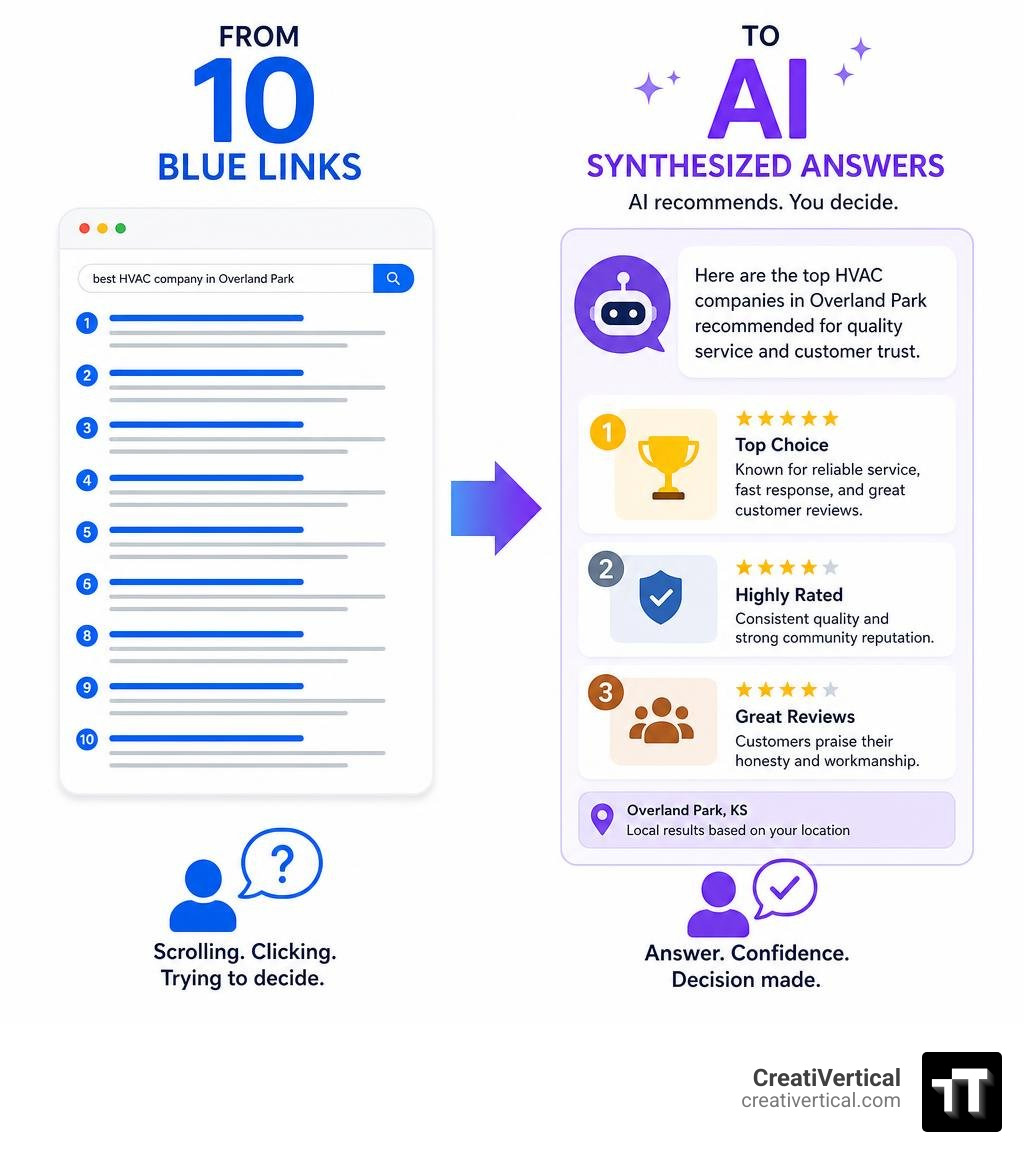
- How it differs from SEO: Traditional SEO gets you a blue link on a results page. GEO gets you named inside the answer itself — there’s no second-place consolation in an AI response the way there is in a list of ten links
Search behavior has shifted faster than most local business owners realize. A growing share of your potential customers are skipping Google’s results page entirely and asking an AI assistant directly. If your business isn’t structured in a way that AI engines can read, trust, and cite, you’re invisible to that audience — even if you rank well in traditional search.
This guide walks you through exactly what to do about it.
I’m Nicholas Cunha, founder of CreatiVertical, a family-run Kansas City digital agency with over two decades of agency experience across web development, SEO, and applied AI. I work hands-on with Kansas City GEO optimization every day — building the kind of content architecture and technical infrastructure that gets local businesses cited by AI engines, not just ranked by them.
What is Generative Engine Optimization (GEO) and Why Does It Matter?
Generative Engine Optimization (GEO) is the next evolution of digital visibility. While traditional SEO focuses on aligning your website with search engine ranking factors to land in the “10 blue links,” GEO focuses on optimization for inclusion and citations within AI-synthesized responses.
When users search today, they are increasingly turning to Large Language Models (LLMs) and conversational interfaces like OpenAI’s ChatGPT, Perplexity, Claude, and Google AI Overviews. These engines don’t just display a list of websites; they read the web, synthesize multiple sources, and present a single, cohesive answer.
If a user asks, “Who is a reliable commercial contractor for a warehouse renovation in Kansas City?” the AI will evaluate hundreds of resources and output a paragraph recommending two or three specific companies, complete with inline citations. If your business isn’t one of those named recommendations, you’ve lost the lead before the user ever sees a search engine results page.
This shift in user behavior is why we emphasize Adaptive SEO Services that evolve alongside search technology. Relying on keyword density and basic backlink counts is no longer enough. To remain visible, local brands must understand the mechanics of how LLMs retrieve information.
By utilizing The Ultimate Tools to Keep Your Brand Visible Across AI Search Platforms, we track how frequently a brand is mentioned across different LLMs, ensuring that our clients don’t get left behind as conversational search gains market share.
The Three Pillars of Kansas City GEO Optimization
To get your Kansas City business recommended by generative engines, you must address three distinct but interconnected disciplines: Answer Engine Optimization (AEO), Generative Engine Optimization (GEO), and Technical AI Readiness. Businesses that implement all three disciplines see an average 40% increase in AI mentions compared to competitors who do not.

Let’s break down what these three pillars actually mean for your business:
- Answer Engine Optimization (AEO): This discipline focuses on structuring your content so AI assistants can easily extract and recite your answers in response to direct, conversational questions. AEO targets voice search, featured snippets, and “zero-click” responses where the user gets their answer directly from the interface. To win here, you need to know how to structure content for immediate retrieval. Learn more about our foundational approach with our SEO Services in Kansas City.
- Generative Engine Optimization (GEO): While AEO handles quick facts, GEO focuses on depth, context, and authority. It ensures your business is cited when AI engines synthesize complex, subjective recommendations (e.g., comparing three local service providers). This requires rich, verifiable data, clear content provenance, and authoritative third-party mentions.
- Technical AI Readiness: This is the underlying infrastructure that makes your website machine-readable. It includes clean semantic HTML, comprehensive schema markup, knowledge graph integration, and configuring your server to allow access to AI crawlers. If your technical foundation is broken, AI crawlers can’t parse your pages, making your content ineligible for synthesis.
Optimizing for these pillars also helps you prepare for the growing wave of voice-activated searches. You can explore this further in our guide on How to Optimize Your Website for Voice Search Before Your Competitors Do.
How AI Search Engines Recommend Local KC Businesses
Local search in the Kansas City metro area has always had a unique personality. With our split across the Missouri-Kansas state line, service businesses often navigate complex targeting dynamics. An HVAC company based in Lake Tapawingo MO needs to signal its reach across the entire metro, while a professional service firm in Kansas City MO wants to capture clients commuting from Overland Park or Brookside.
AI engines handle these local nuances differently than traditional search. Instead of relying solely on proximity to a GPS coordinate, AI recommendation engines synthesize reviews, local news, directories, and website content to build a conceptual map of your business’s real-world footprint.
To win these local recommendations, you must optimize for “near me” and neighborhood-specific queries. Our guide on How to Rank for Near Me Searches and Win Local Customers details how to capture this high-intent traffic.
By combining those local tactics with our Step-by-Step Guide to Local Visibility Online, you can build a digital footprint that AI models recognize as the dominant, most trusted option in your specific geographic service area.
Optimizing Schema and Citations for Kansas City GEO Optimization
To make your business understandable to AI crawlers, you must feed them structured data. Traditional search engines can sometimes guess what your website is about, but AI models require explicit semantic signals. This is where JSON-LD schema markup becomes your most valuable asset.
By implementing comprehensive LocalBusiness, ProfessionalService, or industry-specific schemas (like Dentist or HVACBusiness), you tell the AI exactly what you do, where you are, and who you serve. Your schema should explicitly define:
- Your exact geographic coordinates and defined service area radius.
- Your official business name, address, and phone number (NAP).
- Direct links to your active social profiles and authoritative directory listings (using the
sameAsproperty). - Your customer reviews and rating averages.
Consistency across the web is critical. If your NAP data is mismatched across old directories, AI models see this as a conflicting signal, lowering their confidence in your business’s legitimacy. We outline a straightforward approach to cleaning up these signals in No More Hide and Seek: A No-Nonsense Local Business SEO Strategy.
Content Structuring and Conversational Q&As
AI models are trained on natural human conversation. Therefore, they favor content that mirrors how people actually talk and ask questions.
To optimize your content for AI synthesis:
- Write in a Q&A format: Organize your service pages around direct questions and immediate answers. Use
FAQPageschema to reinforce this structure. - Answer first, explain second: Give the direct answer in the very first sentence of a paragraph. Cut out the introductory fluff. If a user asks “How much does a commercial roof inspection cost in Kansas City?”, start with: “A commercial roof inspection in Kansas City typically costs between $500 and $2,000, depending on…”
- Anticipate the “next search intent”: Think about the follow-up questions a user will ask after their initial query. If they ask about warehouse space, they will likely ask about zoning, loading docks, or highway access next. Address these logical paths on the same page.
For more actionable tips on formatting your site to win these conversational queries, check out our 7 Tips to Improve Local Visibility Online.
Measuring Success in the Age of AI Search
Traditional SEO relies heavily on tracking keyword rankings on Google. In the era of GEO, those metrics only tell half the story. Because AI search results are highly personalized and generated dynamically in real time, there is no single “rank” to track.
Instead, we measure success using three modern metrics:
- Citation Frequency: How often does ChatGPT, Perplexity, or Google AI Overviews cite your website when answering queries related to your services?
- Brand Sentiment and Share of Voice: Are the AI’s synthesized summaries of your business positive, accurate, and aligned with your brand? How often are you recommended compared to your top local competitors?
- AI Referral Traffic: Tracking the actual sessions landing on your site from AI user-agents and conversational platforms.
To help our clients make sense of this new data, we build custom reporting environments. You can read more about tracking these advanced data points in The Ultimate Local SEO Reporting Dashboard Guide for Data Geeks.
| Metric Type | Traditional SEO | Generative Engine Optimization (GEO) |
|---|---|---|
| Primary Goal | Rank in the top 10 organic blue links | Earn direct citations and named recommendations inside AI answers |
| Primary Metric | Keyword Rank, Domain Authority, Organic Impressions | Citation Share of Voice, Brand Mentions in LLM outputs |
| Traffic Source | Google, Bing, Yahoo SERP clicks | ChatGPT, Perplexity, Claude, Gemini, Google AI Overviews |
| Content Focus | Keyword density, search volume, long-tail blog posts | Direct answers, structured data, conversational Q&A, verifiable facts |
Advanced Geographic Testing and Attribution
For larger regional brands, B2B manufacturers, and businesses managing multiple locations across the Midwest, measuring the true incremental impact of geographic marketing can be incredibly challenging. Traditional user-level tracking has been heavily restricted by modern privacy regulations, making geographic-level experiments the gold standard for measuring marketing ROI.
In academic and enterprise settings, advanced frameworks help marketers design highly balanced geographic experiments without bias. For instance, researchers have developed methodologies like Optimized Supergeo Design: A Scalable Framework for Geographic Marketing Experiments, which uses Principal Component Analysis (PCA) and Mixed-Integer Linear Programming (MILP) to partition markets into perfectly balanced test and control groups.
While small local businesses don’t need to run complex multi-market linear programming models, understanding spatial optimization is incredibly useful for logistics, service-area planning, and targeted ad spend. Open-source tools like dvp2004/GeoOps-Studio and geospatial solvers like Kaito-ishiguro/optiloc-hk demonstrate how operations research and demographic data can optimize real-world facility locations and marketing footprints.
By applying these spatial principles to your digital strategy, we ensure your ad spend and local GEO efforts are focused exactly where your target audience lives and searches.
Pitfalls and Future-Proofing Your AI Search Presence
As AI-driven search continues to grow, search engines are constantly updating how they crawl, index, and synthesize information. To future-proof your digital presence, you must ensure your website remains technically accessible to AI crawlers while maintaining a strong, authoritative brand footprint across the web.
One of the most common technical mistakes business owners make is accidentally blocking AI crawlers in their robots.txt files. While you may want to prevent certain AI models from training on your proprietary data, blocking user-agents like GPTBot or PerplexityBot entirely means their respective search engines cannot find or recommend your business in real-time searches.

Managing your crawl boundaries carefully is essential. You want to allow search-focused AI agents to access your public service pages, while restricting access to private databases or thin, duplicate content.
Avoiding Common Mistakes in Kansas City GEO Optimization
When local businesses try to adapt to AI search, they often fall back on outdated tactics. The most common mistake is keyword stuffing. AI models are trained on natural language; they easily detect and ignore unnatural keyword repetition. Instead of trying to trick the algorithm, focus on writing clear, authoritative content that actually answers the user’s question.
Another common pitfall is ignoring off-page brand sentiment. AI models don’t just read your website; they look at third-party forums, local news articles, and reviews. If your Google Business Profile is neglected or you have unresolved negative reviews, AI engines will quickly pick up on those negative signals and recommend a competitor instead.
To stay ahead of these algorithmic shifts, we recommend a proactive, adaptive approach. You can read more about navigating these changes in our guide to Adaptive SEO Services: The Ultimate Guide to Staying Ahead of Google.
Frequently Asked Questions About AI Search Visibility
How do ChatGPT and Perplexity decide which KC businesses to recommend?
AI platforms act as recommendation engines. They analyze a massive index of web data, looking for signals of trust, authority, and relevance. To decide which businesses to recommend, they evaluate:
- Structured Data: Schema markup that clearly defines your business’s services, location, and operating details.
- Review Signals: The volume, frequency, and sentiment of customer reviews on Google and other trusted directories.
- Third-Party Citations: Mentions of your brand on authoritative local news sites, blogs, and industry directories.
- Direct Content Alignment: How clearly and directly your website answers the specific question the user asked.
Is GEO replacing traditional local SEO?
No, GEO does not replace traditional SEO; it builds on top of it. Traditional local SEO practices — like optimizing your Google Business Profile, earning local backlinks, and ensuring fast page speeds — are the baseline eligibility layers for GEO. If your website isn’t indexed by Google and doesn’t have foundational authority, AI engines won’t trust your data enough to cite it. Think of traditional SEO as building your business’s reputation, and GEO as formatting that reputation so AI models can easily share it.
How long does it take to see results from GEO?
For most Kansas City businesses, foundational GEO updates (like implementing schema and restructuring core service pages) begin to show results within four to eight weeks. Because search-focused AI engines like Perplexity and ChatGPT Search pull live web data, they can reflect changes to your site relatively quickly. However, building the deep local authority and broad citation profile needed to dominate competitive AI recommendations is an ongoing process that typically takes three to six months to fully mature.
Conclusion
The digital landscape is shifting, but getting your Kansas City business found by AI doesn’t have to be overwhelming. By focusing on structured data, conversational content, and clean technical execution, you can ensure your business is cited and recommended where your customers are actually looking.
At CreatiVertical, we don’t believe in one-off projects or outdated marketing tactics. We operate as an ongoing growth partner, delivering complete, performance-focused digital systems that help our clients navigate these rapid technological shifts. Whether you are a local KC business looking to secure your neighborhood presence, a B2B manufacturer targeting regional buyers, or an offshore professional service provider building global authority, we are here to help you chart a clear course forward.
Ready to build a digital presence that stands out to both humans and machines? Let’s start with a solid foundation. Explore our approach to Website Design in KC and let’s get your business ready for the future of search.