

What a Google Algorithm Update Means for Your Website
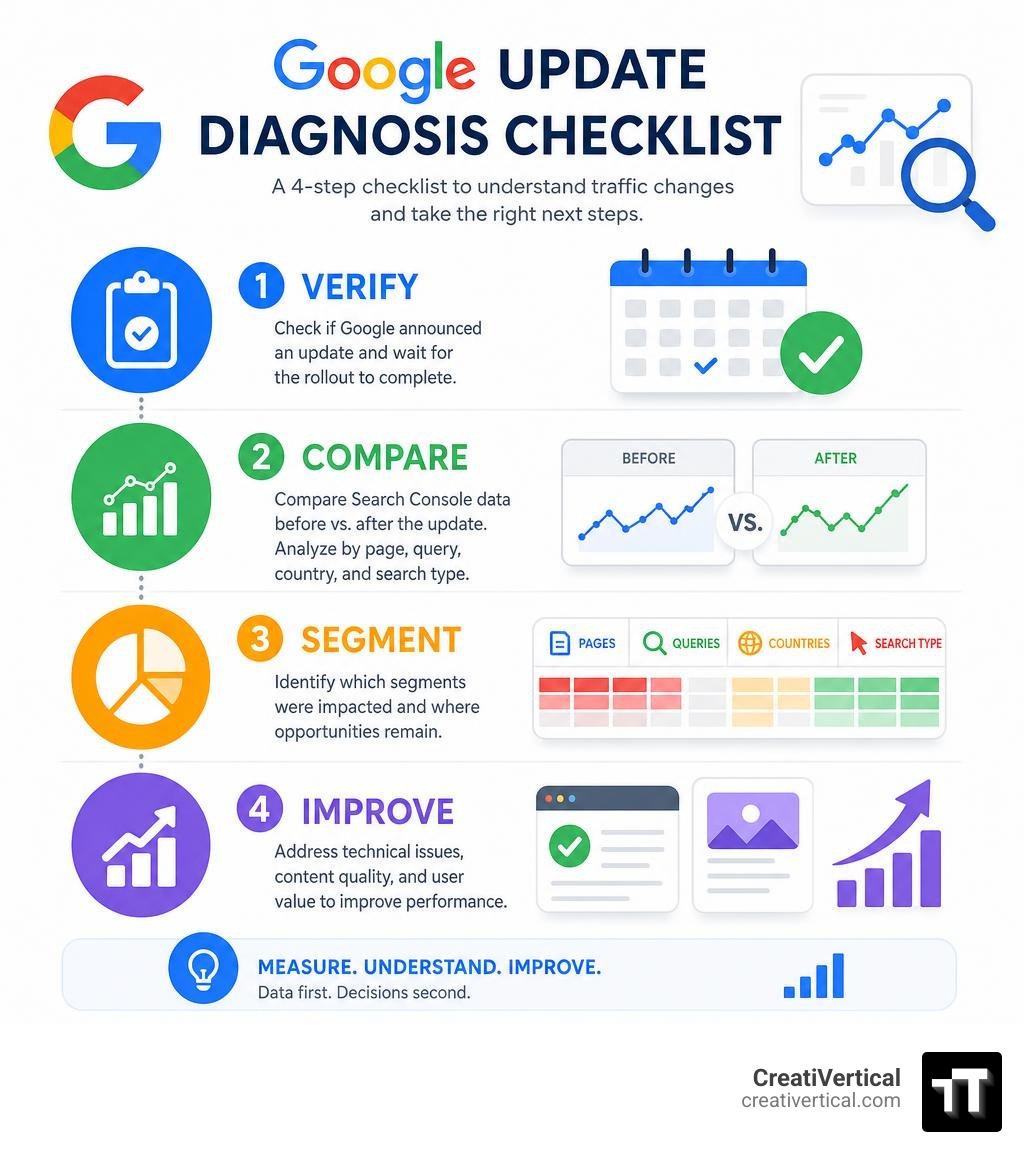
A Google algorithm update is a change to the systems Google uses to rank search results. If your traffic or rankings changed recently, first check whether Google announced an update, wait until the rollout ends, then compare Search Console data by page, query, country, and search type.
Do not assume every drop is a penalty. A shift can also come from a technical problem, tracking error, reduced search demand, Google Discover changes, or an AI Overview taking more clicks from the results page.
Google makes thousands of small ranking adjustments each year and announces larger changes, such as core and spam updates, several times a year. While broad core updates often take several weeks to roll out globally, spam updates frequently conclude in a matter of days. The takeaway is simple: measure before making major changes.
This guide explains what changed, how to identify the likely cause, and how to improve a site without chasing rumors or making panic edits.
I am Nicholas Cunha, founder of CreatiVertical, with more than 20 years of hands-on work in web development, SEO, and digital projects for businesses and institutions. I help organizations interpret each Google algorithm update in practical terms, from technical site health and content quality to AI search visibility.
Google algorithm update vocab to learn:
Decoding the Mechanics of a Google Algorithm Update
Search engines rely on complex ecosystems of automated ranking systems to index, understand, and rank billions of web pages. At its foundation, an algorithm update adjusts the mathematical weights, classifiers, and evaluation criteria these systems use to surface relevant search results.
Google deploys thousands of unannounced, incremental adjustments each calendar year. These continuous updates tweak minor retrieval signals and correct edge cases in natural language processing. Alongside this routine background maintenance, Google issues periodic, broad updates that alter search visibility across global markets.
Understanding the rollout timeline is critical for proper performance attribution. Major updates do not take effect instantaneously across all data centers. For instance, according to official Google Search’s Core Updates documentation, core updates typically require one to several weeks to fully propagate globally:
- The March 2024 core update rolled out from March 5 to April 19, running for 45 days.
- The August 2024 core update took 19 days and 4 hours (August 15 to September 3).
- The November 2024 core update took 23 days and 13 hours (November 11 to December 5).
- The December 2024 core update concluded in 6 days and 4 hours (December 12 to December 18).
During an active deployment, search results experience heightened volatility. Rankings can fluctuate wildly from day to day as individual data centers sync updated model weights. Attempting to diagnose or remediate a website while a rollout is active introduces noise into your performance data. Webmasters should allow the deployment window to close completely before drawing firm conclusions.
Distinguishing a Core Update from a Spam Google Algorithm Update
The fundamental difference between a broad core update and an automated spam update lies in their architectural intent. A core update represents a holistic recalibration of how Google assesses content quality, topical authority, and searcher intent across the entire web. It is not an active penalty against specific websites.
When a site drops during a core update, it often means competing pages demonstrated stronger relevance, better information gain, or more comprehensive answers. Google frequently uses the analogy of a top-20 restaurant list: if new, exceptional restaurants open this year, older favorites may drop down the list simply because better alternatives emerged, not because the older restaurants suddenly deteriorated.
In contrast, spam updates are strictly targeted enforcement actions managed primarily by SpamBrain, Google’s machine-learning spam prevention system. Spam updates evaluate whether domains violate explicit search guidelines. These rollouts enforce rules against manipulative practices such as scaled content abuse (publishing high volumes of unoriginal content to game rankings), expired domain abuse, and cloaking.
| Feature / Attribute | Broad Core Update | Automated Spam Update |
|---|---|---|
| Primary Objective | Reassess holistic relevance, information gain, and user satisfaction across all search queries. | Detect and demote web pages violating explicit search spam guidelines. |
| Algorithmic Scope | Global, system-wide recalibration; affects all niches and content types. | Targeted classifier refresh via SpamBrain; zeroes in on abusive or deceptive behavior. |
| Typical Rollout Duration | 1 to 6 weeks (e.g., March 2024 took 45 days; August 2024 took 19 days). | A few days to several weeks depending on the scope of policy enforcement. |
| Nature of Ranking Loss | Relative demotion: Competitors presented more helpful, authoritative content. | Absolute demotion: Algorithmic suppression due to policy breaches. |
| Recovery Mechanism | Improve site-wide content quality, topical depth, and user experience over multiple months. | Remove violating elements; recovery requires subsequent SpamBrain refreshes. |
| Historical Logging | Tracked under Core Updates on the History for Ranking Search Status Dashboard. | Tracked under Spam Updates on official search status dashboards. |
Unlike core updates, spam updates do not reward high-quality sites directly. They operate asymmetrically by suppressing deceptive actors, which allows compliant sites to move up into vacated positions.
Specialized Systems: Helpful Content, Discover, and Reviews Updates
Beyond broad core and spam adjustments, Google maintains specialized algorithmic sub-systems designed for specific surfaces and content types:
- The Helpful Content System: Originally launched as a standalone classifier in late 2022 (with the December 2022 helpful content update running for 38 days), this system evaluates whether content is built primarily for people or manufactured strictly to manipulate search engines. Following the March 2024 core update, this architecture was folded directly into Google’s primary core ranking systems. This update, combined with prior efforts, contributed to a 45 percent reduction in low-quality search results.
- Google Discover Updates: Content performance on Google Discover relies heavily on user engagement, strong visual assets, and topical freshness. Algorithmic feed calibrations adjust interest modeling and topic affinity rather than explicit text query intent.
- Reviews Systems: These systems evaluate in-depth evaluations, product comparisons, and buying guides. They require demonstrable first-hand testing, quantitative performance metrics, and original media rather than templated product summaries.
Key Ranking Factors and the Rise of AI Overviews
Modern search ranking models evaluate hundreds of contextual signals to match intent. Rather than relying on simple keyword repetition, modern systems analyze semantic completeness, entity relationships, and real-world user engagement.
Recent industry analyses and leaked internal documentation have clarified the operational importance of NavBoost, a system that incorporates aggregated Chrome clickstream signals. Search systems track interaction patterns—such as dwell time, return-to-SERP rates, and extended user engagement sessions—to validate whether a page successfully satisfied the visitor’s underlying objective.
High-ranking pages demonstrate information gain, providing unique insights, proprietary data, or expert analysis that competing search results lack. Furthermore, search engines map authors and organizations as distinct entities, evaluating their historical footprint and topical relevance across specific subject matters. To capture organic demand, websites must balance these authority signals with technical excellence, ensuring that published resources reflect proven organic traffic growth secrets.

How AI Overviews and Generative Search Reshape Algorithm Impact
The widespread rollout of AI Overviews (AIOs) has fundamentally altered traditional click distribution on search engine results pages. AI Overviews now trigger on roughly 48 percent of tracked queries (up from approximately 30 percent in early 2025) and appear in more than 25 percent of general searches.
This generative layer synthesizes multiple web sources to provide a direct answer before a user ever reaches a standard organic blue link. Research reveals a notable divergence between traditional organic rankings and generative citations: only about 38 percent of pages cited within AI Overviews also rank within the organic top 10 search results.
Generative models, powered by systems like Gemini, prioritize concise semantic answers, structured comparison tables, and direct query resolutions. In conversational search environments, models also rely on parametric memory—the brand entities and factual associations learned during model training. When an AI model generates an initial query internally, pre-trained brand entities achieve substantially higher citation rates in the final response than sources retrieved solely via secondary live web queries.
Technical Baselines, Core Web Vitals, and User Engagement Signals
Technical health remains the non-negotiable baseline that allows algorithmic systems to crawl, index, and interpret web assets:
- Mobile-First Indexing: With roughly 70 percent of all web searches originating on mobile devices, Google evaluates pages exclusively from the viewpoint of a mobile smartphone user agent.
- Core Web Vitals: Metrics such as Interaction to Next Paint (INP), Largest Contentful Paint (LCP), and Cumulative Layout Shift (CLS) measure real-world page speed and visual stability. Pages with significant rendering friction see higher bounce rates, directly harming NavBoost engagement signals.
- Security & Protocol Standards: Universal HTTPS encryption and clean crawl paths ensure reliable data retrieval.
- Backlink Integrity: Search engines group backlinks into qualitative tiers based on referring domain relevance and natural user traffic. Artificial link schemes are neutralized by automated spam systems, which permanently removes the ranking benefit those links previously provided. Maintaining authority requires regular audits using a painless backlink profile audit to ensure your external reference profile remains clean.
Diagnosing Traffic Drops and Navigating Algorithmic Recovery
When analytics dashboards show a sharp decline in organic visitors, avoid jumping to immediate conclusions. A drop in traffic does not automatically indicate an algorithmic penalty.
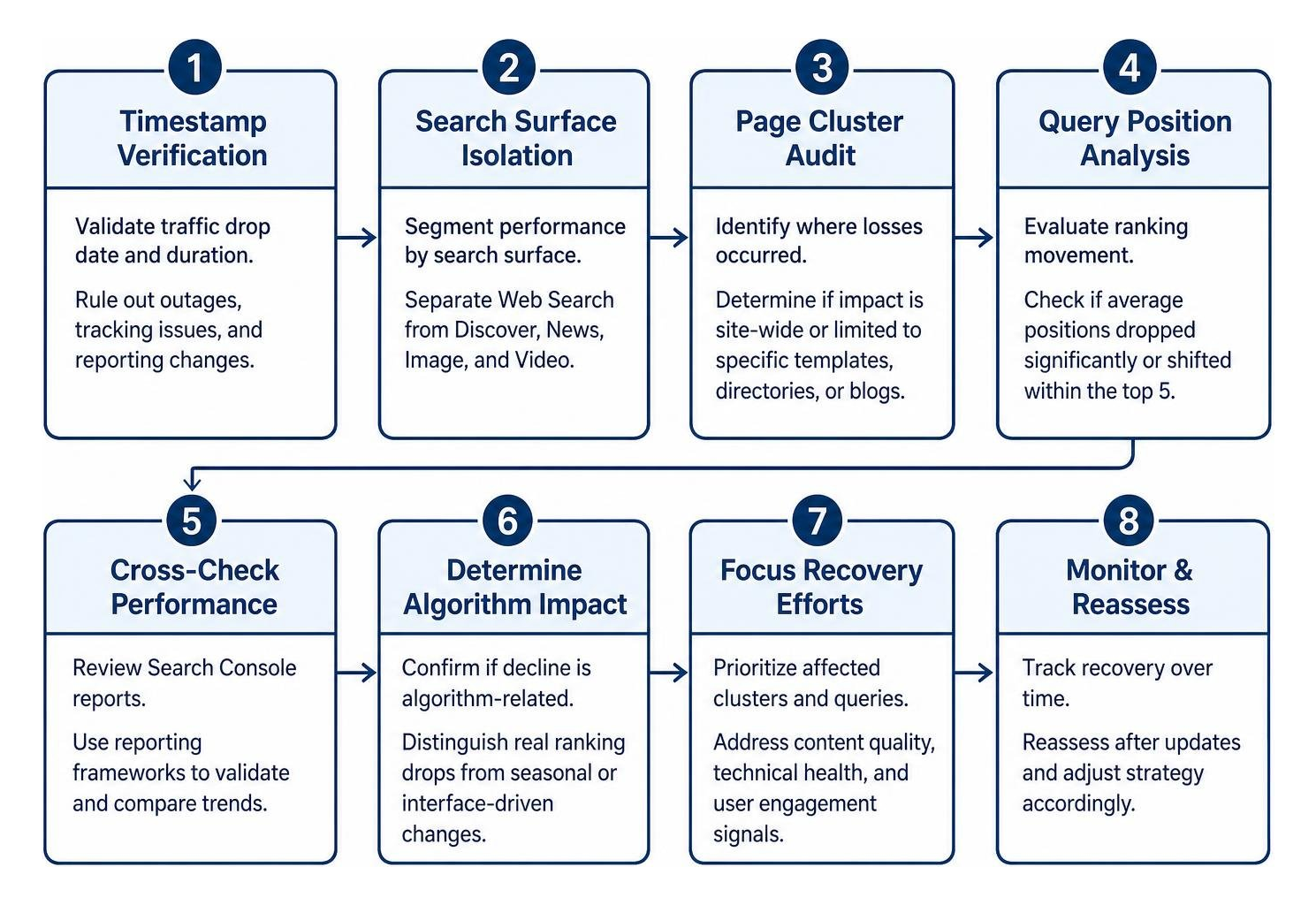
First, rule out technical faults, server outages, analytics configuration errors, and tracking gaps. For example, sudden traffic drops reported by webmasters often trace back to tag firing issues, consent banner updates, or changes in Google Discover traffic rather than standard organic search rankings.
To determine true algorithmic impact, use Google Search Console to compare performance across isolated dimensions. Evaluate your data by looking at:
- Search Surface: Separate standard Web Search from Discover, News, Image, and Video performance.
- Page Clusters: Identify whether losses occurred site-wide or were isolated to specific templates, programmatic directories, or informational blog posts.
- Query Positions: Check whether average ranking positions dropped significantly (e.g., from position 4 to position 28) or simply shifted within the top 5 positions due to normal competitive movement.
Reviewing search performance reports alongside specialized reporting frameworks—such as those detailed in our guide on performance SEO reporting tools—allows digital teams to separate real ranking drops from seasonal or interface-driven changes.
How to Prepare Your Site for a Future Google Algorithm Update
Preparing a domain for upcoming algorithm updates requires moving away from reactive fixes toward building durable digital systems.
- Conduct Regular Content Quality Audits: Systematically review older pages. Update outdated figures, prune thin or unhelpful articles that generate no engagement, and expand shallow summaries with practical, real-world experience.
- Build Demonstrable Brand Authority: Strengthen off-page brand footprint, author bylines, and company entity profiles. Search systems reward established organizations with clear subject matter expertise.
- Prioritize Information Gain: Ensure every new article provides original data, case studies, or perspectives not already duplicated across the top 10 search results.
- Structure Content for AI Extraction: Use clear headings, direct summary answers, and structured markup to allow generative engines to easily extract and cite your data.
- Adopt Ongoing Adaptive Strategy: Sustainable organic growth requires continuous iteration. Deploying adaptive SEO services ensures that site architecture, content quality, and technical performance evolve alongside changing search engine criteria.
Realistic Recovery Timelines: Why Reassessment Takes Months
Recovering from an algorithmic demotion is not an overnight process. Once technical remediations or content overhauls are published, search crawlers must re-crawl, re-process, and re-index the updated URLs.
More importantly, machine-learning models and automated classifiers like SpamBrain require sustained observation periods to verify that quality improvements are consistent and permanent across the entire domain.
While minor adjustments may show incremental recovery in Search Console within a few weeks, substantial ranking recoveries typically require several months. In many cases, full recovery aligns with subsequent unannounced system refreshes or official broad core updates.
Frequently Asked Questions About Google Search Algorithm Changes
How can I tell if my website was affected by a recent Google algorithm update?
To verify whether your site was impacted, check the official Google Search Status Dashboard to confirm the exact start and conclusion dates of the update. Wait at least one full week following the announced completion date.
Next, open Google Search Console and compare performance data from the post-rollout week against a baseline week prior to the rollout. Segment this comparison by URL clusters, query types, and device categories. If impressions and average positions dropped sharply across multiple keyword groups simultaneously during the rollout window, your site was likely affected.
What should I do immediately if traffic drops after a core update?
First, avoid panic edits. Do not bulk-delete hundreds of pages, disavow backlinks without clear evidence of spam, or change site-wide URL structures overnight.
Identify which page clusters lost visibility and compare those URLs directly against the competitors that took their place. Evaluate whether competitor pages provide more direct answers, better media, faster load times, or more verifiable first-hand expertise. Develop a structured remediation plan focused on improving content depth, user experience, and topical completeness, then publish improvements steadily.
How do spam update recoveries differ from core update recoveries?
Core update recoveries occur as search engines re-evaluate the relative quality and helpfulness of your content compared to the rest of the web. Improving topical depth, clarity, and authority allows a site to gradually regain its competitive standing over subsequent crawl cycles.
Spam update recoveries require the complete removal or remediation of policy-violating tactics (such as scaled low-value content, cloaking, or manipulative redirects). Recovery depends entirely on automated classifiers observing sustained policy compliance across subsequent refresh cycles. Furthermore, if a site previously ranked due to unnatural backlinks, neutralizing those links removes their artificial ranking boost permanently—meaning the site will return to its baseline organic authority rather than its artificial peak.
Conclusion
Navigating search ranking changes requires an objective, measurement-driven mindset. Whether managing a precision industrial equipment manufacturer in Missouri, an offshore fiduciary practice in the Caribbean, or a government technology contractor, digital durability comes from sustainable systems rather than short-term optimization tricks.
At CreatiVertical, we engineer complete digital systems—combining custom web development, applied AI workflow automation, performance-focused paid advertising, and technical SEO designed to withstand ranking volatility. Instead of chasing rumors, organizations can build sustainable authority by understanding everything you need to know about Google’s new algorithm update and aligning their digital assets with true user value. Focus on providing substantive information, maintaining clean technical health, and building recognized brand authority, and your search performance will remain resilient through any future algorithm update.