
What Is a Google Core Algorithm Update?
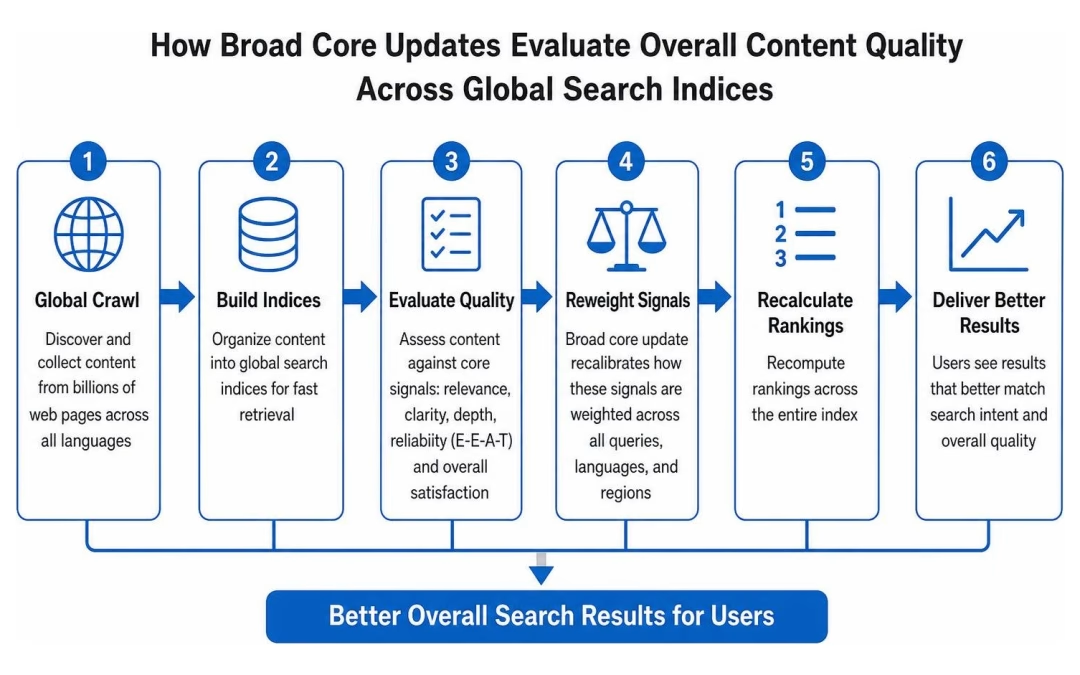
A broad google core algorithm update is designed to adjust search systems so Google can return better overall search results. These releases do not target individual websites, specific niches, or single technical errors. Instead, they recalibrate how automated ranking systems weight overall relevance, clarity, depth, and reliability across billions of web pages.
To grasp how this works, consider Google’s official analogy: imagine making a top-20 list of your favorite restaurants. In 2022, your list reflects what existed at that time. Two years later, several new places have opened, existing chefs have revamped their menus, and your own tastes have matured. When you update your list, previously ranked restaurants might drop lower—not because their food got worse, but because newer, better options emerged to take those top spots.
That same logic applies when Google modifies its core search systems. A site dropping in position does not imply an explicit policy violation or an algorithmic manual action. According to official Google Search’s Core Updates Documentation, broad core updates exist to elevate content that best satisfies search intent, rather than penalizing sites for technical infractions.
Core Updates vs Spam and System Updates
It is crucial to distinguish a broad core update from other specialized algorithm adjustments. Google deploys distinct algorithmic systems to maintain search quality, each designed for a different purpose:
- Broad Core Updates: Re-evaluate broad content relevance, E-E-A-T (Experience, Expertise, Authoritativeness, and Trustworthiness), and overall user satisfaction across all verticals and languages globally.
- Spam Updates: Target explicit policy violations using AI detection tools like SpamBrain. These target practices like site reputation abuse, hidden text, scraped content, and aggressive link manipulation.
- Discover Core Updates: Adjust recommendation algorithms within the Google Discover feed, prioritizing interest-based topic affinity, visual appeal, and local relevance over specific search queries.
Understanding this distinction prevents costly misdiagnoses. If a site loses visibility during a dedicated spam rollout, the underlying cause is often policy compliance or link manipulation. Conversely, losing traffic during a broad core update indicates that competing pages offer more thorough, experienced, or reliable answers. To read more about navigating these distinct systems, see The Ultimate Guide to Google Updates on SEO Without Losing Your Mind.
Key Timeline Patterns and Historical Core Updates
Tracking official timelines on the Google Search Status Dashboard reveals how rollout patterns vary. Broad core updates generally occur every three to four months, taking anywhere from one to several weeks to propagate completely across regional indices.
| Core Update | Start Date | Completion Date | Rollout Duration | Volatility Highlights |
|---|---|---|---|---|
| March 2024 Core Update | March 5, 2024 | April 19, 2024 | 45 days | Targeted reducing unhelpful content by 40%; longest core update rollout on record. |
| August 2024 Core Update | August 15, 2024 | September 3, 2024 | 19 days, 4 hours | Designed to better surface small and independent publishers creating useful, original content. |
| November 2024 Core Update | November 11, 2024 | November 25, 2024 | 14 days | Focused on continuing search quality improvements and refining helpful content systems globally. |
These major updates illustrate how rollout duration and ranking impact can vary widely between releases. As Google continuously refines search quality signals, tracking these historical patterns helps SEO professionals distinguish normal ranking fluctuations from broad algorithmic shifts.
How to Diagnose Impact from a Google Core Update
When ranking volatility strikes, hasty sitewide changes can do more harm than good. A disciplined diagnosis relies on verified data from Google Search Console (GSC) rather than third-party rank-tracking noise.

Identifying Search Console Traffic Drops After a Google Core Algorithm Update
To verify whether your site was affected by a google core algorithm update, wait at least seven days after Google officially confirms the update rollout is complete. Analyzing data mid-rollout can lead to false conclusions caused by temporary algorithmic testing.
- Open Google Search Console: Navigate to the Performance tab for Search results.
- Set Date Comparisons: Filter dates by selecting Compare, then choose Compare last 28 days to previous period (or set custom dates comparing 28 days after completion against 28 days prior to the update’s start date).
- Filter by Search Type: Check Web search first, then run separate analyses for Image, News, and Discover feeds.
- Isolate Affected Pages: Switch the view to Pages and sort by Clicks Difference and Impressions Difference to spot which specific landing pages suffered traffic declines.
- Evaluate Position Magnitude: Differentiate between small and major position shifts.
Evaluating magnitude is key. A position drop from 2 to 4 is considered minor volatility. It typically indicates normal competitive movement that requires no immediate changes. Conversely, dropping from position 4 to position 29 signifies a significant reassessment by search algorithms, pointing to underlying content quality, user experience, or authority gaps. For businesses needing structured diagnostic support, exploring our Adaptive SEO Services can help isolate these underlying issues.
Core Web Vitals and AI Overview Citations
While broad core updates focus heavily on content context and E-E-A-T, technical user experience metrics play an essential supporting role. Pages with slow load times or unstable layouts tend to suffer disproportionately during volatile core update rollouts.
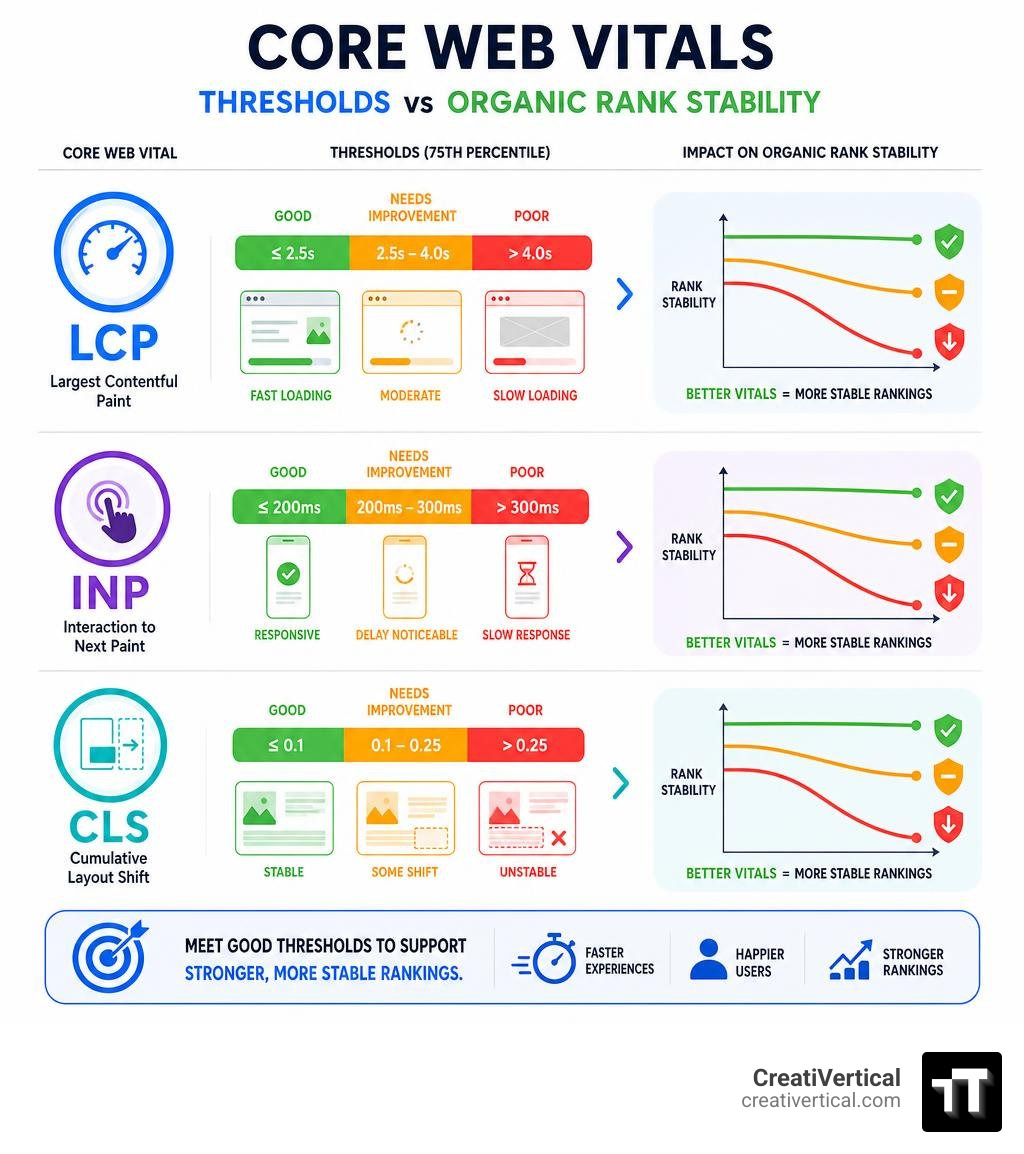
Maintaining solid Core Web Vitals targets evaluated at the 75th percentile of field data remains essential:
- Largest Contentful Paint (LCP): Must occur within 2.5 seconds. Pages with LCP exceeding 3.0 seconds often suffer noticeably greater traffic loss during core updates compared to faster peers.
- Interaction to Next Paint (INP): Must remain below 200 milliseconds. Poor responsiveness (INP > 300ms) correlates with noticeable drops in mobile search positions.
- Cumulative Layout Shift (CLS): Must remain below 0.1 to avoid disruptive visual movement while reading.
Another major shift in recent updates is the divergence between top organic rankings and AI Overview citations. Search tracking shows that a substantial portion of AI Overview citations originate from sources outside top-10 organic search results. Ranking #1 organically no longer guarantees inclusion in Google’s AI-generated summary blocks, making standalone AI search visibility a critical separate objective.
E-E-A-T Expansion and Quality Self-Assessment
Google has expanded its evaluation of Experience, Expertise, Authoritativeness, and Trustworthiness (E-E-A-T) far beyond traditional Your Money Your Life (YMYL) sectors like healthcare, law, and finance. Today, detailed E-E-A-T criteria apply to virtually every commercial and informational query, including industrial manufacturing guides, B2B software comparisons, and local trade services.

Official Action Steps for Google Core Algorithm Update Recovery
If your site experienced a substantial traffic decline following a google core algorithm update, Google’s official advice points away from technical quick fixes. Instead, conduct an honest sitewide content self-assessment:
- Verify Direct Firsthand Experience: Does the content demonstrate actual physical interaction, hands-on usage, or proprietary workflow knowledge? Avoid publishing regurgitated summaries of third-party source material.
- Provide Clear Author Credentials: Every technical, legal, industrial, or professional guide must include visible author bios, real professional qualifications, and verifiable links to professional backgrounds.
- Deliver Superior Depth: Replace brief overview statements with precise, actionable explanations. For instance, rather than stating “we provide offshore compliance solutions,” detail exact statutory filings, jurisdiction-specific registers (such as BVI or Cayman statutory frameworks), and administrative reporting requirements.
- Consolidate Thin and Duplicate Pages: If multiple pages target minor variations of the same intent, consolidate them into one comprehensive, authoritative resource using 301 redirects or canonical tags.
- Seek Unbiased Third-Party Feedback: Ask knowledgeable individuals unconnected to your organization to review affected pages alongside top-ranking competitors. Unaffiliated evaluators quickly spot fluff, aggressive call-to-action blocks, or missing context.
Avoidable Recovery Misconceptions
When search visibility declines, site owners often attempt reactive tactics that produce no recovery or further damage site quality signals:
- Myth 1: Changing Publication Dates Without Substantive Edits. Updating timestamps to 2026 without adding fresh research, revised data, or deeper analysis does not deceive automated freshness algorithms.
- Myth 2: Deleting Underperforming Pages En Masse. Erasing large sections of a site without analyzing search intent can destroy internal linking structures and eliminate secondary long-tail keyword traffic.
- Myth 3: Mass Building Generic Backlinks. Attempting to offset an algorithmic quality downgrade by purchasing external link packages frequently triggers automated spam systems.
- Myth 4: Submitting Reconsideration Requests. Reconsideration requests in Google Search Console are strictly for manual actions applied by human reviewers. They have zero application to automated core update rank adjustments.
Measuring Long-Term SEO Recovery and Success
Recovering organic visibility following a core update is a gradual process requiring sustained site enhancements.
Realistic Recovery Timelines
Site owners often wonder how quickly rankings rebound after content fixes are deployed. Minor improvements may reflect in search results within a few weeks as Google’s web crawlers re-index updated URLs. However, full recovery across broad search verticals generally requires waiting for the next scheduled broad core update.
Because broad core updates run every three to four months, algorithmic re-evaluations occur on a macro timeline. Between major core updates, smaller unannounced systems continuously refresh search signals, providing steady incremental progress if content quality improvements remain consistent.
Key Metrics Beyond Keyword Rankings
Relying solely on primary keyword positions provides an incomplete picture of business performance. Tracking broader success metrics ensures your overall search visibility remains healthy:
- Qualified Organic Conversions: Monitor lead generation forms, consultation requests, or quote submissions from organic traffic. A site receiving slightly fewer visitors can yield higher revenue if remaining traffic aligns better with buyer intent.
- AI Search Visibility and Citation Share: Measure how frequently your domain is cited inside AI search interfaces, including ChatGPT, Perplexity, and Google AI Overviews.
- User Engagement Depth: Review bounce rates, scroll depth, and average time spent on key pages to verify that users find your published content satisfying. To streamline tracking across these areas, consider reviewing the Best AI Tools for SEO 2025.
Frequently Asked Questions About Core Updates
How long does a core update take to complete rolling out?
Most broad core updates take between two and three weeks to complete full global rollout across search indices. However, durations vary significantly based on system complexity: some targeted core updates finish in around two weeks, whereas major releases like the March 2024 core update took 45 days. You can track official start and completion dates directly on the Google Search Status Dashboard.
Does a rank drop after a core update mean my site received a penalty?
No. A drop during a google core algorithm update is not a manual penalty or a policy violation notice. It simply indicates that Google updated its automated ranking calculations, and competing pages across the web are currently evaluated as providing a more satisfying, relevant, or complete answer for those queries.
Why are AI Overviews citing pages outside the top 10 organic search results?
Google’s AI Overview retrieval systems select references based on concise semantic match, factual density, and direct query relevance, rather than traditional organic position alone. Observational data shows that many AI Overview citations originate from pages ranked outside the top-10 organic search results, meaning content can gain AI search citations even if its standard organic rank sits further down the page.
Navigating Algorithm Changes with Confidence
Managing search visibility amidst broad algorithmic changes requires moving past quick fixes and embracing holistic site quality. Every broad google core algorithm update underscores Google’s ongoing objective: surfacing trustworthy, clear, and satisfying content built primarily for human readers.
At CreatiVertical, we work with Kansas City companies, industrial B2B manufacturers, offshore professional firms, and government contractors to build resilient digital systems. Rather than reacting frantically to individual algorithm shifts, we focus on establishing strong foundations—combining high-performance web engineering, comprehensive E-E-A-T content strategy, and clear AI search visibility.
To learn more about keeping your search presence stable amidst ongoing industry updates, explore our guide on Everything You Need to Know About Google’s New Algorithm Update, or reach out to our team to discuss your SEO strategy.