

Google Search Algorithm Updates 2025 & 2026: The Facts That Matter
Google confirmed four major Google Search algorithm updates in 2025: three broad core updates and one spam update. The core updates ran from March 13-27, June 30-July 17, and December 11-29. The August 26-September 22 spam update focused on spam detection and produced especially fast changes for affected sites.
For site owners evaluating performance in 2026, the practical lesson is simple: do not treat every ranking swing as a penalty. Check Google Search Status Dashboard dates against Search Console data, then improve the usefulness, accuracy, technical health, and trust signals of pages that suffered sustained losses.
2025 was also a transition year setting the technical standard for Search in 2026. Google expanded AI Mode and introduced Gemini 3 in Search in November, changing how people research complex questions and how Google finds, summarizes, and presents sources. Meanwhile, Google updated its guidance in December to confirm that smaller core changes deploy on an ongoing basis rather than solely through named updates.
I am Nicholas Cunha, founder of CreatiVertical, with more than 20 years of hands-on web, SEO, and digital project experience across Kansas City, Caribbean professional services, industrial firms, and government-facing organizations. In this guide to google search algorithm updates 2025, I will separate confirmed facts from industry noise and focus on the strategic decisions that help credible websites remain visible and resilient in 2026.
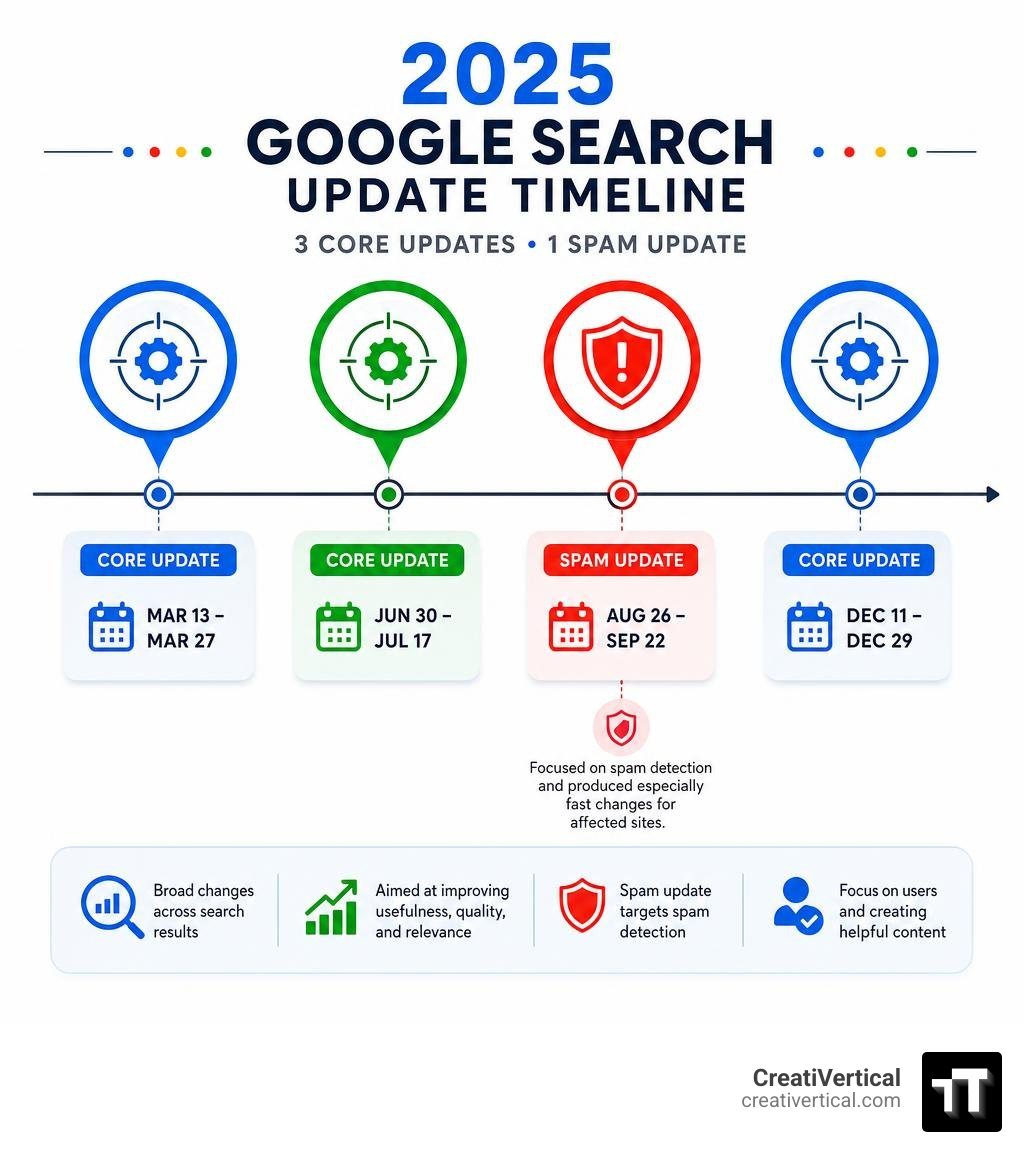
Google search algorithm updates 2025 terms to remember:
Major Google Search Algorithm Updates 2025: Confirmed Timeline and Rollouts
Navigating algorithmic changes requires matching your traffic data with confirmed rollout dates. Throughout 2025, Google deployed four confirmed updates designed to re-evaluate quality and counter manipulative content. Reviewing the official records on the Google Search Status Dashboard helps isolate routine search fluctuations from genuine algorithmic recalibration.
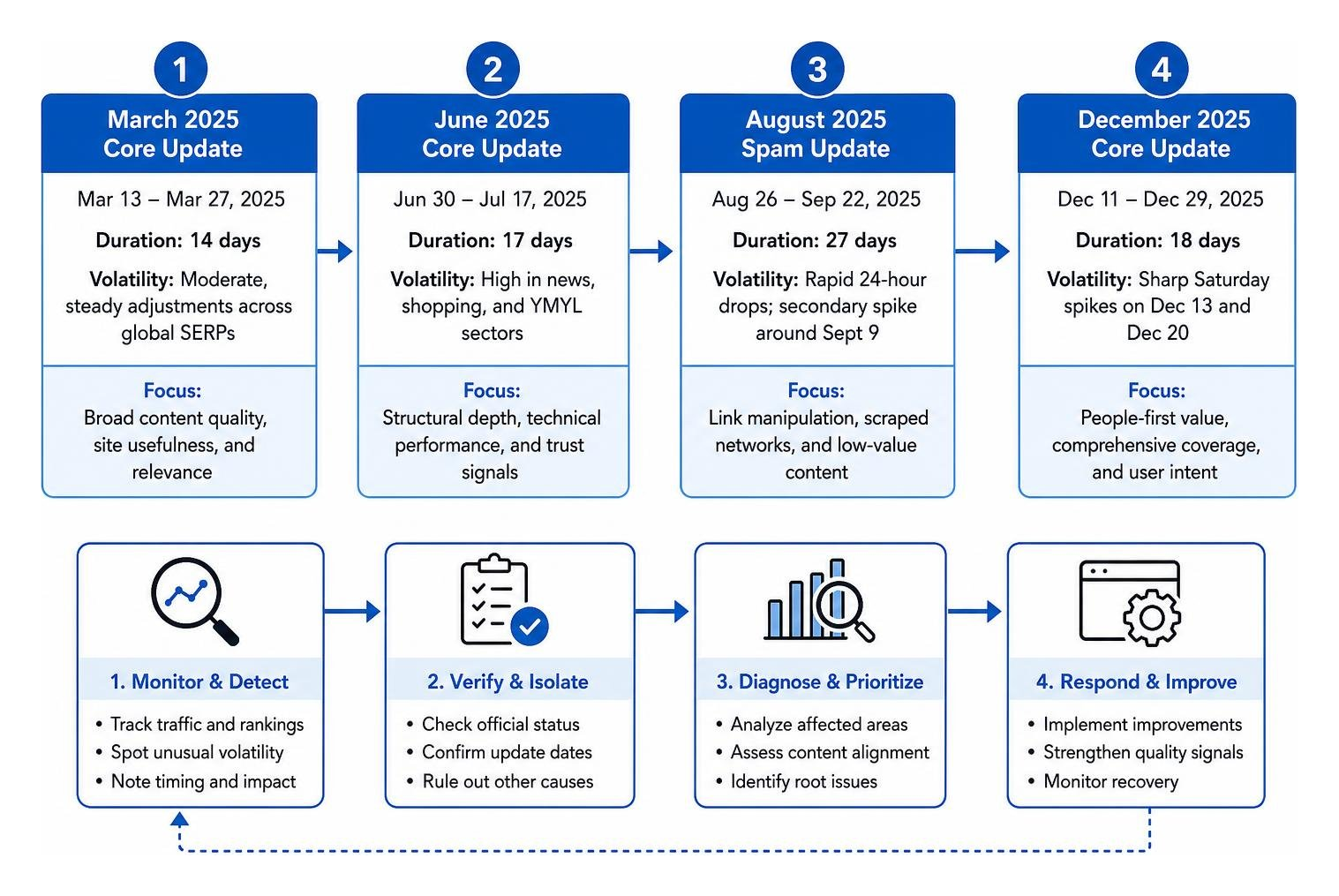
| Update Name | Start Date | Completion Date | Rollout Duration | Volatility Characteristics | Primary Focus Area |
|---|---|---|---|---|---|
| March 2025 Core Update | March 13, 2025 | March 27, 2025 | 13 days, 21 hours (14 days) | Moderate, steady adjustments across global SERPs | Broad content quality, site usefulness, and relevance |
| June 2025 Core Update | June 30, 2025 | July 17, 2025 | 16 days, 18 hours (17 days) | High volatility in news, shopping, and YMYL sectors | Structural depth, technical performance, and trust signals |
| August 2025 Spam Update | August 26, 2025 | September 22, 2025 | 26 days, 15 hours (27 days) | Rapid 24-hour drops; secondary spike around Sept 9 | Link manipulation, scraped networks, and low-value content |
| December 2025 Core Update | December 11, 2025 | December 29, 2025 | 18 days, 2 hours (18 days) | Sharp Saturday spikes on Dec 13 and Dec 20 | People-first value, comprehensive coverage, and user intent |
Understanding how these systems operate is essential for any modern SEO strategy, as explained in our guide to understanding Google core algorithm updates.
Chronological Breakdown of Google Search Algorithm Updates 2025
The 2025 search calendar opened with the March 2025 core update, which rolled out over 14 days (March 13–27). This release served as a broad recalibration across all languages and regions. Rather than targeting specific web violations, it reassessed how effectively indexed pages satisfied general user expectations.
Midway through the year, the June 2025 core update launched on June 30 and concluded on July 17 after roughly 16 days. This rollout brought heightened volatility to information-heavy verticals, including health, finance, and technical B2B manufacturing queries. As documented in industry coverage of the Google algorithm updates 2025 in review, the June release rewarded sites demonstrating first-hand subject matter depth while shifting rankings away from surface-level overviews.
The August 2025 Spam Update and Aggressive Link Filtering
The August 2025 spam update started on August 26 and ran for 27 days, completing on September 22. This update deployed rapid automated filtering, causing impacted sites to see dramatic ranking drops within 24 hours of launch.
After initial volatility, a secondary disruption occurred around September 9, triggering additional ranking and indexing fluctuations. The update heavily impacted manipulative backlink schemes, private blog networks, and mass-syndicated articles. Maintaining a healthy reference profile remains vital, and you can conduct a routine check with our guide to a painless backlink profile audit.
December 2025 Core Update: Volatility Spikes and Continuous Rollouts
The year concluded with the December 2025 core update, initiating on December 11 at 12:25 PM ET and concluding on December 29 at 2:05 PM ET (an 18-day duration). The rollout produced distinct volatility patterns, showing notable spikes on two consecutive Saturdays—December 13 and December 20—while tracking calmer during weekdays.
Alongside this release, Google updated its official documentation on Google Search’s Core Updates on December 10, confirming that smaller, unannounced core updates now deploy on an ongoing, continuous basis.
Technical Shifts: Gemini 3 Integration, E-E-A-T Expansion, and Quality Signals

Search architectures evolved significantly throughout 2025. Ranking systems placed heavier weight on direct experience, reliable data sources, and efficient technical delivery. To maintain consistent search visibility, organizations must adapt to these changing quality evaluations, as detailed in our Google Algorithm Update Guide 2026.
Key Shifts from Google Search Algorithm Updates 2025: Continuous Rollouts and AI Search
On November 18, 2025, Google introduced its Gemini 3 model into Search and expanded AI Mode. As highlighted in Google’s official announcement on Gemini 3 in Search and AI Mode, this integration introduced advanced query fan-out capabilities. Instead of evaluating a query against simple keyword indices, the system executes multiple background micro-searches to retrieve precise answers for nuanced, multi-layered queries.
This structural shift made direct citation in generative UI layouts a key visibility goal. Teams looking to support their content strategy can explore our breakdown of the best AI tools for SEO.
Core Web Vitals and User Engagement Thresholds
Technical foundations directly influenced ranking stability across all 2025 rollouts. Google enforced strict page performance thresholds:
- Interaction to Next Paint (INP): Pages maintaining an INP below 200ms demonstrated greater stability during core updates, whereas sluggish interfaces exceeding 300ms frequently lost position on high-intent terms.
- Largest Contentful Paint (LCP): Sites maintaining an LCP under 2.5 seconds retained visibility during competitive reassessments. Pages taking longer than 3.0 seconds suffered higher ranking losses.
- Cumulative Layout Shift (CLS): Visual stability benchmarks required scores under 0.1, reducing frustrating layout jumps during page rendering.
- Engagement and Freshness Signals: Algorithms evaluated behavioral indicators, favoring pages where users found complete answers without immediately bouncing back to the search results.
Sector Impacts: E-Commerce, Health, Affiliates, and B2B
The updates produced distinct outcomes across specific market verticals:
- Affiliate and Aggregator Sites: Pages relying on thin product summaries, copied manufacturer specifications, or superficial top-ten lists experienced significant visibility drops.
- Health and Financial Portals (YMYL): Search systems strictly evaluated author qualifications, medical review disclosures, and institutional backing.
- E-Commerce Retailers: Category pages offering filtering, verified customer reviews, clear inventory data, and rapid load times outperformed generic product directories.
- B2B Industrial Manufacturers and Professional Services: Technical accuracy, detailed specification sheets, documented certifications, and verifiable case studies preserved visibility during ranking recalculations.
Organizations seeking to build resilient web architectures can implement structured strategies through adaptive SEO services.
Core Update Recovery Playbook: Auditing Traffic Drops and Fixing Content Quality

Experiencing traffic volatility after an algorithm update requires a structured, data-backed approach rather than hasty overhauls.
Search Console Diagnostics and Rollout Window Analysis
Isolate whether ranking shifts stem from broad algorithmic recalculations or local technical bugs by following these steps:
- Verify Timeline Alignment: Check your Google Search Console performance data against the exact rollout dates recorded on the Google Search Status Dashboard.
- Observe a Stabilization Window: Avoid making reactive modifications during an active update. Wait at least seven days after Google confirms the rollout is complete before assessing final impact.
- Compare Matched Timeframes: Analyze a 28-day post-rollout window against the 28 days preceding the update to identify macro trends.
- Segment by Search Dimension: Filter performance metrics by search type (Web, Image, Video, Discover) and geography to pinpoint specific areas of visibility loss.
- Identify Affected Page Clusters: Isolate URLs that suffered substantial position declines (e.g., dropping from position 3 to position 28) versus normal baseline fluctuations (e.g., position 2 to position 4).
Common Recovery Misconceptions to Avoid
When diagnosing ranking drops, avoid these common industry mistakes:
- Treating Core Updates as Manual Penalties: Core updates adjust the overall ranking algorithm; they are not punitive manual actions applied to a single domain. Filing a reconsideration request is ineffective for algorithmic adjustments.
- Executing Mass Deletions: Pruning dozens of informative pages without evaluating user demand often damages internal link equity and reduces overall topical relevance.
- Making Cosmetic Timestamp Changes: Updating the “Last Modified” date on an article without making substantive text, data, or structural improvements provides no algorithmic benefit.
- Assuming AI Content is Automatically Disqualified: Google prioritizes content usefulness and factual reliability regardless of production methods. Pages are demoted for lacking original depth or substance, not for using AI tools responsibly.
Sustainable Long-Term Content and Technical Remediation
To restore and strengthen search performance, focus on building authoritative, user-first resources:
- Document First-Hand Experience: Incorporate proprietary lab test results, original photography, internal case data, and identifiable author credentials with demonstrable subject matter experience.
- Enhance Information Depth: Replace vague marketing claims with exact technical specifications, regulatory frameworks, and actionable problem-solving workflows.
- Streamline Crawl Hierarchy: Ensure XML sitemaps, canonical tags, and internal link structures allow search engine crawlers to navigate your site’s core content efficiently.
- Maintain Technical Health: Regularly resolve broken redirect chains, eliminate render-blocking resources, and verify that structured schema accurately mirrors on-page content.
Frequently Asked Questions About Google Search Algorithm Updates 2025
Why did Google confirm fewer updates in 2025 despite high ranking volatility?
Google confirmed four major algorithm updates in 2025 (three core updates and one spam update), compared to seven in 2024, nine in 2023, and ten in 2022. Despite fewer public announcements, SERP volatility remained high because Google transitioned to deploying smaller, incremental core adjustments on a continuous background schedule.
How long did the December 2025 core update take to roll out?
The December 2025 core update took 18 days and 2 hours to deploy. It launched on December 11, 2025, at 12:25 PM ET and finished on December 29, 2025, at 2:05 PM ET. Search tracking tools recorded its highest volatility spikes on Saturday, December 13, and Saturday, December 20.
Does Google penalize AI-generated content after the 2025 updates?
Google does not systematically penalize content simply because AI tools contributed to its creation. However, 2025 algorithm updates heavily demoted automated content that was published at scale without human oversight, factual verification, original insights, or demonstrable expertise. Quality, accuracy, and user utility remain the primary ranking criteria.
Conclusion: Applying 2025 Search Lessons to 2026
The 2025 search updates reinforced a clear standard for organic visibility in 2026: websites succeed by publishing accurate, user-focused information supported by clean technical architecture. Quick fixes and artificial optimization tactics continue to lose effectiveness against sophisticated ranking systems.
At CreatiVertical, we engineer integrated digital systems—combining modern web development, search visibility, technical optimization, and applied AI automation—to help organizations build resilient digital platforms. For ongoing insights on navigating algorithmic shifts, explore our complete guide on everything you need to know about Google’s new algorithm update.