
What the Google Core Update April 2026 Actually Was
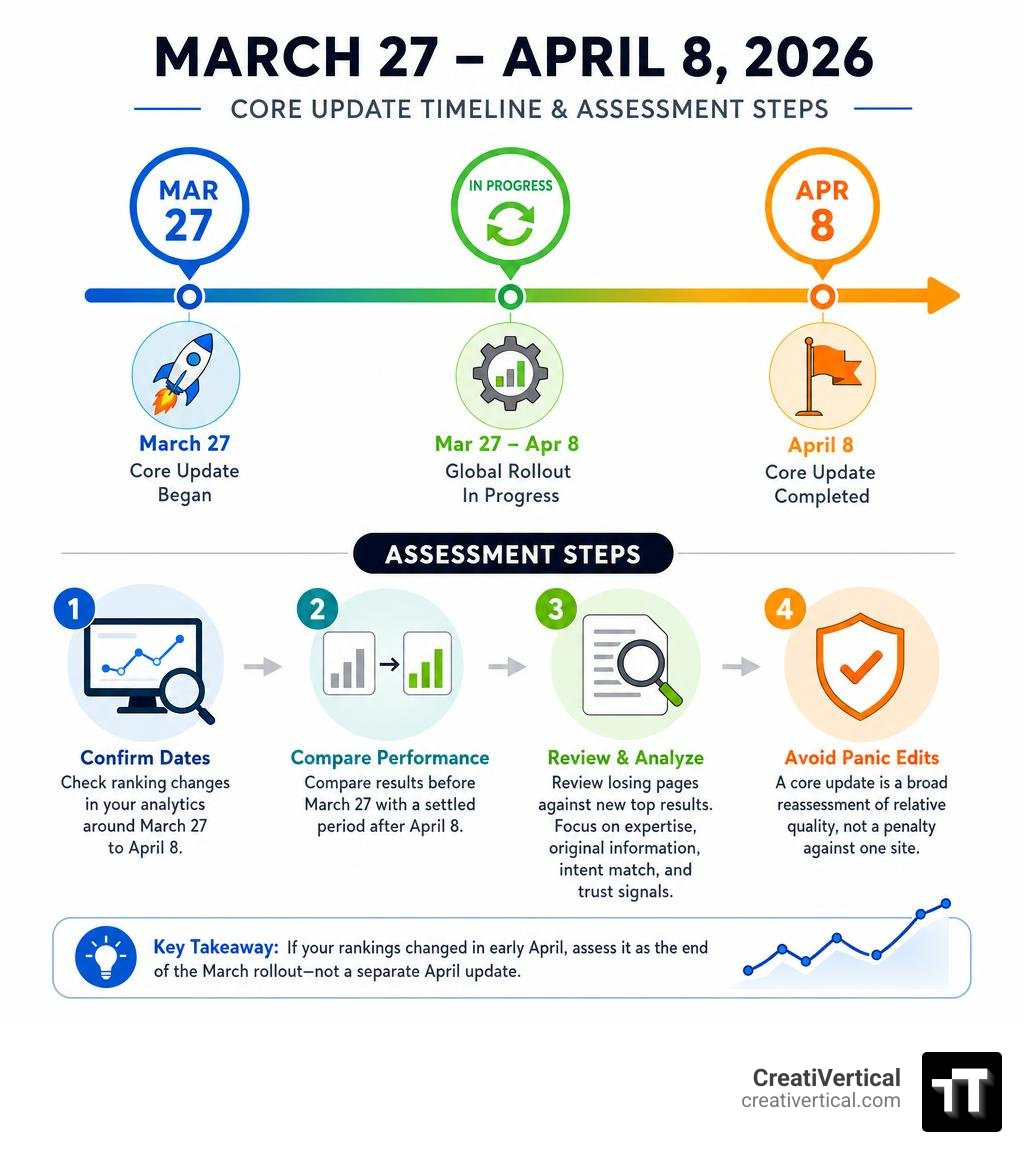
There was no standalone Google Core Update in April 2026. The name commonly refers to the March 2026 broad core update, which began on March 27 and completed on April 8, according to the Google Search Status Dashboard. If your rankings changed in early April, assess that period as the end of the March rollout, not as a separate April release.
For website owners, the practical takeaway is simple:
- Confirm the dates of the ranking change in Google Search Console.
- Compare performance before March 27 with a settled period after April 8.
- Review losing pages against the new top results for stronger first-hand expertise, original information, clearer intent match, and trust signals.
- Avoid panic edits. A core update is usually a broad reassessment of relative quality, not a penalty against one site.
The March rollout followed a February Discover update and a March spam update, which made spring 2026 unusually hard to diagnose. Industry tracking reported major movement in top results, while analysis of winners and losers suggested that direct sources, specialist publishers, official organizations, and pages with unique evidence often gained ground over thin aggregators, copied location pages, and generic content summaries.
I’m Nicholas Cunha, founder of CreatiVertical, with more than 20 years of web, SEO, and digital project experience for businesses, institutions, and public-sector organizations. In this guide to the Google Core Update April 2026, I’ll connect the update’s confirmed timeline with practical steps for improving search and AI-search visibility without relying on shortcuts.
Simple google core update april 2026 word guide:
1. Timeline and Mechanics of the Google Core Update April 2026
Understanding what transpired across search indexes requires looking closely at official telemetry. The event widely referred to in digital marketing as the google core update april 2026 was formally launched on March 27, 2026, at 02:14 PDT, and completed its worldwide distribution on April 8, 2026, at 06:12 PDT. Spanning exactly 12 days and 4 hours, this represents the second-fastest rollout among recent broad core updates, trailing only the six-day release seen in December 2024.
According to the official Google Search Status Dashboard ranking history, systems returned to a baseline state by mid-April. Despite the brief window, third-party monitoring confirmed intense volatility. The Semrush Sensor peaked at a maximum reading of 9.5 out of 10 during the height of the transition. For teams seeking a broader historical perspective on these algorithmic shifts, our Google Algorithm Update Guide 2026 documents how these systemic adjustments have evolved over recent cycles.
How the Google Core Update April 2026 Rolled Out Across Search Systems
The velocity of this rollout translated directly into major index turbulence. Industry datasets revealed unprecedented shifts across competitive ranking tiers:
- 79.5% of URLs occupying top-3 positions shifted rank during the rollout window.
- 90.7% of URLs in the top 10 experienced measurable displacement.
- Approximately 24.1% of domains holding top-10 placements before the rollout dropped entirely outside the top 100 results.
- Overall, more than 55% of all monitored commercial domains experienced significant visibility adjustments.
As detailed by Search Engine Roundtable reporting on the rollout, core updates are holistic reassessments of content across the entire web rather than manual penalties aimed at individual sites. Pages losing ground were not necessarily flagged for technical violations; rather, newer, more authoritative, or more complete resources were re-evaluated and elevated above them.
Discover, Spam, and Core: The Triple-Update Sequence
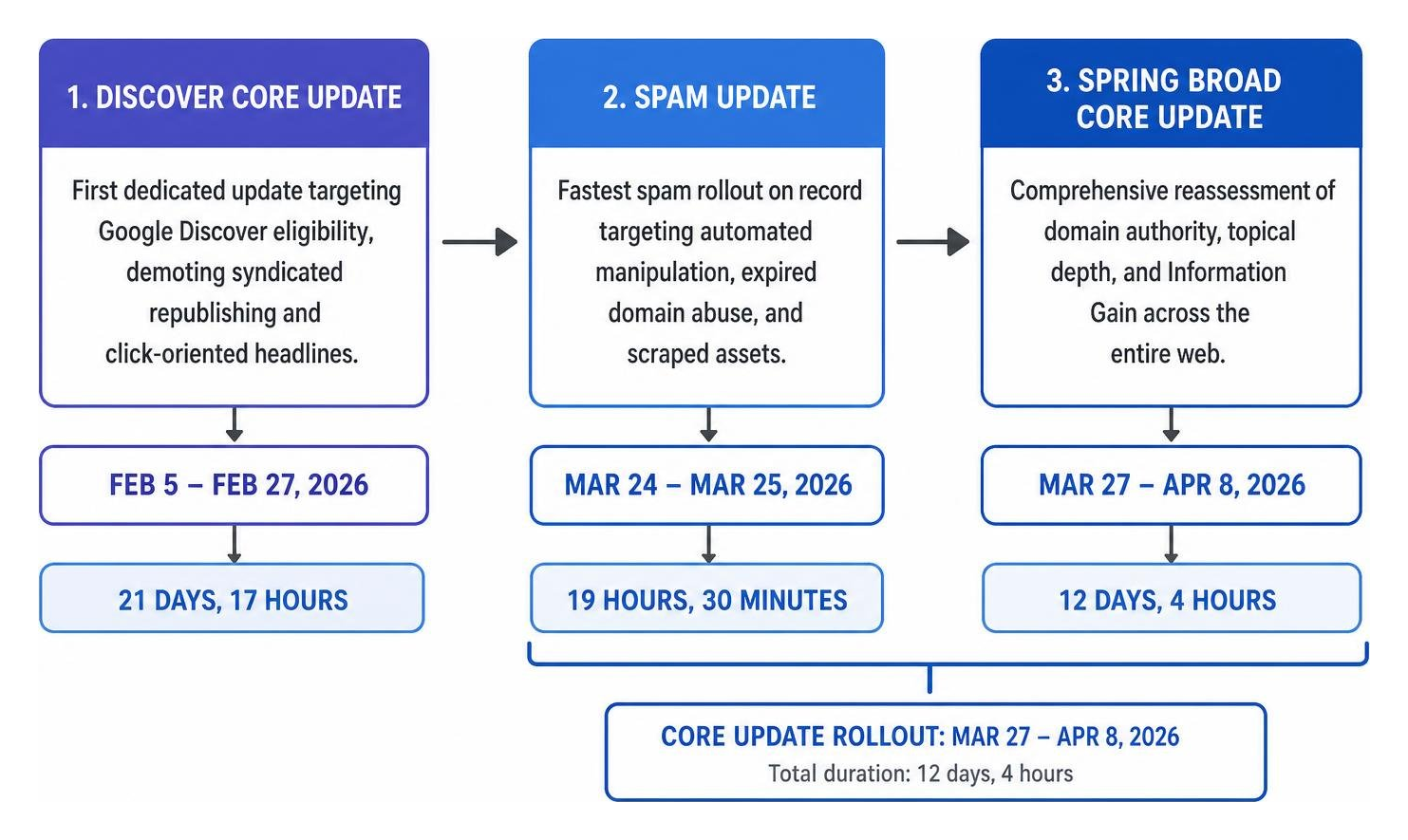
Diagnosing traffic drops in April 2026 proved unusually challenging because Google executed three significant algorithm updates across a compressed five-week window. Isolating root causes requires mapping search drops to the precise operational dates of each event:
- February Discover Core Update (Feb 5 – Feb 27, 2026): Lasting 21 days and 17 hours, this marked the first dedicated update targeting Google Discover eligibility, demoting syndicated republishing and click-oriented headlines. See the Google Developer documentation on the Discover Core Update for underlying quality guidelines.
- March 2026 Spam Update (March 24 – March 25, 2026): Completed in 19 hours and 30 minutes—the fastest spam rollout on record—targeting automated manipulation, expired domain abuse, and scraped assets.
- Spring Broad Core Update (March 27 – April 8, 2026): The comprehensive 12-day reassessment of domain authority, topical depth, and Information Gain.
Understanding these layered interactions is critical. As outlined in The Complete Guide to Understanding Google Core Algorithm Updates, if your traffic dropped sharply between March 24 and 25, your site ran afoul of spam policy filters. If your visibility migrated between March 27 and April 8, your content was evaluated under broad quality reassessment criteria.
2. Core Winners and Losers: Primary Sources vs. Thin Intermediaries
The primary structural trend of the spring 2026 update was a clear shift toward destination authorities and first-party publishers, coupled with a systematic devaluation of middleman directories, thin aggregators, and templated comparison portals.
| Industry Sector | Primary Source / Authority Winner | Visibility Change (%) | Aggregator / Intermediary Loser | Visibility Change (%) |
|---|---|---|---|---|
| Healthcare & Medical | New England Journal of Medicine / Nature | +107.3% / +41.0% | Healthgrades / WebMD | -43.5% / -16.9% |
| Government & Public Data | CISA.gov / HUD.gov / Census.gov | +101.2% / +36.2% / +30.2% | Generic Data Portals / Scraping Hubs | Dropped out of Top 50 |
| Employment & Recruiting | Direct Employer Career Hubs | Variable Gains | SimplyHired / ZipRecruiter / Glassdoor | -43.2% / -36.6% / -36.3% |
| Financial Services | Primary Lenders / Federal Reserve | +18.4% to +34.0% | LendingClub / Credit Karma | -44.0% / -40.6% |
| Travel & Hospitality | Official Airline & Hotel Portals | +12.0% to +29.5% | Travelocity / Hotwire / Expedia | -44.3% / -36.0% / -23.4% |
| Digital Media & Audio | Audible.de (German SERP sample) | +172.0% | YouTube (Organic SERP footprints) | -24.7% |
This divergence highlights a broader behavioral shift in search economics: more than 51% of all Google searches now conclude as zero-click queries. When searchers require concrete answers, Google’s systems increasingly favor primary data sources and established domain authorities over multi-layered affiliate or directory listings.
Institutional Authorities and Brand Destinations That Surged
Federal domains, research institutions, and direct brand properties saw substantial gains across both informational and high-intent transactional queries. Census.gov experienced a 30.2% visibility increase, BLS.gov gained 26.8%, and the Cybersecurity and Infrastructure Security Agency (CISA) surged by 101.2%. Peer-reviewed scientific sources like the New England Journal of Medicine (+107.3%) and Nature (+41.0%) replaced commercial health portals on complex biomedical topics.
Brand-owned digital properties holding primary product data, direct inventory, or proprietary technical documentation also gained visibility. Rather than indexing third-party review directories, search systems prioritized direct manufacturers and certified service providers who demonstrate verifiable authority in their respective fields.
Aggregators and Comparison Portals That Suffered Massive Declines
Intermediary business models that sit between the user and the end provider bore the heaviest losses. In the employment sector, SimplyHired dropped 43.2%, ZipRecruiter fell 36.6%, and Glassdoor declined 36.3%. Travel aggregators followed a similar trajectory, with Travelocity losing 44.3%, Hotwire falling 36.0%, and Expedia declining 23.4%.
In financial and healthcare sectors governed by strict Your Money or Your Life (YMYL) standards, Credit Karma lost 40.6%, LendingClub fell 44.0%, and Healthgrades declined 43.5%. These drops occurred because search algorithms demoted third-party affiliate listicles and thin lead-generation directories that provide no original underwriting, direct care, or unique data sets.
3. Ranking Factors Reweighted in the Google Core Update April 2026

The spring 2026 update re-weighted several core signals, fundamentally altering how quality is measured across both standard search listings and AI citation ecosystems. Organizations modernizing their organic search presence through Adaptive SEO Services must align their content development with these specific algorithmic criteria:
Information Gain and Proprietary Data Over Content Synthesis
Google’s ranking systems place substantial weight on Information Gain—a technical framework based on measuring the incremental new information a document provides relative to what the searcher has already encountered.
Content that merely synthesizes or summarizes the current top 10 search results without adding fresh data, proprietary testing, or experience suffered major demotions. Under modern evaluation models, a 600-word brief supported by proprietary customer benchmarks or internal laboratory metrics frequently outperforms a 3,500-word generic guide that simply rephrases existing web content.
To align with Information Gain standards, enterprise content must supply net-new value:
- Internal performance benchmarks and anonymized client case metrics.
- Direct quotes and operational methodologies from credentialed in-house specialists.
- Proprietary calculation workflows, downloadable specifications, or unique field observations.
- Concise direct answers that resolve user intent without conversational filler.
Author Entities, Verified E-E-A-T, and Generative Engine Optimization (GEO)
Algorithmic systems have tightened URL-level evaluation and author entity verification. Generic bylines such as “Editorial Staff” or unverified contributor accounts no longer carry sufficient authority in competitive sectors.
Search engines now cross-reference author identities across external knowledge bases, academic directories, industry registries, and verified professional profiles (such as LinkedIn entity graphs). Furthermore, domain authority no longer shields low-quality subpages; sub-directory parasitic SEO and unvetted third-party commercial articles suffered independent, page-level ranking demotions.
These quality factors directly shape Generative Engine Optimization (GEO). Large Language Models powering conversational search engines (such as ChatGPT, Claude, and Gemini) rely on structured, high-authority web assets for citation. Notably, research indicates that 88% of AI citation sources ignore the standard Google top 10 entirely, relying instead on topically coherent, expert-attributed source material that delivers clear, authoritative answers.
4. Strategic 5-Step Recovery and Audit Framework for Impacted Websites
If your website experienced a significant visibility decline following the spring 2026 updates, avoid making reactive, cosmetic changes. Follow this structured diagnostic and remediation framework:
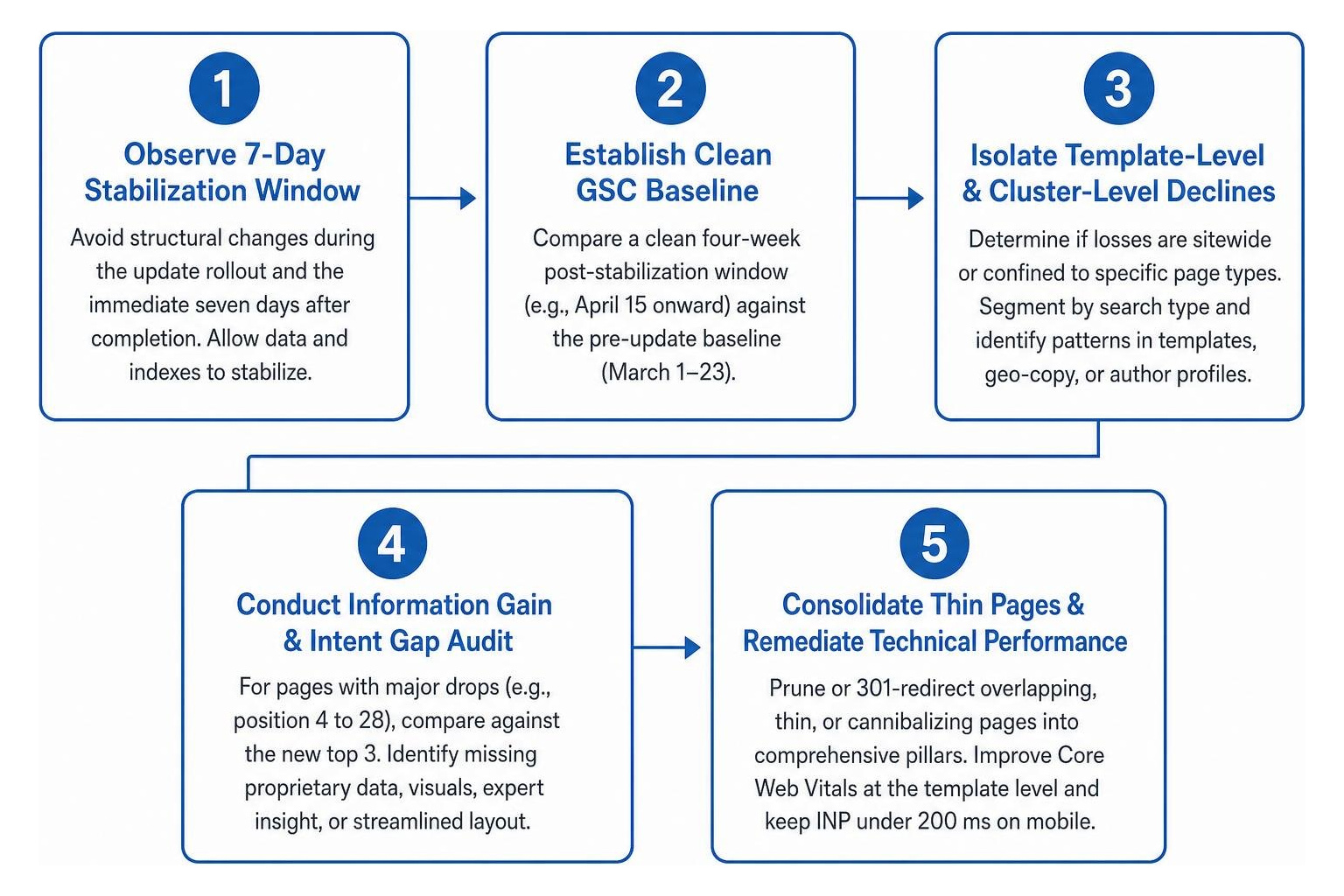
- Observe the Mandatory 7-Day Stabilization Window: Never implement structural changes while an algorithm update is actively rolling out or during the immediate seven days following its announced completion. Allow data centers and tracking indexes to stabilize before evaluating traffic changes.
- Establish a Clean Google Search Console Baseline: Filter Search Console performance reports to compare a clean four-week post-stabilization window (e.g., April 15 onward) directly against the pre-update baseline (March 1–23).
- Isolate Template-Level and Cluster-Level Declines: Determine whether losses are sitewide or confined to specific page types. In Google Search Console, segment data by search type (Web, Images, Video, Discover). Check whether declining URLs share identical page templates, thin location-specific geo-copy, or outdated author profiles.
- Conduct an Information Gain and Intent Gap Audit: For URLs suffering large ranking drops (e.g., falling from position 4 to position 28), perform a side-by-side comparison against the newly elevated top-3 competitors. Identify what proprietary data, visual evidence, expert commentary, or streamlined layout the outranking pages offer that your content lacks.
- Consolidate Thin Pages and Remediate Technical Performance: Prune or 301-redirect overlapping, thin, or cannibalizing articles into comprehensive pillar assets. Address Core Web Vitals at the template level, ensuring Interaction to Next Paint (INP) remains strictly under the 200-millisecond threshold across mobile devices.
For organizations evaluating their existing agency support or auditing resource allocation during an algorithm transition, our guide on How to Not Get Ripped Off by a Monthly SEO Retainer outlines realistic budgeting benchmarks and deliverable standards.
Frequently Asked Questions About the 2026 Search Updates
Was there an official standalone Google Core Update in April 2026?
No. There was no standalone algorithm release officially designated as the “April 2026 Core Update.” Google initiated a broad core update on March 27, 2026, which completed its rollout on April 8, 2026. The volatility observed during early to mid-April was the final phase and immediate aftermath of the March 27 release. The subsequent core update launched on May 21, 2026.
How long does it typically take to recover from a core update ranking drop?
Recovery timelines depend on the depth of required improvements and Google’s crawl cycles. While minor technical and content adjustments can reflect positively within weeks, comprehensive reassessments typically take 3 to 6 months for general business websites, and 6 to 12 months for sensitive YMYL categories (such as legal, finance, and medical services). In many instances, full visibility recovery materializes when subsequent core updates validate sustained quality improvements across the domain.
How does the spring 2026 update impact Generative Engine Optimization and AI search visibility?
The update established quality criteria that closely mirror the retrieval mechanisms used by generative AI platforms. Both Google Search and AI answer engines prioritize content that delivers clear information gain, verified author attribution, and topically clustered domain depth. Structuring technical and commercial content with clear direct answers, robust schema markup, and verifiable primary data ensures visibility across both traditional organic search and conversational AI citation engines.
Conclusion
The algorithmic shifts of spring 2026 made one reality clear: modern search systems are systematically filtering out superficial, synthetic content in favor of genuine domain authority, verifiable human expertise, and proprietary information gain. Whether navigating traditional search rankings or securing visibility across conversational AI platforms, sustainable growth requires building digital assets that serve as definitive primary resources in their fields.
At CreatiVertical, we operate as a long-term growth partner for businesses across Kansas City, Missouri, and specialized global markets. We build and execute integrated digital systems—combining high-performance web development, technical and adaptive SEO, Generative Engine Optimization (GEO), paid acquisition, and applied AI enablement. To explore our full analysis of modern ranking systems and technical search standards, consult our guide on Everything You Need to Know About Google’s New Algorithm Update to ensure your digital footprint remains resilient through every future update.