
Compare Custom Web App Development Services Before You Commit
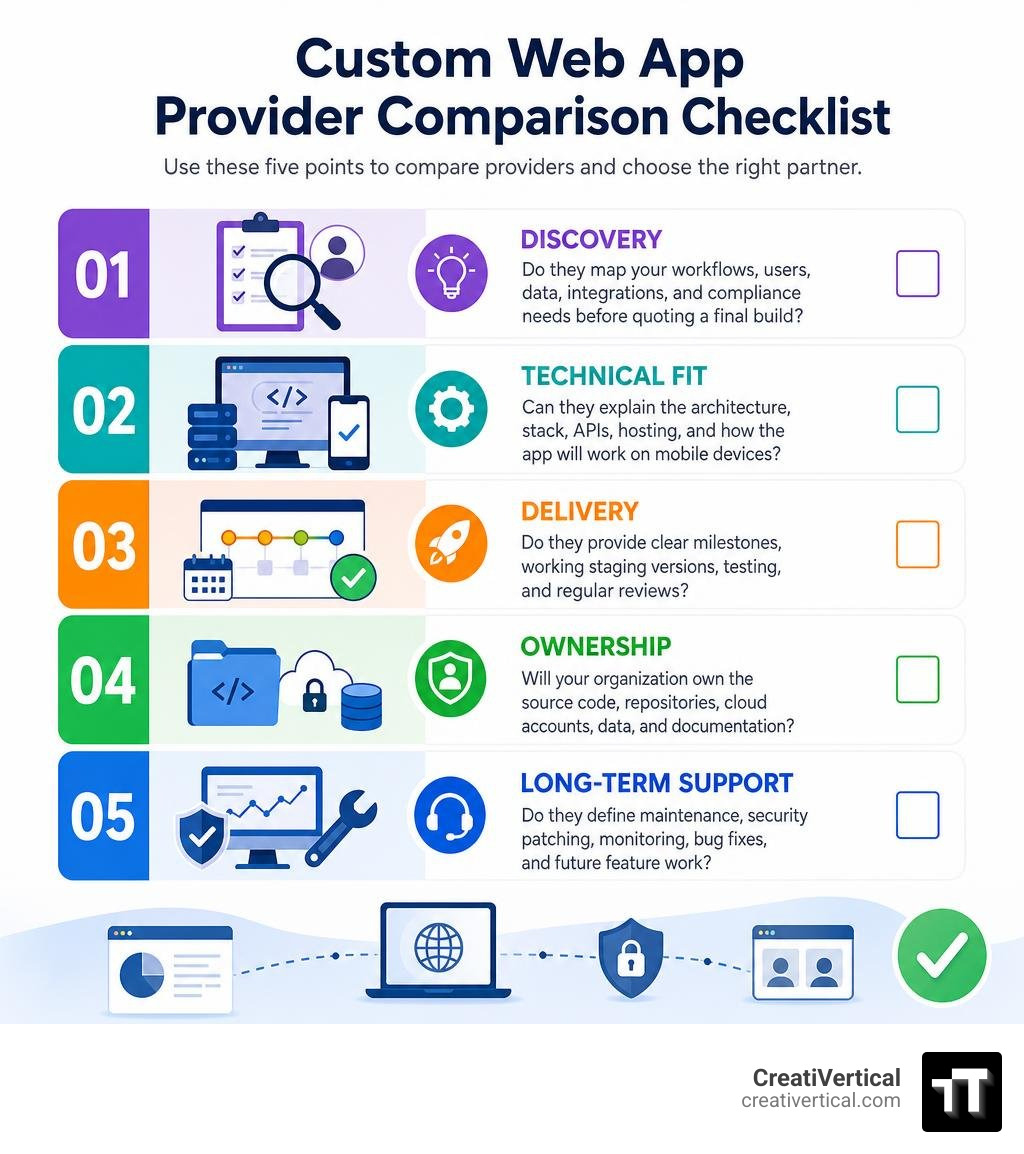
The right provider should first prove that a custom build is the right fit. Compare providers on five practical points:
- Discovery: Do they map your workflows, users, data, integrations, and compliance needs before quoting a final build?
- Technical fit: Can they explain the architecture, stack, APIs, hosting, and how the app will work on mobile devices?
- Delivery: Do they provide clear milestones, working staging versions, testing, and regular reviews?
- Ownership: Will your organization own the source code, repositories, cloud accounts, data, and documentation?
- Long-term support: Do they define maintenance, security patching, monitoring, bug fixes, and future feature work?
Custom web app development services are most useful when templates, spreadsheets, and disconnected SaaS tools no longer match how your business operates. A well-scoped web app can support customer portals, internal workflows, CRM connections, reporting dashboards, secure data access, or a new SaaS product. But a custom build is not automatically the right answer; a straightforward marketing site or simple workflow may be better served by a CMS or existing software.
For Kansas City firms, industrial businesses, offshore professional-service providers, and public-sector vendors, the real question is not “Who can build an app?” It is whether a provider can build a maintainable system that fits your business rules, connects to the tools you already use, and accounts for the security requirements that apply to your work.
I’m Nicholas Cunha, founder of CreatiVertical, with more than 20 years of agency and project experience serving businesses, institutions, and government-related organizations in Kansas City and the British Virgin Islands. I bring hands-on web development and applied AI experience to evaluating custom web app development services, with a focus on practical systems that are understandable, supportable, and aligned with real operating needs.
Related content about custom web app development services:
Core Architecture and Custom Web App Development Services
When evaluating providers, the conversation must start with foundational architecture rather than visual mockups. A custom web application is fundamentally different from a content website. While a marketing website exists to deliver information, a web app is an interactive engine that runs operational workflows, processes authenticated transactions, and enforces complex business logic across structured database schemas.
Our approach to Website Development prioritizes clean architectural separation between the presentation tier, API logic, and persistent storage layers. A dependable agency will guide you through whether your application benefits from a modular monolith or a distributed microservices pattern. While microservices allow independent scaling of discrete components, a well-structured modular monolith often avoids unnecessary infrastructure overhead and simplifies debugging for mid-market platforms.
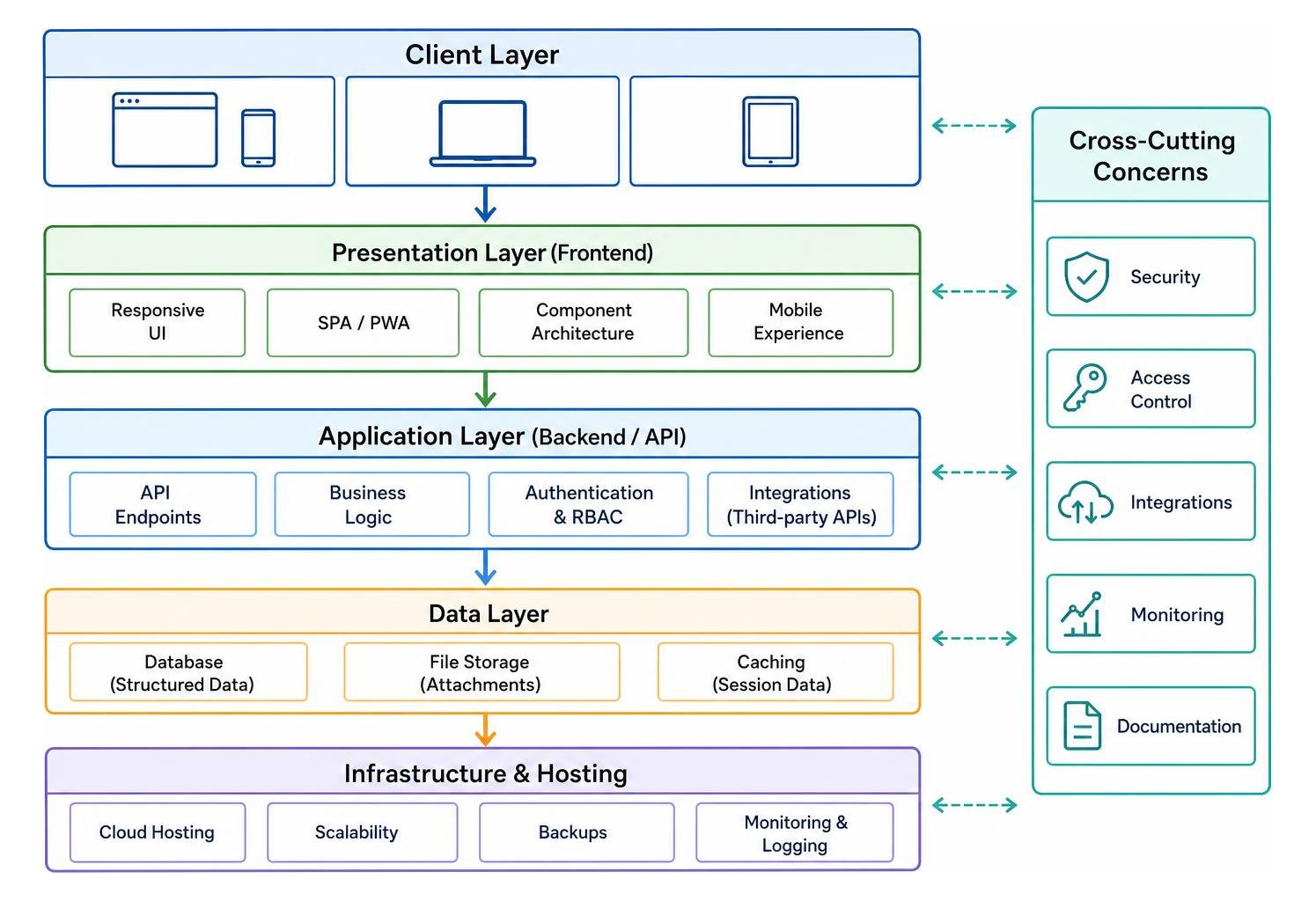
Engineering a custom system also requires clear protocols for user authentication, API integrations, and role-based access control (RBAC). If your internal operations require distinct permission tiers for administrators, operational staff, and external clients, the backend must enforce these boundaries at the database level rather than merely hiding user interface elements.
Evaluating Architecture in Custom Web App Development Services
Modern custom web applications rely on responsive, component-driven frontends paired with robust server environments. Evaluating technical fit means understanding how an agency approaches Single-Page Applications (SPAs), Progressive Web Apps (PWAs), and headless architecture:
- Single-Page Applications (SPAs): Utilizing frameworks like React, Vue, or Angular, SPAs dynamically rewrite the current web page rather than loading entire new pages from a server. This delivers fluid, desktop-like responsiveness for high-interaction portals.
- Progressive Web Applications (PWAs): PWAs bridge the gap between web applications and native mobile apps. By utilizing service workers and local caching, PWAs provide push notifications, offline capability, and rapid loading directly inside mobile browsers without app store distribution overhead.
- Headless and Decoupled Systems: Decoupling your presentation layer from backend business logic allows you to push data across multiple endpoints—such as web portals, client dashboards, and mobile extensions—using unified RESTful or GraphQL APIs.
- Multi-Tenant SaaS Systems: When building customer-facing software products, multi-tenant databases isolate customer records while sharing underlying cloud compute resources efficiently.
Frontend engineering must be matched with cross-platform stability so that complex operational systems render consistently across all mobile, tablet, and desktop viewport breakpoints.
Core Solutions Delivered by Custom Web App Development Services
Custom software should replace the friction of manual workarounds, spreadsheets, and rigid out-of-the-box software. The most common applications delivered include:
- Client-Facing Portals: Secure, authenticated gateways where clients can track project milestones, access confidential documents, review invoices, and manage service requests without manual staff intervention.
- Internal Operations Tools & Custom CRMs: Proprietary platforms engineered around exact company sales stages, project tracking, and approval hierarchies, eliminating disconnected SaaS subscriptions.
- Enterprise ERP & Workflow Automation: Centralized platforms that manage inventory tracking, automated dispatching, and equipment allocation across industrial facilities.
- Business Intelligence (BI) Dashboards: Unified analytics consoles that query multiple relational databases to compile live operational metrics, cutting down reporting cycles from hours to minutes.
- Commercial B2B SaaS Platforms: Scalable, multi-tiered platforms built from scratch with recurring subscription billing, user provisioning, and public developer APIs.
Project Timelines, Cost Modeling, and Team Delivery Models
Navigating the financial and logistical realities of software builds requires clear cost modeling and realistic scheduling. Custom web application investments vary across distinct complexity tiers. A focused MVP or simple internal operational tool requires less initial investment and scope, while mid-complexity business portals and CRMs involve deeper integration layers and more intricate permission models. Enterprise-grade platforms, legacy ERP modernizations, and multi-tenant SaaS products with rigorous compliance integrations represent the highest tier of investment due to extensive architectural, security, and concurrency demands.
Understanding What Should a New Website Cost versus a fully functional web application helps stakeholders set realistic budget bands before engaging an engineering partner.
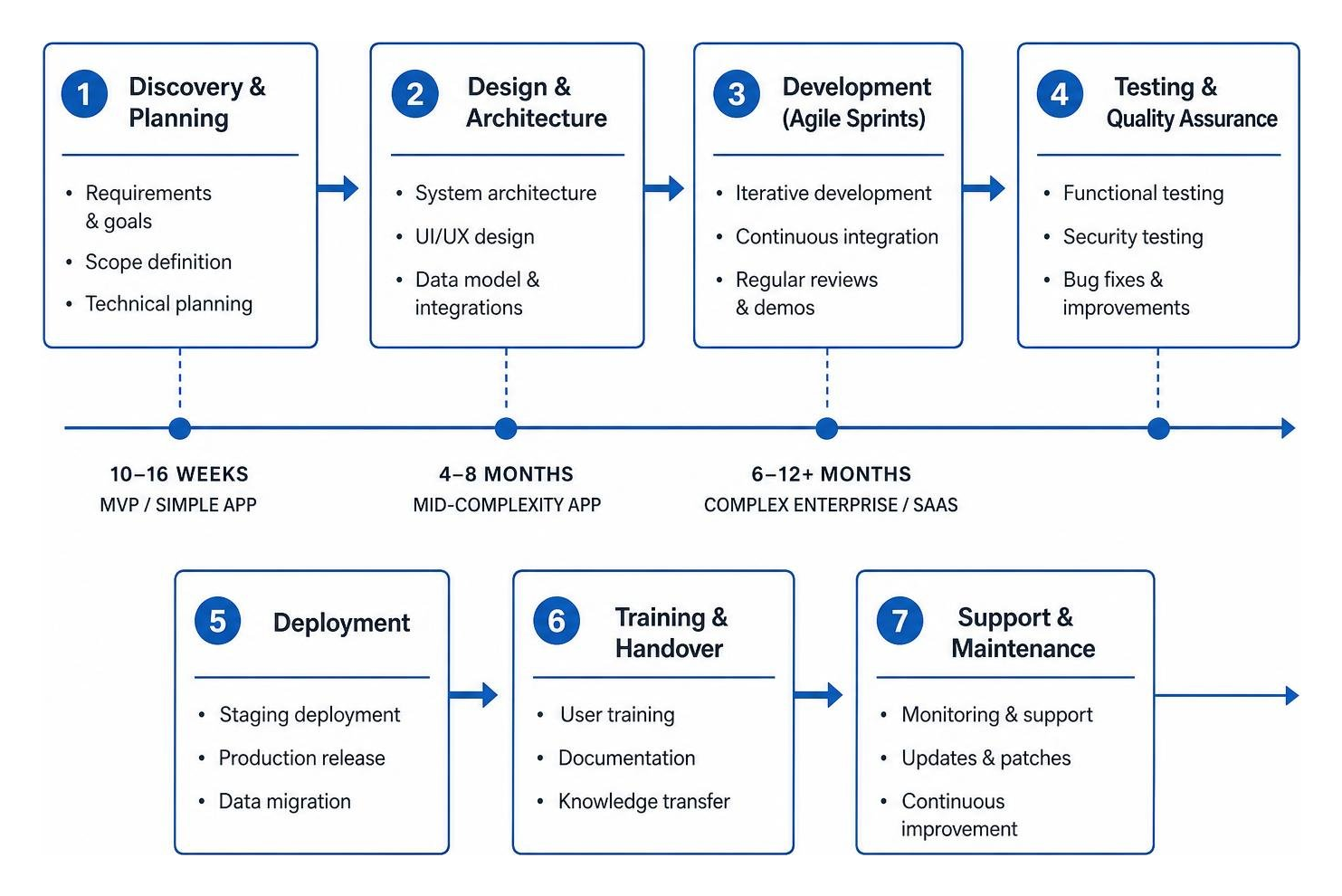
Timelines correlate directly with technical complexity, user role hierarchies, and API dependencies. A focused minimum viable product (MVP) with core CRUD functionality can take 10 to 16 weeks (roughly 3 to 4 months). Mid-tier web applications with external integrations generally require 4 to 8 months, while complex enterprise systems often span 6 to 12 months or more. For companies assessing whether to build locally or work with external squads, reviewing The Complete Guide to Outsourcing Web Application Development offers practical perspectives on risk mitigation and team structuring.
Development Phasing and Delivery Milestones
Predictable software engineering avoids monolithic waterfall releases. Reliable agencies structure development through iterative two-week Agile sprints, supported by continuous integration and automated deployment (CI/CD) pipelines to live staging environments.
Professional development cycles should include clear checkpoints:
- Discovery & Domain Modeling: Comprehensive business process mapping, API audits, data structure planning, and technical constraint discovery.
- Interactive Wireframing & UX Architecture: Prototyping user journeys, validation states, and navigation flows prior to backend engineering.
- Sprint Execution & Build Milestones: Incremental engineering across two-week sprint cycles, delivering demonstrable, testable features on staging servers.
- Automated QA & Security Hardening: Comprehensive unit testing, end-to-end regression testing, cross-browser validation, and vulnerability assessments.
- Production Deployment & Observability: Phased production rollouts, DNS and SSL configuration, telemetry monitoring, and rollback readiness.
Engagement Models, Cost Bands, and Timelines
| Complexity Tier | Typical Scope & Features | Estimated Timeline | Investment Scope | Primary Engagement Model |
|---|---|---|---|---|
| Focused MVP / Internal Tool | Single user role, simple CRUD forms, basic dashboard, 1–2 third-party API connections | 10 – 16 Weeks (2–4 Months) | Scoped Entry Tier | Fixed-Scope Milestone / Sprint-Based |
| Mid-Complexity Web Portal / Custom CRM | Multi-role permissions, automated workflows, custom reporting, payment gateways, CRM/ERP hooks | 4 – 8 Months | Mid-Range Scope | Dedicated Team / Time & Materials |
| Enterprise Platform / Multi-Tenant SaaS | High concurrency, multi-tenant isolation, legacy data migration, regulatory audits, real-time data pipelines | 6 – 12+ Months | Comprehensive Enterprise Tier | Dedicated Engineering Squad |
Evaluating Security, Compliance, and Technical Feasibility
Security cannot be treated as an afterthought or a final pre-launch checklist. It must be woven directly into the core architectural design. Custom applications must strictly adhere to the OWASP Top 10 guidelines to defend against common vulnerabilities like SQL injection, cross-site scripting (XSS), and broken access controls.
For specialized firms, compliance requirements dictate exact engineering patterns. In the public sector, aligning with Secure by Design Best Practices for FedRAMP Compliance Web Design ensures system integrity across federal standards such as NIST 800-53, FISMA, and CMMC. In healthcare, platforms handling protected health information (PHI) require end-to-end encryption at rest and in transit, comprehensive audit-ready logging, and strict HIPAA compliance.
Intellectual Property and Infrastructure Ownership
A major risk when outsourcing software development is vendor lock-in. Before signing an agreement, verify that your business retains complete, unencumbered ownership of all intellectual property, source code, and assets from day one.
- Repository Access: Source code should reside in your organization’s version control repositories (e.g., GitHub, GitLab) with direct administrative rights.
- Cloud Infrastructure Tenancy: Cloud environments (AWS, Microsoft Azure, Google Cloud Platform) should be provisioned directly under your organization’s billing accounts.
- Database Portability: Schemas, automated migration scripts, and data pipelines must allow complete database extraction without proprietary software barriers.
- Comprehensive Documentation: System architecture, API contracts, deployment runbooks, and environment variable configurations must be fully documented in writing.
Long-Term System Scaling and Integration Depth
As your business grows, your application must scale horizontally without requiring complete architectural rebuilds. Engineering teams must design data pipelines and connection points using standard RESTful APIs, GraphQL endpoints, and asynchronous webhooks.
Robust software architecture bridges modern web applications with legacy on-premise systems and external enterprise tools. Whether synchronizing inventory telemetry with industrial manufacturing backends or routing lead data to external CRMs, well-architected pipelines ensure data moves reliably without manual intervention.
Criteria for Selecting the Right Development Agency
Choosing a development partner is an important operational decision. Rather than selecting an agency based purely on visual styling, evaluate candidates on technical engineering depth, process transparency, and long-term support capabilities.
Consulting resources like 5 Tips for Choosing a Website Development Company can help structure your vendor vetting process. When reviewing candidate proposals:
- Evaluate Portfolio Functional Complexity: Look beyond cosmetic design. Ask candidates to demonstrate complex business logic, multi-role authorization models, and dynamic data filtering systems they have built.
- Demand Discovery Rigor: Avoid agencies that provide a rigid, low-cost quote before conducting a structured technical discovery phase. Discovery is essential for clarifying edge cases, data flows, and security requirements.
- Verify Code Quality and Engineering Standards: As outlined in Stop Settling for Bad Code Your Guide to KCs Top Web Developers, prioritize teams that enforce mandatory peer code reviews, automated linting, containerized environments (Docker), and automated testing suites.
- Assess Communication and Reporting Cadence: Ensure the agency provides dedicated project management, bi-weekly sprint demos, staging environment access, and transparent issue tracking.
Post-Launch SLA and Managed Support Frameworks
Software development does not end at production deployment. Custom web applications require continuous monitoring, regular vulnerability patching, and ongoing performance tuning to maintain stability.
Establishing a reliable framework with Website Maintenance Support in Kansas City ensures your business has defined Service Level Agreements (SLAs) for incident response times, scheduled security updates, automated database backups, and regression testing as third-party APIs evolve. In general, organizations should budget a predictable portion of the original build cost annually to cover ongoing maintenance, infrastructure optimization, and continuous feature enhancements.
Frequently Asked Questions about Custom Web App Development
What is the difference between a custom web app and a progressive web app (PWA)?
A custom web application is any database-driven software that runs in a web browser, executing business logic and processing transactions over the internet. A Progressive Web App (PWA) is a specific type of web application built using modern browser APIs, service workers, and manifest files.
PWAs provide native mobile app-like experiences directly through web browsers—including offline access, home screen installation, background data synchronization, and push notifications—without requiring users to download software from an app store.
How do custom web apps integrate with existing enterprise tools?
Custom web applications connect to existing enterprise tools through secure API layers, webhook endpoints, and dedicated database connectors. By utilizing modern RESTful architectures or GraphQL endpoints, your web application can send and receive real-time data from platforms such as Salesforce, HubSpot, SAP, QuickBooks, or custom internal ERPs.
This automated data exchange eliminates manual entry, prevents duplicate records, and ensures consistency across your entire operational toolset.
Who owns the source code and intellectual property after deployment?
With a professional custom development agreement, your company should retain 100% full ownership of all source code, database architectures, digital assets, and intellectual property upon payment.
All repositories, cloud hosting environments, DNS configurations, and deployment pipelines should be established directly within your company’s accounts to guarantee zero vendor lock-in, full data sovereignty, and complete freedom to maintain or transition the codebase in the future.
Conclusion
Selecting the right development partner requires looking beyond surface-level aesthetics and evaluating engineering rigor, discovery depth, architectural scalability, and clear ownership agreements. When properly planned and executed, custom software eliminates operational bottlenecks, protects proprietary business logic, and provides an enduring digital foundation built for growth.
At CreatiVertical, we engineer performance-driven digital platforms, custom web applications, applied AI workflows, and secure web systems for Kansas City businesses, industrial manufacturers, offshore fiduciary providers, and compliance-driven organizations. Explore our full approach to Website Development to see how we build maintainable systems tailored around your operational needs.