
What is AI Search Visibility and Why Traditional SEO Falls Short in 2026
If you run a B2B business, an industrial manufacturing plant, or a specialized offshore legal practice, your buyer’s journey doesn’t look like it did three years ago. Today, more than 60% of Google searches terminate without a single click. Instead of scrolling through ten blue links, buyers are asking conversational AI engines to summarize options, compare features, and build shortlists for them.
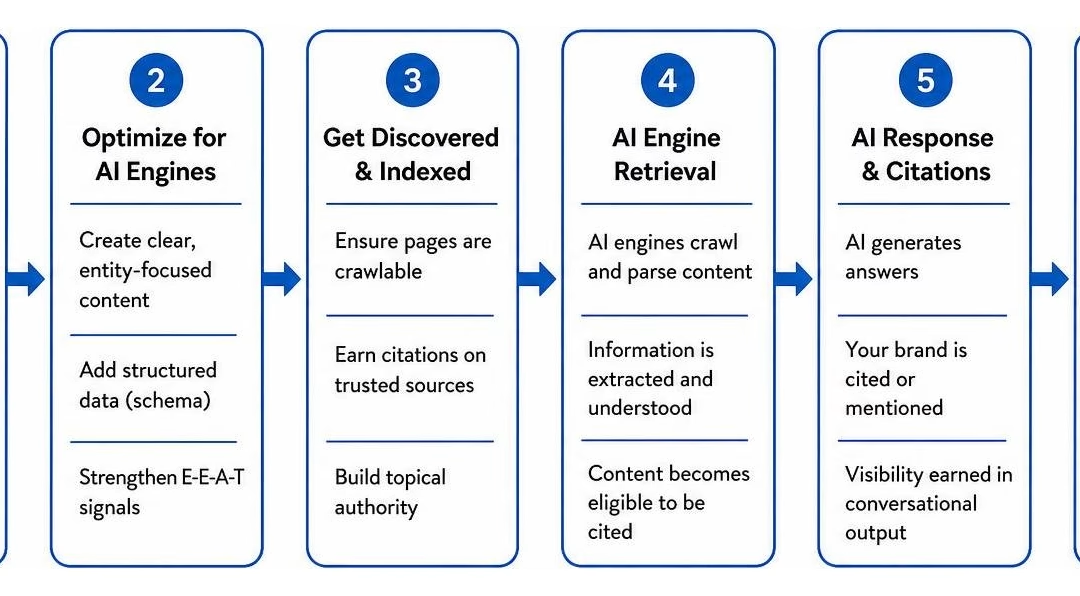
This shift has created a massive blind spot for classic search marketing. Traditional SEO tools are built to measure where your website ranks in a list of search results. But AI engines don’t rank URLs; they synthesize information. They scan millions of data points, extract specific paragraphs, and write a custom response. If your brand is not cited or mentioned inside that conversational output, you are completely invisible to the buyer.
This is why we focus heavily on Generative Engine Optimization (GEO). To win in this landscape, you have to understand how LLM crawlers like OpenAI’s GPTBot and PerplexityBot access and parse your site. If these crawlers are blocked, or if your content is structured in a way that machines cannot easily synthesize, your brand will be left out of the answer entirely. To map out how your buyers navigate this new landscape, explore The Ultimate Guide to Buyer Journey SEO.
The Shift from SERP Rankings to Generative Engine Optimization (GEO)
Traditional SEO is built on keyword optimization and backlink volume. GEO, however, relies on entity ranking, semantic content planning, and structured data. AI engines look for clear, authoritative, and consistent declarations of facts across trusted web sources. They prioritize content that answers specific user intents directly and concisely, often pulling from structured tables, bulleted lists, and clear schema markup.
For example, an industrial lubricant manufacturer might rank first on Google for a technical term, but when Claude or ChatGPT is asked to recommend a supplier with specific environmental certifications, the AI may cite a competitor instead. This happens because the competitor’s site has better semantic structure, clear entity associations, and accessible data tables that the AI can easily extract. To bridge this gap, we help brands transition to modern framework adjustments outlined in our guide on Adaptive SEO Services: The Ultimate Guide to Staying Ahead of Google.
The Best Tools for Monitoring AI Search Visibility SEO 2025 2026
To keep your brand visible across conversational search platforms, you need specialized software. Relying on traditional keyword trackers is like trying to measure wind speed with a ruler.

The best tools for monitoring AI search visibility SEO in 2025 and 2026 run thousands of prompts across different LLMs to see when and how your brand is mentioned. They analyze the sentiment of those mentions, track which specific pages are being cited, and compare your “share of voice” against your direct competitors. For a deeper look at the software landscape, read our breakdown of The Ultimate Tools to Keep Your Brand Visible Across AI Search Platforms.
Purpose-Built GEO Platforms: ZipTie, Evertune, and Rankflo
These platforms were built from the ground up specifically for the AI search era. They do not treat LLM tracking as an afterthought or a “bolt-on” feature.
- ZipTie: Highly favored by marketing leaders who want actionable insights over raw data. Starting at $69/month, ZipTie runs real-time frontend queries across consumer interfaces to show you exactly what your prospects see. It helps you identify which content pieces are generating citations and where your site has crawlability issues.
- Evertune AI: An enterprise-grade powerhouse that recently raised $19M in funding. Built by early team members of The Trade Desk, Evertune leverages a 25-million-person consumer panel and tracks AI responses across 33 languages and 140 countries. It is designed for massive, multi-brand portfolios that need deep statistical validation.
- Rankflo: Excellent for tracking AI crawler logs and real-time visitor analytics. Rankflo crawls data every 72 hours, showing you how bots like GPTBot or Gemini’s crawler discover and interpret your site. It is highly effective for technical teams who want to make sure their server architecture isn’t accidentally blocking AI search engines.
To understand what to look for in these specialized systems, you can review the detailed AI Search Monitoring Tool Features | OtterlyAI Platform .
Integrated SEO Suites: SEOcrawl AI and SEObolt
If you prefer to manage your traditional search rankings and your AI visibility inside a single dashboard, these integrated suites are excellent options.
- SEOcrawl AI: This platform successfully bridges the gap between classic SEO and GEO. Starting at €33/month, it connects directly to your Google Search Console and Google Analytics 4 via OAuth. It segments and normalizes the actual referral traffic sent to your site from ChatGPT, Claude, Perplexity, Gemini, and Copilot, allowing you to tie your AI search optimization directly to real visitor data.
- SEObolt: Priced from $29/month, SEObolt provides a comprehensive dashboard featuring 26 distinct SEO and GEO tools. It introduces a proprietary “GEO Score” based on 37 factors across six categories (derived from peer-reviewed research from Princeton and Georgia Tech). It also includes a built-in
llms.txteditor, making it incredibly easy to guide AI crawlers. For more secrets on growing your organic footprint, check out Organic Traffic Growth Secrets Your Competitors Hope You Never Find.
Enterprise and Agency Powerhouses: Profound and Peec AI
For large agencies and enterprise teams managing multiple clients or massive product catalogs, reporting and client management features are critical.
- Profound: A highly robust data platform designed for Fortune 500-scale teams. While its enterprise pricing is reportedly $4,000+/month per user, it offers unique “pitch environments.” These allow agencies to audit a prospect’s AI visibility before a sales call, making it a powerful tool for winning new business.
- Peec AI: Having raised $21M in Series A funding, Peec AI has worked with over 1,300 brands. Starting at $97/month, it offers strong geographic capabilities and deep research tools. For example, Wix reportedly achieved a 5x traffic increase using Peec AI for strategy prioritization.
If you are a business owner in the Kansas City metro looking to implement these enterprise-grade strategies locally, we can help you navigate these tools through our targeted SEO Services in Kansas City.
How to Evaluate and Choose Your AI Tracking Stack
Selecting the right tool depends on your organizational scale, technical resources, and budget. For a small B2B firm or a local professional service provider, a lightweight tool like SEObolt or OtterlyAI is often more than enough. For an enterprise manufacturer or a multi-jurisdictional law firm, a platform with deep API access, automated sentiment analysis, and robust crawler log monitoring is essential.
When evaluating these tools, look closely at their data gathering methodology. Some low-cost tools rely purely on API-only monitoring, which can miss real-time web-browsing data and show different results than what a human user actually sees on their screen. Frontend monitoring of consumer interfaces is generally more accurate but can be more expensive. To ensure your underlying site health is strong enough to support these advanced integrations, read The Ultimate Guide to a Painless Backlink Profile Audit.
Key Features of the Best Tools for Monitoring AI Search Visibility SEO 2025 2026
The right platform should do more than just count brand mentions. Look for these essential features to ensure you are getting actionable intelligence:
- Citation Tracking: The tool must trace AI mentions back to specific source URLs. This tells you which of your pages (or third-party directories) are driving your visibility.
- Sentiment Analysis: Is the AI recommending your product enthusiastically, mentioning it with caveats, or dismissing it entirely?
- Misinformation Detection: LLMs are prone to “hallucinations.” Your monitoring tool should alert you immediately if an AI engine is quoting incorrect pricing, misrepresenting your services, or attributing your features to a competitor.
- AI Crawler Log Analysis: The platform should monitor your server logs to show you how often bots like PerplexityBot or GPTBot are indexing your site.
- llms.txt Management: A built-in editor to manage your
llms.txtfile, which acts as a structured roadmap for AI bots.
For a deeper dive into preparing your site’s structure for modern search technologies, read How to Optimize Your Website for Voice Search Before Your Competitors Do.
Comparing the Best Tools for Monitoring AI Search Visibility SEO 2025 2026 by Use Case
To help you decide, we have mapped out the ideal use cases for these tools based on business size and objective:
- For Enterprises: Profound or Evertune AI. These platforms offer the compliance, scale, and multi-model tracking necessary to safeguard global brand reputation and monitor complex competitor landscapes.
- For Marketing Agencies: Peec AI or Profound (Agency Plan). The inclusion of Looker Studio integrations, white-label reporting, and pre-sales pitch environments make these tools indispensable for client management.
- For SMBs and In-House Teams: SEOcrawl AI, SEObolt, or ZipTie. These tools offer the best balance of price, ease of use, and actionable content recommendations without requiring a massive enterprise budget.
Frequently Asked Questions about AI Search Visibility
What is the difference between AI visibility tools and traditional SEO tools?
Traditional SEO tools measure your keyword rankings and backlink profiles for search engines that display list-based links. AI visibility tools measure whether, where, and how your brand is mentioned inside synthesized, conversational answers across LLMs. They focus on citation rates, share of voice within AI responses, and brand sentiment rather than numerical SERP positions.
Can I use Google Search Console to track AI search visibility for free?
Yes, but only partially. Google Search Console is the strongest free option for tracking traffic from Google AI Overviews, as it records real impressions and clicks. However, it cannot track your visibility inside non-Google engines like ChatGPT, Claude, or Perplexity. For those, you must combine GSC data with manual prompt monitoring or dedicated GEO tracking software.
How quickly can a brand expect to see results from GEO strategies?
While traditional SEO can take months to show results, simple GEO strategies—such as implementing structured schema, adding verifiable statistics, and publishing clear Q&A content structures—can improve your visibility in generative engine responses by up to 40% in a matter of weeks. Because AI search engines crawl and synthesize trusted data rapidly, structured content optimizations tend to be recognized much faster than traditional link-building campaigns.
Conclusion
The search landscape has fundamentally changed. Winning the organic search game in 2026 is no longer just about ranking first on Google; it is about being cited as an authoritative recommendation by the AI models your buyers trust.
At CreatiVertical, we don’t just hand you a dashboard and leave you to figure it out. We act as your ongoing growth partner, helping you build, promote, and maintain complete digital systems. Whether you are a Kansas City local business, an offshore professional service firm in the Caribbean, an industrial B2B manufacturer, or a government-facing tech vendor, we can help you implement custom AI agents, workflow automation, and robust GEO strategies to keep your brand visible.
If you’re ready to stop guessing what ChatGPT and Gemini are saying about your business, explore our guide on the Best AI Tools for SEO 2025 or reach out to us today to chart your course.