

How to Evaluate FedRAMP Compliant AI Agents
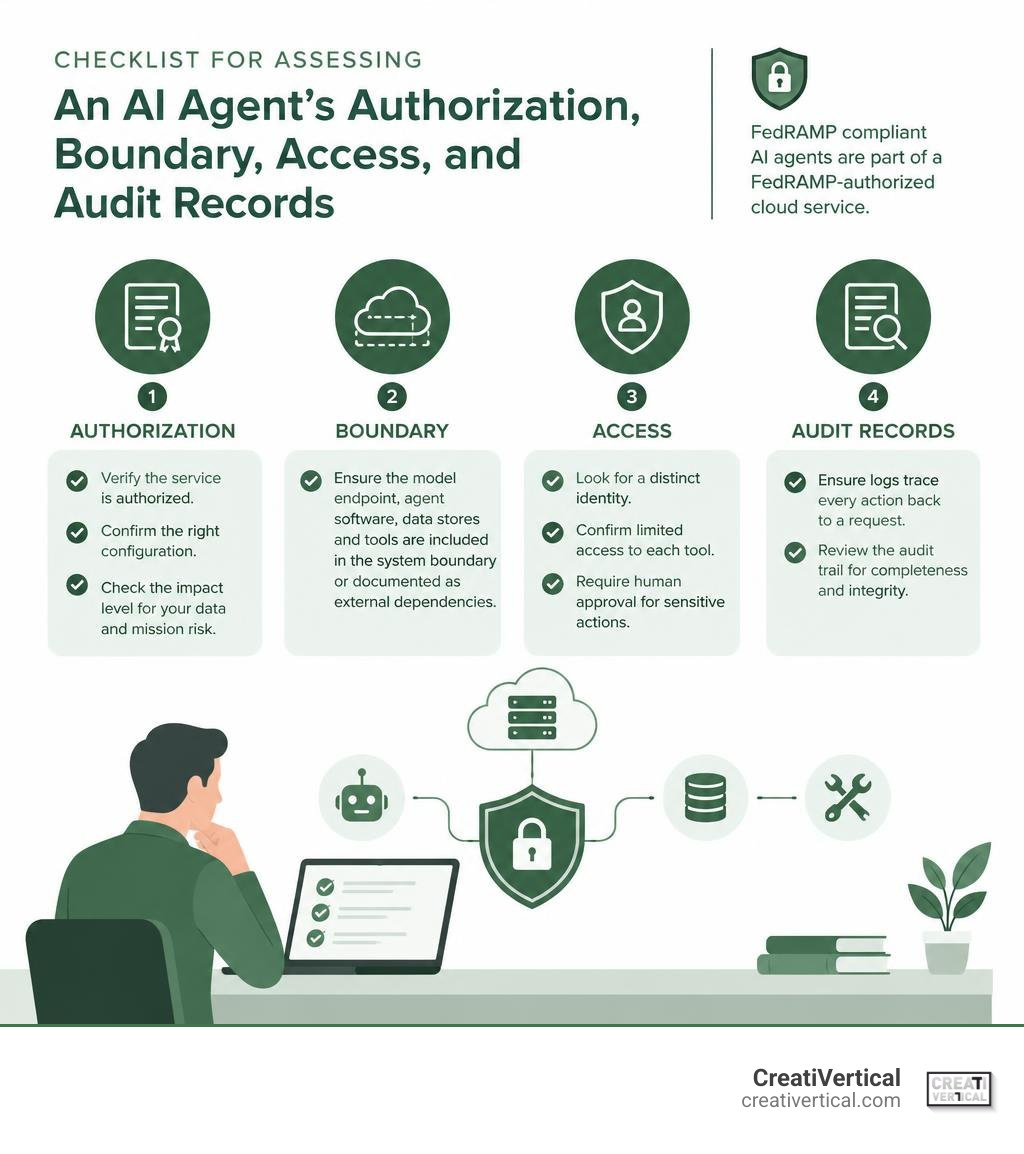
FedRAMP compliant AI agents are part of a FedRAMP-authorized cloud service, not separately certified agents. Before choosing one, verify the authorization for the specific service and configuration you plan to use. Then check that the model endpoint, agent software, data stores, and connected tools are covered by the assessed system boundary or documented as external dependencies. The required impact level depends on the data and mission risk, not the fact that the service uses AI.
For federal contractors, the next question is what the agent can do. Look for a distinct identity, limited access to each tool, human approval for sensitive actions, and logs that trace every action back to a request. This guide walks through those checks and the evidence you’ll need to review.
I’m Nicholas Cunha, founder of CreatiVertical. I’ve spent more than 20 years building digital projects, including work for government bodies, and now build production AI agents and automation; I’ll use that practical lens to explain how to evaluate FedRAMP compliant AI agents without claiming that an agent alone carries an authorization.
Essential FedRAMP compliant AI agents terms:
FedRAMP Baselines and Impact Categorization for Autonomous AI
Deploying automated systems within the federal market requires navigating the Federal Risk and Authorization Management Program (FedRAMP). Federal agencies reported more than 3,600 AI use cases across 41 agencies in the 2025 inventory cycle. However, governance often lags behind adoption. For example, a USDA Office of Inspector General audit revealed that 73 of 82 operational AI use cases went live without an approved Authority to Operate (ATO).
Understanding how to adopt FedRAMP compliant AI services requires evaluating the system through the lens of Federal Information Processing Standards (FIPS) Publication 199.
Determining FIPS 199 Impact Levels for Agentic Workflows
FIPS 199 categorizes federal information systems based on the potential impact of a security compromise across three objectives:
- Confidentiality: The unauthorized disclosure of data.
- Integrity: The unauthorized modification or destruction of data.
- Availability: The disruption of access to or use of information.
Autonomous agents introduce new dynamics to this assessment. Unlike static software, an agent actively interacts with tools, modifies database entries, executes scripts, and invokes third-party Application Programming Interfaces (APIs). If an agent possesses write access to federal records, an integrity failure could cause system-wide data corruption. Consequently, systems operating with autonomous decision loops are often categorized under Moderate or High baselines.
Low vs Moderate vs High Impact Baselines
The National Institute of Standards and Technology (NIST) Special Publication (SP) 800-53 Revision 5 defines the specific controls required across each baseline:
- Low Impact Baseline: Suitable where the loss of confidentiality, integrity, or availability causes limited harm. Typical examples include public-facing information search bots.
- Moderate Impact Baseline: Required when handling Controlled Unclassified Information (CUI), Personally Identifiable Information (PII), or operational financial records. A FedRAMP Moderate boundary inherits 161 NIST SP 800-53 Rev 5 controls, addressing deeper identity governance and audit logging.
- High Impact Baseline: Protects mission-critical data, healthcare infrastructure, and emergency operations. FedRAMP High inherits 410 controls, demanding segregated infrastructure such as dedicated government cloud regions.
Federal agencies evaluate these systems following official FedRAMP AI Program Guidelines to ensure risk parity across public-sector operations.
Architectural Boundaries for FedRAMP Compliant AI Agents
The most critical factor in achieving compliance is properly scoping the system authorization boundary. An authorization boundary defines every hardware component, software component, data flow, and external API connection supporting the Cloud Service Offering (CSO).
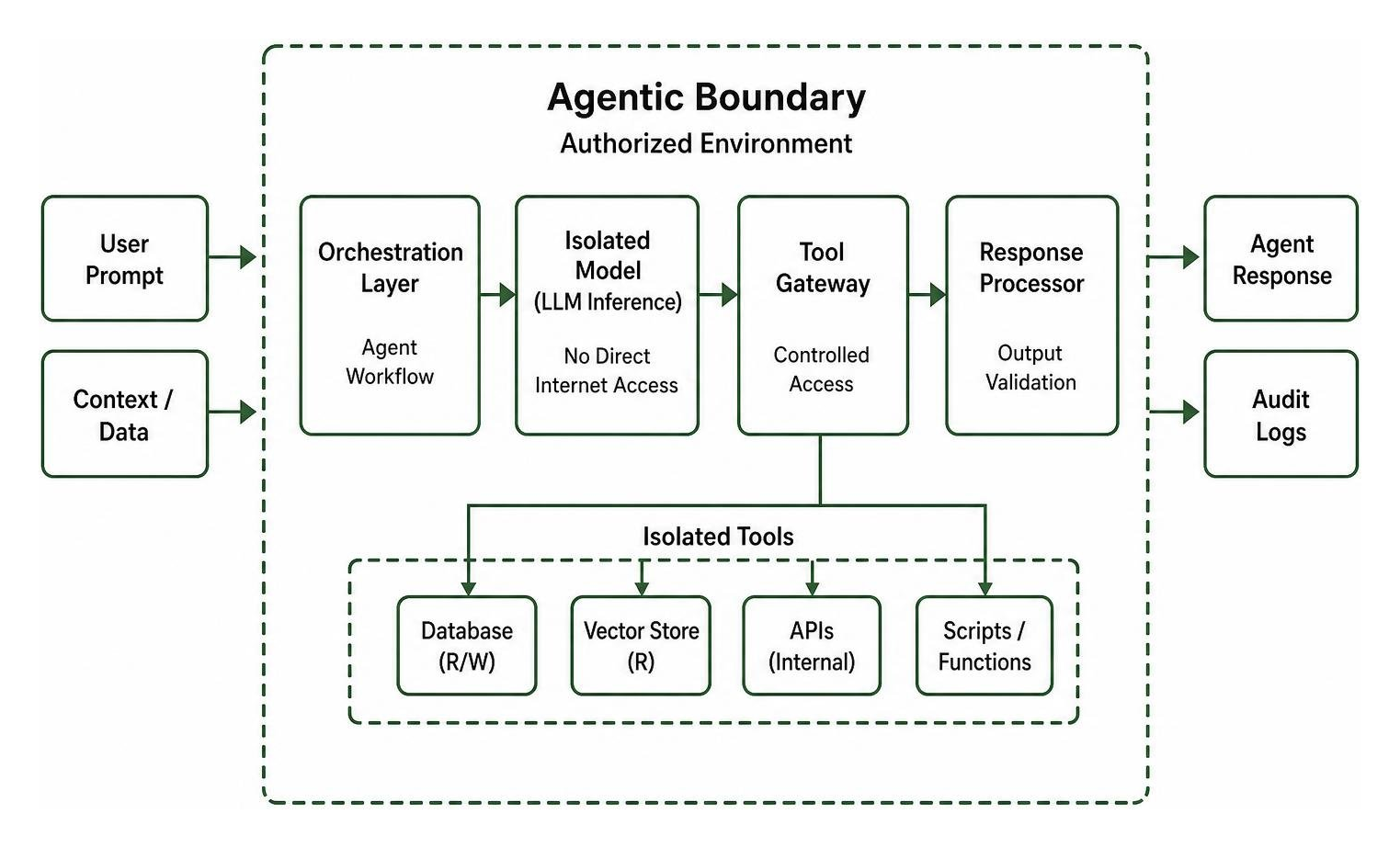
When evaluating secure-by-design compliance architectures, every element that touches federal prompts, context, or tool outputs must reside inside an authorized environment.
Scoping Inference Endpoints, Vector Stores, and Orchestration Layers
An autonomous agent is rarely a single monolithic application. It functions as a pipeline of interacting components:
- The Foundation Model & Inference Endpoint: The Large Language Model (LLM) processing tokens must operate within the authorized boundary. Calling a commercial API that routes data through unassessed public infrastructure breaches the boundary.
- Vector Stores & Retrieval-Augmented Generation (RAG): Databases storing document embeddings contain sensitive source data. Vector stores, indexing pipelines, and embedding models must be explicitly scoped and assessed.
- The Orchestration Layer: The software coordinating reasoning loops (e.g., LangChain or custom orchestration engines) makes runtime execution decisions and requires strict boundary documentation.
- Tool Integrations and Model Context Protocol (MCP) Servers: Tool execution endpoints that interface with external APIs must employ verified mutual authentication and least-privilege scoping.
Minimum Assessment Scope and the 2026 Consolidated Rules
The FedRAMP Consolidated Rules for 2026 introduce stricter expectations for external interconnections. If an AI agent interacts with third-party software as a service (SaaS) platforms, those external platforms must hold their own FedRAMP authorization or be comprehensively evaluated as connected external services within the primary System Security Plan (SSP).
Non-Person Entity (NPE) Governance and NIST SP 800-53 Rev5 Controls
AI agents do not act merely as passive software applications; they operate as Non-Person Entities (NPEs). When an agent automates workflows across enterprise systems, it functions like an automated digital employee.

Implementing secure AI workflow automation requires mapping operational capabilities directly to NIST SP 800-53 Rev 5 control families.
Implementing Access Controls for FedRAMP Compliant AI Agents
The Access Control (AC) and Identification and Authentication (IA) families set strict rules for NPEs:
- AC-2 (Account Management): Every AI agent must be registered as a first-class identity in a central directory, complete with a designated human owner accountable for its operational lifecycle.
- AC-3 (Access Enforcement) & AC-6 (Least Privilege): Static, long-lived API keys are prohibited. Agents must rely on scoped, short-lived delegated tokens. If an agent only needs to read a database, it must not possess write or schema-alteration permissions.
- Runtime Kill-Switches: Administrative controls must allow operators to instantly sever an agent’s access tokens if it exhibits behavioral drift or unexpected tool calls.
Audit Trails and System Integrity (AU and SI Families)
Audit and Accountability (AU) presents significant compliance considerations for agent systems. If a parent agent delegates a task to multiple sub-agents, standard logs can lose the lineage of execution.
To satisfy controls like AU-2 and AU-6, platforms must generate an immutable, tamper-evident audit record capturing:
- The human user who initiated the request.
- The system prompts and context supplied to the agent.
- The intermediate reasoning and decision policy evaluations.
- The specific parameters and target endpoints of all executed tool calls.
Additionally, SI-10 (Information Input Validation) requires proactive defenses against direct and indirect prompt injection attacks. System architectures must sanitize untrusted citizen inputs and external document uploads before supplying them to model context windows.
Configuration Management and Continuous Monitoring
Under CM-2 (Baseline Configuration) and CM-3 (Configuration Change Control), organizations must version-control system prompts, agent tool registries, model weights, and orchestration logic. Uncontrolled prompt tweaks in production invalidate baseline documentation and introduce compliance gaps.
Fast-Tracking Authorization: Inheritance and Pre-Authorized Platforms
Traditional FedRAMP authorizations frequently take between 12 to 36 months and cost upwards of $3.5 million to complete from scratch. For modern GovTech software vendors, building an independent infrastructure boundary is rarely efficient.
Instead, vendors can fast-track their ATO through control inheritance and pre-authorized hosting platforms, building upon proven FedRAMP compliant web hosting foundations.
Control Inheritance from Authorized IaaS and PaaS
By deploying agent applications on authorized Infrastructure as a Service (IaaS) and Platform as a Service (PaaS) providers—such as AWS GovCloud or Microsoft Azure Government—vendors inherit the underlying physical, facility, and environmental controls.
- FedRAMP Moderate: Inherits up to 161 underlying controls.
- FedRAMP High: Inherits up to 410 baseline infrastructure controls.
This shared responsibility model allows software providers to concentrate solely on application-layer governance, data protection, and agent decision monitoring.
Accelerated Paths to Authority to Operate (ATO)
Emerging automation platforms and specialized pre-authorized hosting enclaves drastically reduce entry barriers. Modern pre-authorized system boundaries, such as those provided by Knox Systems, can guide SaaS vendors to an authorization in approximately 90 days at roughly 90% less cost than traditional custom builds by inheriting 60% to 80% of required NIST SP 800-53 Rev 5 controls.
Furthermore, programmatic documentation using machine-readable Open Security Controls Assessment Language (OSCAL) JSON formats aligns with modern automated continuous monitoring expectations.
Evaluating Authorized Federal AI Platforms and GovTech Solutions
Federal agencies and prime contractors have access to an expanding ecosystem of authorized AI solutions designed to streamline mission workflows.
Evaluating FedRAMP Compliant AI Agents Across Marketplace Vendors
FedRAMP launched its formal AI Prioritization Initiative in August 2025, completing the accelerated assessment of high-demand platforms by April 2026. This framework prioritized enterprise-grade features including role-based access control (RBAC), Single Sign-On (SSO), System for Cross-domain Identity Management (SCIM) provisioning, and strict tenant isolation.
As documented in the official Google Agentspace authorization overview, modern platforms maintain strict data residency guarantees, assuring that customer prompts, search queries, and agency data are never repurposed to train foundation models without explicit permission.
Real-World Agency Workflows and Efficiency Benchmarks
Federal contractors and agencies deploy authorized agent platforms to resolve operational bottlenecks across diverse departments:
- IT Support and Incident Management: Leidos documented a 180X reduction in support resolution time after deploying Moveworks. Similarly, MANTECH projected a 52% cut in Tier-1 support costs by automating routine ticketing workflows.
- Enterprise Search Consolidation: Internal research shows that roughly 89% of employees must search up to six different sources to locate the information required for their daily tasks. Secure agentic search unifies these silos while respecting existing access permissions.
- Public Administration & Citizen Services: Municipal and federal programs use compliant agents to automate permit reviews, benefits pre-qualification screening, and FOIA document processing, reducing administrative backlogs by 45% to 55%.
Frequently Asked Questions about FedRAMP AI Compliance
Can federal contractors use commercial AI APIs through standard commercial endpoints?
No. Standard commercial API endpoints transmit data through multi-tenant, unassessed public infrastructure that falls outside federal compliance boundaries. Federal agencies and contractors handling regulated data must use specifically designated and assessed government offerings (such as Azure OpenAI Service within Government regions or dedicated GovCloud endpoints) that hold formal FedRAMP certification.
What is the biggest audit risk when deploying autonomous AI agents in federal systems?
The most prevalent audit vulnerability is unattributable action chains. When an AI orchestrator delegates tasks across multiple sub-agents and tool calls, traditional logging frequently fails to connect the final database write or external API call back to the authenticated human initiator. To pass third-party audits, every agent action must produce an immutable record linking the human actor, policy decision, input prompt, and executed output.
Does FedRAMP authorization evaluate the underlying foundation model or the entire software stack?
FedRAMP evaluates the complete Cloud Service Offering (CSO), not a standalone foundation model or algorithmic neural network in isolation. The assessment covers the model weights, inference hosting servers, data transmission pipes, database stores, web interfaces, authentication modules, and maintenance procedures. A model hosted inside an unassessed wrapper remains non-compliant.
Conclusion
Integrating automated systems into federal operations unlocks efficiency gains, but it requires strict alignment with federal security baselines. Deploying compliant AI workflows means treating agents as governed, non-person entities operating inside rigorously defended system boundaries.
At CreatiVertical, we engineer complete, reliable digital systems—combining technical enablement, secure web architecture, and digital strategy. Whether you are mapping out public-sector applications or modernizing core operations, we help you chart a dependable path forward. Explore our approach to performance web systems and AI development to build scalable, compliant infrastructure for your organization.