

Why Generic B2B Agencies Fail Machinery and Precision Parts Manufacturers
Industrial manufacturer SEO services are specialized search optimization programs built for companies that make and sell complex physical products — machined parts, precision equipment, industrial chemicals, lubricants, batteries — to buyers like procurement officers, design engineers, and OEM sourcing teams.
If you’re evaluating your options, here’s what to know upfront:
What industrial manufacturer SEO services typically include:
- Technical SEO for large, complex product catalogs (SKUs, specs, faceted navigation)
- Keyword research targeting spec-driven, high-intent queries used by engineers and procurement teams
- Content strategy mapped to long B2B sales cycles and buying committees
- Schema markup so search engines and AI tools can read your product data
- Link building through trade publications and industry directories
- AI search visibility (GEO/AEO) so your brand gets cited by ChatGPT, Perplexity, and Google AI Overviews
- RFQ conversion optimization — turning qualified traffic into actual quote requests
Who needs it: Manufacturers with technical products, niche audiences, and long sales cycles — where a generic agency’s “traffic growth” dashboard means nothing if it isn’t generating RFQs.
How long it takes: Early ranking movement typically appears within 60–120 days. Real pipeline impact usually follows between months 6 and 12.
What it costs: Monthly retainers across the industry typically range from a few hundred to several thousand dollars per month, scaling with catalog size, competition, and goals.
The core problem most manufacturers run into isn’t a lack of marketing budget — it’s spending that budget on agencies that don’t understand how industrial buyers actually search. More than 68% of B2B buyers start their research online before ever contacting a sales rep. But those buyers aren’t typing “great manufacturing company” into Google. They’re searching for “6 inch 316L stainless butterfly valve,” “AS9100 certified CNC machining,” or “ISO 9001 injection molding supplier.” If your website isn’t built to show up for those queries — and to be cited by the AI tools procurement teams increasingly rely on — you’re losing RFQs you never knew were in play.
This guide is written to help you cut through the noise, spot the chartalans, and find or build a real industrial SEO program that drives qualified leads.
I’m Nicholas Cunha, founder of CreatiVertical, and I’ve spent over two decades delivering digital strategy for industrial, government, and B2B clients — including hands-on work with industrial manufacturer SEO services for precision equipment makers, lubricant brands, and specialty chemicals companies. I’ll show you exactly what separates a strategy that compounds into a lead pipeline from one that just looks good in a monthly report.
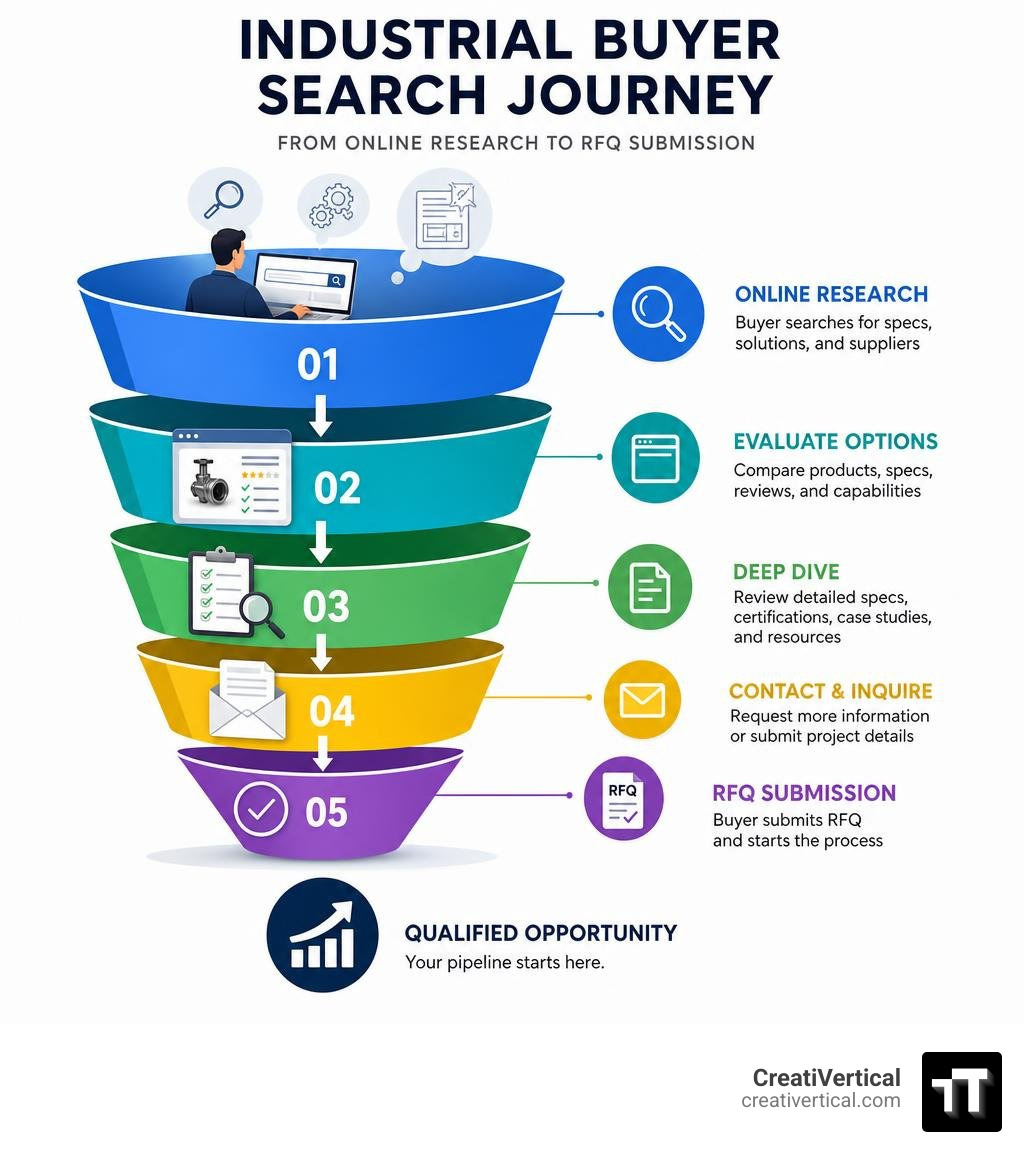
When you hire a generic digital marketing agency, they usually bring a playbook designed for local plumbing companies, software-as-a-service (SaaS) startups, or consumer e-commerce brands. They focus heavily on raw traffic volume, high-velocity blogging, and vanity metrics like “impressions” and “total organic clicks.”
But industrial manufacturing does not operate on impulse. Your buying committee isn’t scrolling through Google looking for entertaining blog posts. They are design engineers, plant operations managers, and procurement officers who need to solve highly specific technical problems.
Generic agencies fail manufacturers because they do not understand these four realities of the industrial sales cycle:
- The Multi-Stakeholder Buying Committee: A single industrial purchase can involve an engineer checking tolerances, an operations manager reviewing capacity, a compliance officer verifying AS9100 certifications, and a procurement specialist negotiating the final contract. Each of these players searches using completely different terms.
- The Obsession with Specifications: Sourcing agents do not search for “best metal fabrication.” They search for “5-axis CNC machining tolerances for aerospace titanium.” If your agency is busy writing broad, top-of-funnel blog posts to capture high search volume, they are missing the low-volume, high-intent technical queries that actually generate Request for Quotes (RFQs).
- The Long Sales Cycle: Industrial deals take months or even years to close. An organic visitor who downloads a 3D CAD drawing today might not submit an RFQ for six months. Generic agencies often abandon high-value technical keywords because they do not see immediate conversions, failing to map their efforts to the true length of your pipeline.
- The PDF Trap: Many manufacturers have decades of engineering expertise locked away in spec sheets and product catalogs saved as PDFs. Google and AI search engines struggle to index these files efficiently. A generic agency rarely has the technical capability to extract this data and restructure it into indexable, crawlable HTML.
Before signing a contract with an agency that promises to double your traffic with generic blog posts, it is vital to learn How to Not Get Ripped Off by a Monthly SEO Retainer. Without specialized expertise, you will end up with a beautiful dashboard full of irrelevant traffic and a sales team that still isn’t receiving qualified RFQs. While industrial directories like Thomasnet have historically highlighted the importance of targeting in-market buyers, true modern SEO requires building search equity on your own domain rather than relying solely on third-party platforms.
The Core Pillars of Legitimate Industrial Manufacturer SEO Services
A successful search strategy for manufacturers must treat your website as an engineering asset, not just a digital brochure. We break this down into a highly structured, four-pillar methodology designed to align your technical capabilities with search engine algorithms and modern AI search agents.

To help visualize how this differs from standard marketing, consider this comparison between generic SEO and specialized industrial SEO:
| Optimization Element | Generic SEO Approach | Industrial Manufacturer SEO Approach |
|---|---|---|
| Keyword Target | High-volume, broad terms (e.g., “metal parts”) | Low-volume, high-intent specs (e.g., “custom 316L stainless steel CNC milling”) |
| Primary Audience | General consumers or broad business managers | Design engineers, procurement officers, plant managers |
| Content Format | Informational blog posts, listicles, social graphics | Highly detailed spec sheets, interactive HTML tables, CAD downloads |
| Site Architecture | Simple blog and service pages | Deep product databases, SKU filters, faceted navigation |
| Conversion Focus | Newsletter sign-ups, free trials, direct e-commerce | Technical asset downloads, interactive quote engines, secure CAD RFQs |
| Authority Focus | General B2B guest posts and directory listings | Trade publications, engineering journals, industrial supplier networks |
To establish this level of performance, we focus on a deep Keyword Research Strategy that maps out every technical variation of your products. This research feeds directly into our Adaptive SEO Services, ensuring your site remains resilient as search algorithms shift.

Why Technical Catalog Optimization is Crucial for Industrial Manufacturer SEO Services
If you manufacture a wide array of products, your website likely features hundreds or thousands of SKUs, material variations, and dimensional specifications. This complexity presents major challenges for search engine crawlers.
- Faceted Navigation Issues: Filters that allow users to sort by material, size, or tolerance can generate thousands of duplicate URLs. If not managed correctly, search engines will waste their “crawl budget” indexing duplicate filter combinations instead of your primary product pages.
- The PDF Problem: If your technical specifications are locked inside PDFs, search engines cannot easily parse the relationships between products. We solve this by extracting engineering data from static documents and transforming them into mobile-responsive, structured HTML tables.
- Duplicate Content Across Networks: If you sell through distributors or manufacture original equipment manufacturer (OEM) parts, you might share product descriptions across multiple sites. This duplicate content can cause search engines to suppress your pages. We write unique, application-specific descriptions and technical commentary for every single SKU to ensure your pages stand out as the primary source of truth.
Managing these technical complexities is especially critical during website updates. To prevent losing your hard-earned search equity, review The Ultimate Guide to Maintaining SEO Rankings During a Site Redesign.
How to Align Content Strategy with Industrial Manufacturer SEO Services
Industrial content strategy is not about writing generic articles; it is about building trust with highly analytical buyers. Your content must speak directly to the distinct roles within the buying committee:
- For the Design Engineer: Provide precise tolerances, material comparisons (such as 304 vs. 316 stainless steel for corrosive environments), and downloadable CAD files.
- For the Procurement Officer: Highlight certifications (ISO 9001, AS9100, ITAR), production capacities, lead times, and shipping logistics.
- For the Plant Manager: Focus on operational reliability, maintenance intervals, installation guides, and real-world case studies detailing how your equipment solved a specific production bottleneck.
To get this content noticed, we back it up with targeted Link Building from respected trade publications, engineering forums, and industrial databases. This off-page authority signals to search engines that your business is a trusted leader in your field. If you want to uncover the hidden strategies that keep competitors ahead, explore these Organic Traffic Growth Secrets Your Competitors Hope You Never Find.
Navigating the 2026 AI Search Shift: GEO and AEO for Procurement Agents
In 2026, the search landscape has fundamentally changed. Procurement officers and design engineers are no longer just scrolling through ten blue links on a Google search results page. Instead, they are increasingly using AI-powered search engines and large language models (LLMs) like ChatGPT, Perplexity, Gemini, and Google’s AI Overviews to research suppliers, compare capabilities, and draft shortlists.
This shift has made Generative Engine Optimization (GEO) and Answer Engine Optimization (AEO) critical components of any modern industrial marketing program.

To ensure your manufacturing business is cited as the recommended supplier by these AI agents, your digital presence must adapt:
- Semantic Schema for Industry: AI tools do not just read keywords; they map relationships between “entities.” By implementing advanced semantic schema markup, we translate your technical specs, materials, tolerances, and certifications into structured, machine-readable code that AI models can instantly understand.
- Citation-Friendly Answer Formats: LLMs pull their answers from highly structured, authoritative sources. We design your capability pages, technical FAQs, and comparison guides in clear, citation-friendly formats. When an AI tool searches for “ITAR-certified custom battery manufacturers in the Midwest,” your site is formatted to be the direct, cited source of truth.
- High-Density Data Structure: AI agents prefer raw, verifiable facts over marketing fluff. Our content strategy focuses on high-density technical writing—explicitly listing your materials, machinery models, production limits, and quality control protocols.
By structuring your data for both human buyers and AI agents, you build an authority loop that ensures your business is visible wherever research happens. To see how these technologies are being deployed, check out our insights on the Best AI Tools for SEO 2025.
Evaluating Agencies: Red Flags, Real Metrics, and Top Providers in 2026
Choosing an agency to manage your search strategy is a major decision. The market is filled with generalists who will happily charge you a monthly retainer while delivering little more than generic traffic.
When evaluating potential partners, look out for these common red flags:
- The “Traffic Volume” Trap: If an agency promises to double your traffic but cannot explain how they will target spec-driven, low-volume keywords, they are optimizing for the wrong metrics.
- No Technical Writers: If their content team consists of general copywriters who do not understand basic engineering concepts, your content will lack the technical depth required to earn the trust of design engineers.
- Lack of Transparency: If they hide behind proprietary reporting dashboards that only show “ranking improvements” rather than actual RFQ submissions, digital downloads, and pipeline growth, they are likely hiding a lack of real results.
Finding the right partner requires looking for localized performance, deep technical execution, and a clear understanding of your specific manufacturing niche. A qualified agency should act as an ongoing growth partner, integrating technical SEO, web development, and AI search visibility into a single, cohesive digital system that aligns with your regional operations.
Frequently Asked Questions About Industrial Search Strategy
How long does it take to see real revenue impact from industrial SEO?
Industrial SEO is a long-term investment, not a quick fix. Because the sales cycle for complex machinery, precision parts, and industrial chemicals is naturally long, the timeline for search success mirrors this reality.
Most manufacturers see early technical improvements and initial keyword ranking shifts within 60 to 90 days. However, real, qualified pipeline growth and measurable RFQ increases typically take 6 to 12 months to build momentum. This compounding effect is why organic search is so valuable—unlike paid ads, the authority you build continues to generate high-quality leads long after the initial optimization is complete. If you are looking to build this foundation in the Midwest, our team offers specialized SEO Services in Kansas City tailored to industrial and B2B manufacturers.
Are directories like Thomasnet enough for modern industrial lead generation?
While industrial directories like Thomasnet can provide short-term visibility and useful backlinks, relying on them as your sole source of digital leads is a risky strategy.
When you rely entirely on third-party directories, you are competing head-to-head in a crowded space where buyers can easily compare you to dozens of other suppliers with a single click. By investing in owned-site SEO, you build long-term, scalable traffic directly to your own domain. This allows you to control the user experience, showcase your unique engineering capabilities, and guide prospects through a personalized RFQ process without distraction. To understand how to break free from relying on third-party platforms, read through our guide on No More Hide and Seek: A No-Nonsense Local Business SEO Strategy.
How do we handle duplicate content issues between OEMs and distributors?
Duplicate content is a common headache for manufacturers who distribute their products through a network of dealers, or for distributors who use standard OEM product descriptions. If multiple websites publish the exact same product copy, Google’s algorithms will typically choose one primary source to rank and suppress the rest.
To solve this, we add unique context to every product page. Instead of copy-pasting standard manufacturer descriptions, we write custom content highlighting specific industrial applications, local availability, engineering commentary, and custom modification capabilities. This signals to search engines that your page offers unique value to the user. To stay ahead of how search engines evaluate content quality, keep up with Everything You Need to Know About Google’s New Algorithm Update.
Conclusion
Building a successful digital presence for an industrial manufacturing company requires moving past generic marketing playbooks. Your buyers are not looking for flashy ads; they are seeking precise technical solutions, verified certifications, and reliable production partners.
At CreatiVertical, we operate as a family-run digital agency and dedicated growth partner. We don’t believe in one-off projects or vanity metrics. Instead, we specialize in delivering complete, performance-focused digital systems—combining technical web development, specialized SEO, and next-generation AI search visibility (GEO/AEO)—to help precision manufacturers, lubricant brands, and industrial chemical suppliers secure the digital authority they deserve.
Ready to turn your website into a highly efficient sales asset? Launch your custom digital system today and let’s build a pipeline that compounds for years to come.