

A Better Way to Plan Kansas City Google Ads
Start with the customers you can serve and the jobs you can profitably win. Build Search campaigns around high-intent terms, target only your service area, and exclude searches that don’t fit. Before you raise your budget, track which calls and forms turn into booked work. Set your target cost per lead from your margins and close rate, not a generic benchmark.
That local focus matters in a metro that crosses Kansas and Missouri. A click from across the state line may be valuable to one business and useless to another. This guide shows you how to structure campaigns, measure real outcomes, and decide when to expand beyond Search.
I’m Nicholas Cunha, founder of CreatiVertical, a family-run agency in the Kansas City area. I bring more than 20 years of agency and project experience to web development, SEO, and paid media, including hands-on work helping local businesses plan Kansas City Google Ads around leads they can actually serve.
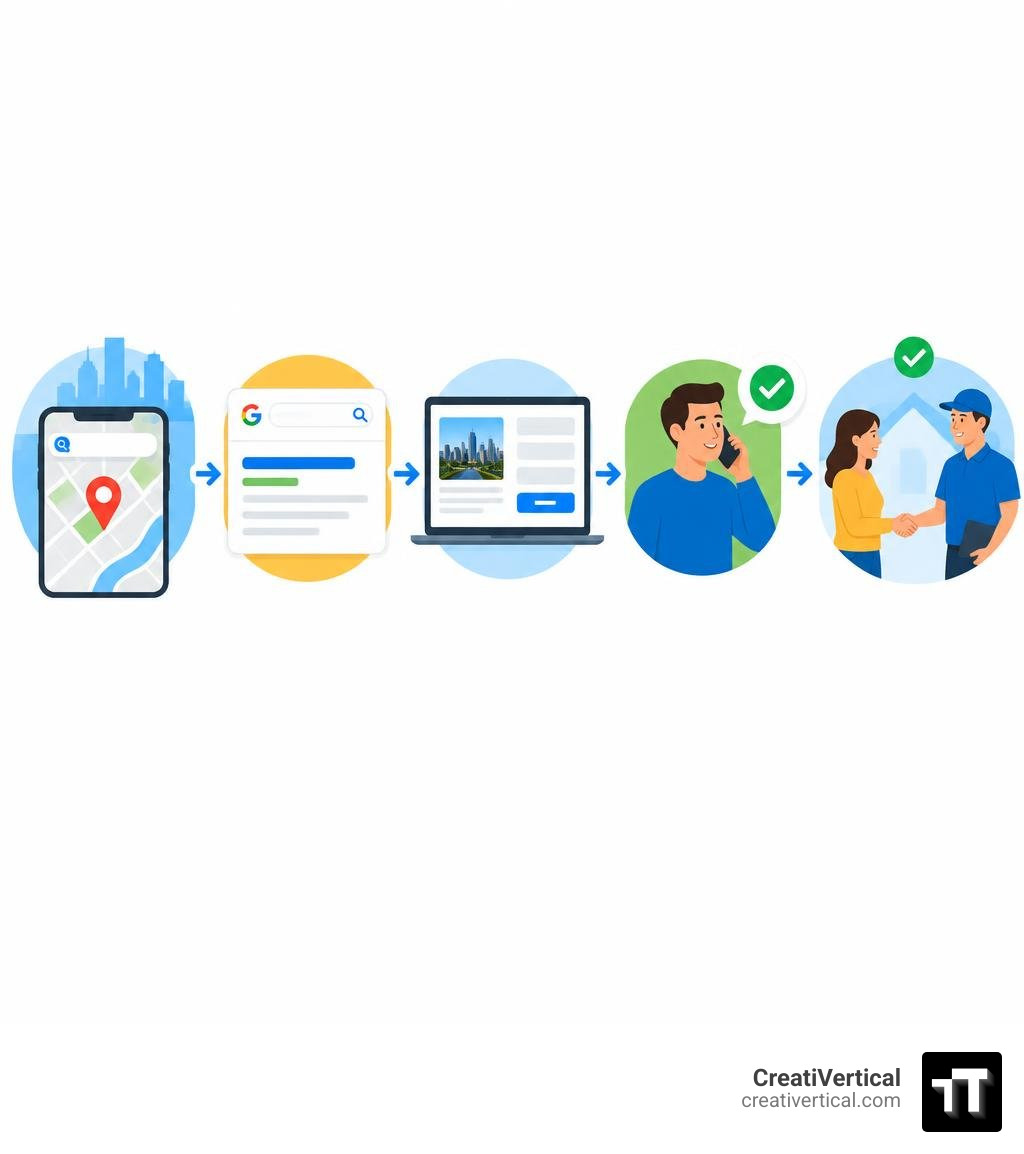
Simple guide to kansas city google ads terms:
- digital marketing in kansas city
- digital marketing services in kansas city
- kansas city marketing firms
Structuring Kansas City Google Ads for Bi-State Metro Success
Running pay-per-click advertising in the Kansas City metropolitan area presents a unique geographic challenge. The metro spans two states and encompasses 2.2 million residents across diverse communities like Jackson County, Missouri, and Johnson County, Kansas. Kansas City, Missouri alone accounts for over 508,000 residents, surrounded by suburban economic centers like Lee’s Summit, Independence, Blue Springs, Lake Tapawingo, and Grain Valley.
When managing kansas city google ads, advertisers must account for the natural divide between Missouri and Kansas. If your business holds trade licenses exclusively in Missouri, an ad click originating from Overland Park or Olathe represents wasted ad spend. Conversely, if your firm serves regional commercial accounts across both states, treating the entire bi-state area as a monolithic ad target leads to poor ad relevance and diluted quality scores.

To avoid cross-state search leakage, every campaign must reflect your true operational capacity. For technical B2B firms or regional equipment suppliers, this structure requires distinct campaign tiers that isolate local transactional searches from wider regional industrial procurement, as outlined in our strategic PPC framework for high-ticket industrial equipment manufacturers.
Geo-Targeting Precision and Negative Keyword Sculpting
Without proactive geographic rules and negative keyword discipline, local accounts can waste a meaningful share of their ad spend on irrelevant queries. Google Ads default location settings target “Presence or search interest,” meaning someone in Florida planning a move to Kansas City might trigger your emergency plumbing ad.
To eliminate waste, apply these targeting safeguards:
- Switch to Strict Physical Presence: Change your campaign location setting from “Presence or interest” to “Presence: People in or regularly in your included locations.”
- Layer Zip-Code and County Radii: Rather than targeting the broad “Kansas City DMA,” select specific zip codes, counties, or radius zones around your actual service hubs in locations like Lee’s Summit or Blue Springs.
- Implement Cross-Border Negative Keyword Lists: If you cannot service Kansas clients, add negative keywords for Kansas municipalities (e.g., “Overland Park,” “Olathe,” “KCK,” “Shawnee,” “Lenexa”).
- Maintain Match Type Discipline: Rely on exact match and modified phrase match for core commercial terms. Broad match should only be used alongside extensive negative keyword lists and smart bidding strategies that already possess substantial conversion volume.
Campaign Type Selection: Search, LSAs, Performance Max, and Video
Selecting the right campaign format depends on your business model, customer buying cycle, and conversion goals.
| Campaign Type | Best Industry Fit | Primary Advantage | Conversion Intent |
|---|---|---|---|
| Google Search Ads | Home services, legal, dental, B2B services | Captures active, bottom-of-funnel search intent | High |
| Local Services Ads (LSAs) | Plumbers, electricians, HVAC, roofers | Google Guaranteed badge; pay-per-lead model | Immediate / Emergency |
| Performance Max (PMax) | Ecommerce, multi-location retail, high-volume B2B | Cross-network reach across Search, YouTube, Display, and Maps | Moderate to High |
| YouTube & Video Ads | Brand awareness, specialized commercial trades | Visual storytelling and local retargeting | Top / Mid-Funnel |
For service trades, combining Search Ads with Local Services Ads (LSAs) builds dominant real estate at the top of the search engine results page. LSAs offer trust through the Google Guaranteed badge, while traditional Search Ads allow you to control custom ad copy, emphasize local promotions, and direct users to specialized landing pages.
Profit-First Math: Calculating CPL, CPA, and Return on Ad Spend
A common pitfall for local advertisers is evaluating paid campaigns strictly on cost-per-click (CPC) or raw impression volume. Clicks do not pay overhead—profitable customer acquisitions do.
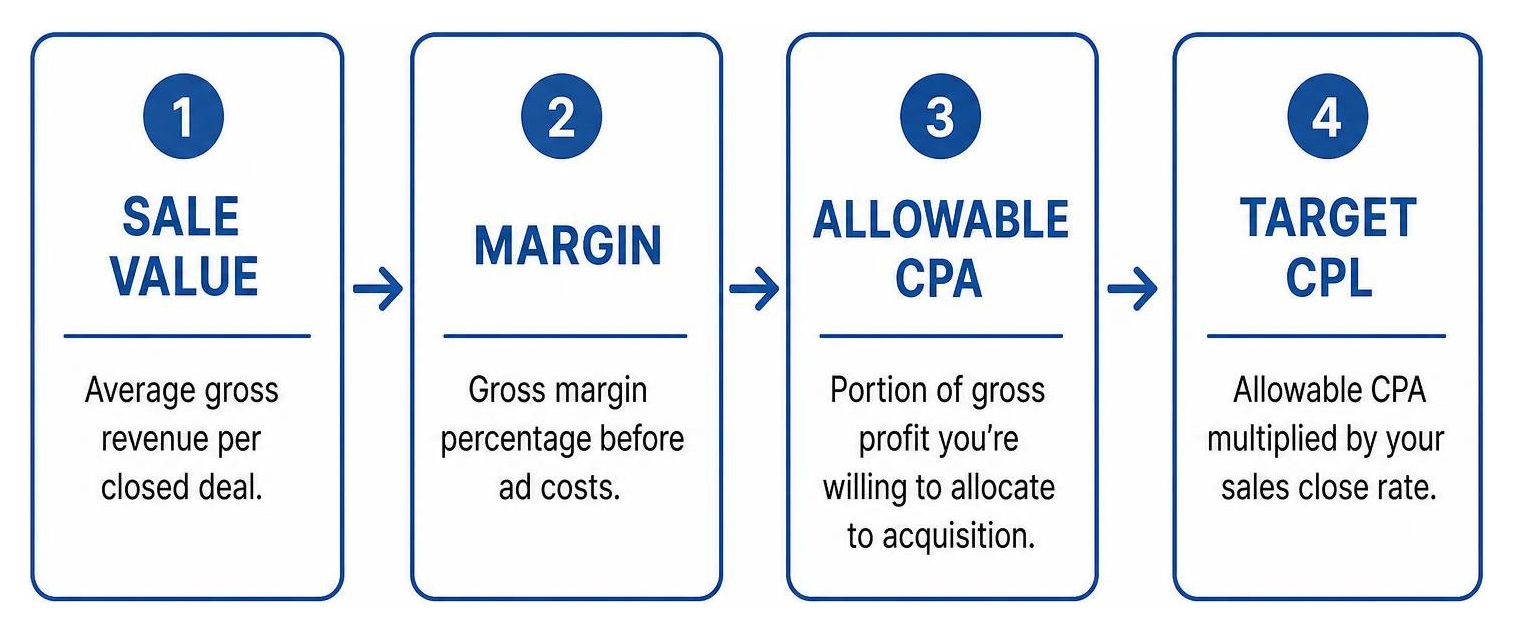
To determine an acceptable target Cost Per Acquisition (CPA) and Cost Per Lead (CPL), work backward from your core financials:
- Identify Average Sale Value: What is the average gross revenue generated per closed deal or job?
- Determine Profit Threshold: What is your gross margin percentage before ad costs?
- Calculate Sales Close Rate: What percentage of inbound phone calls and form submissions turn into paying customers?
- Establish Target CPL: Multiply your allowable customer acquisition cost by your close rate.
For example, if a home remodeling project yields an average revenue of $10,000 with a 40% margin ($4,000 profit), and you are willing to allocate 25% of that profit ($1,000) toward marketing acquisition:
- Allowable Target CPA = $1,000
- If your sales team closes 1 out of every 5 qualified leads (20% close rate):
- Target Cost Per Lead (CPL) = $1,000 × 20% = $200
In the Kansas City market, optimized home service campaigns often see lead costs that vary by trade, season, and competition, while specialized legal or commercial accounts carry higher costs reflecting larger lifetime client values. Maintaining a high Quality Score (7 or above) through tightly aligned ad copy and intent-matched pages can meaningfully reduce click costs, making your website ready for paid traffic an essential asset.
Budget Planning and Management Fees for Kansas City Google Ads
Budgeting for paid media includes two distinct line items: media spend paid directly to Google, and professional management or optimization fees.
Across the Kansas City region, typical service businesses run budgets that reflect their margins, close rates, and growth stage, paired with professional management fees that scale with account complexity and scope.
When evaluating how to manage campaigns, consider the trade-offs:
- In-House / DIY: Eliminates agency retainers, but often suffers from unmanaged negative keywords, broad match bleed, and missed attribution tracking.
- Automated DIY Tools: Useful for basic local shops, but lack custom landing page integration and human nuance for bi-state targeting rules.
- Specialized Local Agency: Provides strategic bid management, dynamic call tracking, landing page split testing, and bi-state market knowledge. If you are comparing providers, review our guide on how to choose marketing firms for practical vetting criteria.
Campaign Optimization Timeline: Launch to Stable ROI
Google Ads is not an instant faucet; it operates on machine learning algorithms that require data collection and systematic refinement.
During the initial 14-day setup phase, technical tracking, conversion actions, and localized ad copy are built. Within the first 30 days, early inquiries arrive, revealing which search terms waste budget and which produce real phone calls. By days 60 to 90, Smart Bidding algorithms mature, stabilizing your cost per lead and establishing a predictable return on ad spend.
Conversion Infrastructure: Landing Pages, Call Tracking, and CRM Integration
Sending expensive paid clicks to a generic website homepage is the fastest way to erode your marketing budget. Homepages contain too many navigation links, diluted messaging, and lack a direct call to action.
To convert clicks into revenue, you need an integrated conversion path:
- Dedicated, Intent-Specific Landing Pages: Build single-offer pages stripped of extraneous menu links. Ensure mobile load times remain under 2.5 seconds, and place contact forms and click-to-call buttons above the fold. Review our guide on how to improve landing page performance for core conversion design principles.
- Dynamic Call Tracking: Implement tools like CallRail using Dynamic Number Insertion (DNI). This swaps the phone number on your page based on the visitor’s traffic source, allowing you to trace individual calls back to the specific keyword and ad that generated them.
- Qualified Call Duration Rules: Only count phone calls longer than 60 seconds as conversions in Google Ads and Google Analytics 4 (GA4), preventing misdials from skewing bidding algorithms.
- Offline CRM Conversion Imports: Connect your CRM to Google Ads. When a lead turns into a signed contract or completed job, pass that revenue data back to Google to train the algorithm toward high-value customers rather than cheap tire-kickers.

Multi-Channel Growth: Lowering Blended Customer Acquisition Cost
While Google Ads excels at capturing active, ready-to-buy search intent, relying entirely on bottom-of-funnel search can become costly as auction competition rises.
A mature acquisition strategy blends channels. Paid Search captures immediate demand, Meta Ads introduces your brand to prospective clients on Facebook and Instagram, and retargeting keeps your business top-of-mind while prospects compare quotes. This unified approach lowers your blended customer acquisition cost across your entire Kansas City digital marketing footprint.
Full-Funnel Integration: Pairing Kansas City Google Ads with SEO and Meta
Pairing paid search with organic search engine optimization yields compounding advantages. When your business holds both the top paid position and a prominent organic local rank, your brand captures a commanding share of clicks on the search results page.
Search query data from your highest-converting Google Ads campaigns can directly inform your long-term organic content plan. Simultaneously, organic visibility builds sustained brand equity that lowers your overall reliance on paid clicks. To explore how these channels reinforce each other, read our breakdown on why PPC and SEO work better together and our overview of local SEO services in Kansas City.
Frequently Asked Questions About Kansas City PPC
How quickly do Kansas City Google Ads generate qualified leads?
Campaigns can generate tracked phone calls and form submissions within the first week of going live. However, the first 30 days serve as a data-gathering and negative-keyword pruning phase. Account efficiency and cost per lead generally stabilize between 60 and 90 days as automated bidding systems accumulate conversion volume.
What is a normal cost per lead for Kansas City service businesses?
Cost per lead varies significantly by industry vertical, transaction size, and geographic competition. For standard residential home services (such as HVAC, plumbing, or roofing), optimized lead costs tend to be moderate relative to other local markets, but the exact figure depends on your close rate, average job value, and auction competition. High-stakes legal, financial, or industrial B2B sectors carry higher lead costs due to substantial customer lifetime values and competitive auctions.
Should I manage Google Ads in-house or hire a local agency?
Managing campaigns in-house can work for small budgets with basic local radius settings, but internal teams often lack the time for daily search-term audits, negative keyword sculpting, conversion API integrations, and landing page split testing. Partnering with a local agency ensures your campaigns are built with bi-state geographic precision and tracked against actual revenue outcomes.
Conclusion: Building a Scalable Paid Acquisition Engine
Profitable paid search is not about buying clicks; it is about building a disciplined acquisition system. By defining precise geographic boundaries across Missouri and Kansas, establishing clear profit-first CPA thresholds, and wiring dedicated conversion tracking through to your CRM, you transform Google Ads from an operational expense into a predictable driver of business growth.
At CreatiVertical, we serve Kansas City businesses, industrial manufacturers, and public-sector contractors as an ongoing growth partner. We design, launch, and manage integrated digital systems—spanning web development, search engine optimization, AI search visibility, and paid media.
If you are ready to eliminate wasted ad spend and build a high-converting paid search campaign tailored to your service area, explore our full suite of Kansas City digital marketing solutions and connect with our team today.