

Why Offshore Legal Firm SEO Demands a Different Playbook
Offshore legal firm SEO is one of the most demanding niches in digital marketing — and one of the most rewarding to get right.
Here’s what you need to know up front:
- Offshore legal clients (high-net-worth individuals, family offices, and international founders) vet firms heavily before making contact. Your search presence is your first credential.
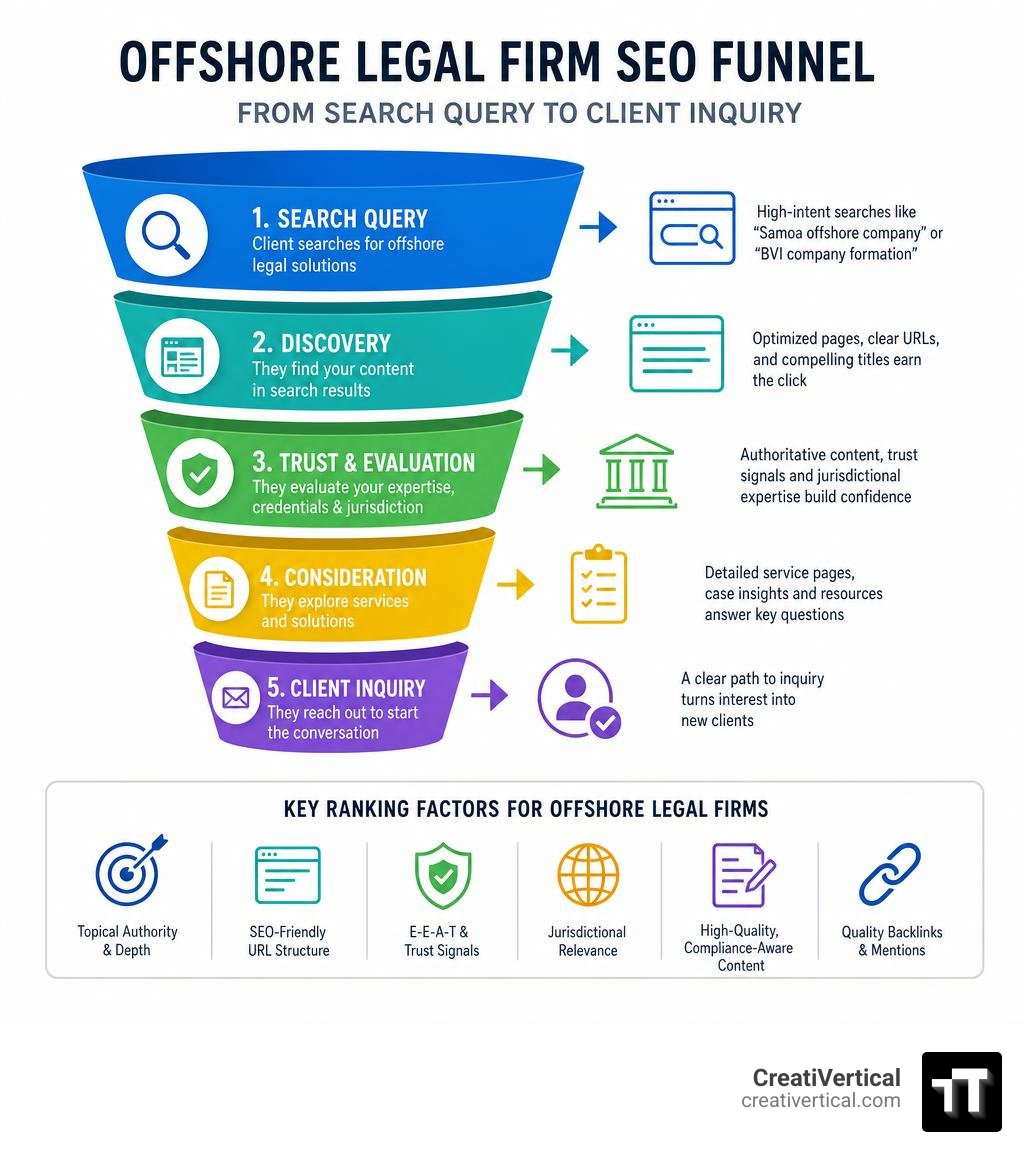
- Ranking for terms like “Samoa offshore company” or “BVI company formation” requires topical authority, precise URL structure, and compliance-aware content — not just generic SEO tactics.
- Real-world results are achievable. One offshore legal firm went from zero organic traffic to 210 monthly visits and a #1 ranking for its core commercial terms in under 10 months.
- The biggest mistakes: thin content, ignoring URL keyword structure, and treating offshore legal SEO the same as local personal injury SEO.
What separates offshore legal SEO from standard law firm SEO:
| Factor | Standard Law Firm SEO | Offshore Legal Firm SEO |
|---|---|---|
| Target audience | Local residents | International HNWIs and founders |
| Search intent | “lawyer near me” | “Samoa offshore company formation” |
| Trust signals | Reviews, local citations | Credentials, jurisdictional expertise, editorial mentions |
| Content risk | Low | High — YMYL, regulatory, and compliance exposure |
| Competition | Other local firms | Global directories and specialist firms |
| SEO timeline | 4–8 months | 6–12 months for durable rankings |
This guide walks you through exactly how to build search visibility that earns trust with the clients who matter most — and converts that visibility into real inquiries.
I’m Nicholas Cunha, founder of CreatiVertical — I spent fifteen years running a digital agency in the British Virgin Islands, delivering projects for government bodies and institutions in an offshore market where credibility and compliance aren’t optional. That experience in Caribbean professional services is exactly what I bring to offshore legal firm SEO strategy, and it shapes every recommendation in this guide.
What Makes Offshore Legal Firm SEO Different from Standard Law Firm SEO?
Standard search engine optimization for law firms is fundamentally local. If you run a personal injury practice or a criminal defense firm in Missouri, your target audience lives within a 50-mile radius. You optimize for Google Maps, local reviews, and geo-modified keywords like “DUI attorney in Kansas City.”
But in the offshore legal world, your market is global, highly regulated, and exceptionally relationship-driven. You are not trying to attract a high volume of local foot traffic; you are trying to capture the attention of a highly sophisticated, international audience of high-net-worth individuals (HNWIs), family office managers, corporate counsel, and tax advisors.
These users do not search for “lawyer near me.” Instead, they search for highly specific, multi-jurisdictional solutions. They want to understand the exact regulatory nuances of setting up an asset protection trust, establishing a private trust company, or navigating cross-border compliance.
Because offshore legal matters are inherently classified as “Your Money or Your Life” (YMYL) by Google, the search engine holds these websites to the highest standards of Experience, Expertise, Authoritativeness, and Trustworthiness (E-E-A-T). A single compliance breach or misleading statement on your site can damage your organic rankings and, worse, invite regulatory scrutiny from bodies like the SRA, BSB, or Caribbean financial services commissions.
To win in this space, you need a strategy designed for global high-trust markets. To see how this works in practice for specific jurisdictions, you can read The Ultimate Guide to Cayman Legal SEO Services and look at how tier-one international firms present their capabilities on platforms like Offshore Law | Premium International Legal Solutions .
Structuring Your Site and URLs for High-Intent Offshore Keywords
One of the most underrated leverage points in offshore legal firm SEO is website architecture and URL design. When international clients search for solutions, they use precise terms. If your site structure is messy, search engines cannot map your expertise to their queries.
Data-backed research in competitive legal search reveals that 62.5% of Position 1 organic results include the target keyword inside the URL slug. This is not a correlation to ignore. It is the most actionable technical SEO lever available to your firm.

Instead of using generic URLs like:
yourfirm.com/services/page2
You must use clean, keyword-rich slugs that tell search engines exactly what the page is about:
yourfirm.com/samoa-offshore-company
yourfirm.com/samoa-tax-planning
yourfirm.com/samoa-asset-optimisation
This structure directly supports your practice area strategies. For instance, if you are targeting corporate clients looking for clear, non-promissory guidance on corporate structures, your URL path should match that exact intent. This approach is highly visible in competitive environments, such as when structuring informational hubs around No Hidden Fees: Your Guide to All-Inclusive BVI Company Formation.
However, you aren’t just competing against other firms. In legal search, directories are incredibly dominant.
| Ranking Factor | Legal Directories (e.g., Justia, Martindale) | Independent Offshore Law Firms |
|---|---|---|
| Market Share | Own approximately 42% of Position 1 results | Fight for the remaining organic real estate |
| Primary Strength | Massive domain authority and sheer page volume | Deep, highly specialized, jurisdiction-specific expertise |
| URL Strategy | Broad, category-based slugs | Highly specific, intent-focused slugs |
| Content Depth | Surface-level profiles and short answers | Exhaustive, lawyer-led guides and case analyses |
To beat the directories, your URL structure must be paired with flawless internal linking, ensuring your primary practice pages sit exactly one click away from your homepage.
Building Topical Authority and Entity Signals in a YMYL Space
Because Google treats legal advice as YMYL content, generic blog posts written by cheap freelance writers will actually damage your site’s performance. The search engine’s algorithms are trained to detect thin, low-value content.
Our analysis of legal search data shows that pages in the 250-500 word range post the worst Position 1 win rate at just 10.3%. This range is the legal content graveyard. If you are publishing short, superficial articles about complex legal topics, you are wasting your marketing budget.

Topical authority is built by creating comprehensive, deeply researched content hubs. If you want to rank for high-intent corporate governance and asset protection terms, you must cover the topic from every angle. For example, rather than just writing a basic page about corporate governance, you should build out supporting articles that demystify complex arrangements, such as Offshore Nominee Directors: Staying Anonymous Without Staying Shady.
Your content must be lawyer-led. It should focus on precision, regulatory compliance, and practical case studies. This level of quality is what search engines expect, and it is how modern, tech-forward legal models position their expertise, as seen with platforms like AI Law-Firm for Offshore Business | Rega .
Furthermore, you must optimize for entity signals. Google no longer just reads keywords; it seeks to understand “entities” (real-world people, organizations, and concepts) and the relationships between them. You can strengthen your firm’s entity signals by:
- Linking attorney bio pages to their official bar association profiles and court registries.
- Utilizing structured Schema markup to define your partners’ credentials, publications, and speaking engagements.
- Securing verified, unlinked brand mentions in reputable financial and legal publications.
Technical SEO and Answer Engine Optimization (AEO) for Global Reach
To attract international clients, your website must perform flawlessly on a technical level across borders. If a wealth advisor in Zurich or a founder in Singapore clicks your link, and your page takes five seconds to load, they will bounce back to the search results.
Technical SEO Foundations for Offshore Legal Websites
Many legal marketers obsess over third-party vanity metrics while ignoring actual technical performance. Interestingly, 64.7% of Position 1 legal search results received a ‘Poor’ grade on Largest Contentful Paint (LCP). This means the majority of top-ranking law firm sites are technically slow.
For an agile offshore firm, this is a massive competitive opportunity. By optimizing your core technical infrastructure, you can easily leapfrog slower, older competitor sites.
Key technical priorities include:
- Core Web Vitals: Optimizing your code, utilizing modern image formats, and leveraging global content delivery networks (CDNs) to ensure lightning-fast load times globally.
- Mobile-First Design: Ensuring your site is perfectly responsive, as HNWIs and corporate executives heavily utilize mobile devices while traveling.
- Multilingual Capabilities: Structuring your site to serve international audiences in their native languages without creating duplicate content issues.
- Clean Code & Schema: Implementing structured data so search engines can easily parse your site’s meaning, a practice shared by top-performing regional firms like Cisar Law Firm | Lake of The Ozark Law Firm Camden County … .
Answer Engine Optimization (AEO) in Offshore Legal Firm SEO
Traditional search is changing. Today, clients are bypassing standard search results and asking conversational questions directly to Large Language Models (LLMs) like ChatGPT, Perplexity, Gemini, and Claude.
If your firm is not optimized for Answer Engine Optimization (AEO), you are invisible to a rapidly growing segment of your target market. LLMs do not scrape the web the same way traditional search engines do; they synthesize answers from a limited set of highly structured, high-trust pages.
To ensure your offshore firm is cited as a trusted source by AI search engines, you must:
- Implement LegalService and FAQPage Schema: This structured data makes your pages machine-readable, allowing AI models to easily understand your exact services and answers.
- Write in a Q&A Format: Structure your content with clear, conversational headers that match the exact questions clients ask, followed by direct, authoritative answers.
- Integrate Interactive Touchpoints: Provide clear, structured paths for users seeking immediate, sophisticated guidance. To understand how this fits into a modern digital system, read about how we implement an AI Concierge for Financial & Legal Services.
Off-Page Authority, Editorial Mentions, and Measuring Real Success
Off-page SEO is not about buying cheap, automated backlinks. For an offshore law firm, your backlink profile must reflect the same level of prestige and trust as your physical office. A few high-quality links from respected financial journals, legal directories, and academic institutions will do more for your rankings than thousands of low-grade forum links.
Generating High-Quality Backlinks for Offshore Legal Firm SEO
To build real domain authority, focus on digital PR and editorial mentions. This involves getting your attorneys quoted in major financial media, contributing thought leadership pieces to international tax publications, and maintaining active listings on premium legal directories.
For example, when building authority, look at how established firms secure regional and national trust, such as the strategies outlined by Lake Munro Attorneys: St Louis Area Law Firm .
The impact of combining high-quality off-page authority with precise technical execution is undeniable. In our work with offshore clients, we have seen how a dedicated, compliance-engineered campaign can completely transform a firm’s digital footprint. In a real-world case study, an international firm targeting the Samoa market implemented these exact pillars:
- They rebuilt their website on a fast, secure, and schema-rich framework.
- They targeted high-intent keywords with dedicated, long-form practice pages.
- They secured authoritative editorial mentions.
The result? The firm went from 0 to 210 monthly visits in under 9 months and achieved the #1 ranking for “Samoa offshore company” and “Samoa asset optimisation” within 10 months, alongside a #3 ranking for “Samoa tax planning”.
This is why understanding the mechanics of search is vital. Many firms waste thousands of dollars on campaigns that yield no return. To avoid these pitfalls, we highly recommend reading our deep dive on Why Legal Marketing Campaigns Fail and What Works Instead and reviewing our hands-on work, such as Project: GHP BVI Law Firm.
Frequently Asked Questions about Offshore Legal SEO
How long does it take to see results from offshore legal SEO?
Because offshore legal SEO targets highly specialized, global terms rather than broad local keywords, the timeline to see meaningful, durable organic rankings is typically 6 to 12 months.
However, first signals — such as impressions for target terms and page-one rankings for highly specific long-tail queries — often appear within the first 3 to 4 months. As demonstrated in our Samoa case study, achieving dominant #1 positions for core commercial terms is entirely realistic within a 9-to-10-month window of disciplined, consistent execution. For more context on structuring your expectations, check out our Great Legal Marketing Advice.
Do we need separate pages for every offshore jurisdiction we cover?
Yes. Each offshore jurisdiction (such as the Cayman Islands, BVI, Samoa, or Jersey) operates under its own distinct corporate and legal frameworks. Clients search for these jurisdictions individually based on their specific tax, asset protection, and privacy needs.
Creating separate, substantive pages allows you to build dedicated content silos, optimize your URL slugs for each jurisdiction, and establish clear topical authority. If you are ready to dominate a specific jurisdiction, you can connect with a Cayman Islands SEO expert to map out your practice-area architecture.
How do we balance SEO content with strict regulatory compliance?
Compliance must be the foundation of your SEO strategy, not an afterthought. Every piece of content published on your site must use careful, non-promissory language. Avoid making guarantees about tax savings, asset protection outcomes, or speed of formation.
Instead, focus on explaining the statutory frameworks, court precedents, and administrative processes objectively. By keeping your content educational, precise, and aligned with regulatory guidelines (such as the SRA Standards or local Bar Association rules), you protect your firm from compliance risks while building the exact type of high-trust content that Google’s YMYL algorithms reward.
Conclusion: Charting Your Course to the Top of Search
Winning the search battle in the offshore legal sector requires a partner who understands that compliance and performance are not mutually exclusive.
At CreatiVertical, we are a family-run digital agency and a dedicated growth partner. We don’t deliver disconnected, one-off marketing projects. Instead, we build complete, performance-focused digital systems — combining custom web design, compliance-engineered SEO, and cutting-edge AI search visibility — to help your firm secure high-value international clients.
Whether you are looking to dominate Caribbean corporate services or scale your international private wealth practice, we are here to help you chart a clear, successful course.
If you are ready to build a fast, secure, and authoritative digital presence, explore our premier website development services and let’s start a conversation.