

What Brand Development Actually Is (And Why It Matters)
Brand development is the ongoing strategic process of defining what your business stands for, how it communicates, and how it grows its identity in the market over time.
It is not just a logo. It is not a color palette. Those are outputs. Brand development is the thinking that comes before them.
Quick answer:
| Question | Answer |
|---|---|
| What is brand development? | The process of building and strengthening your brand’s positioning, identity, and market presence over time |
| How is it different from branding? | Branding is the visual execution (logo, colors). Brand development is the full strategy behind it |
| Why does it matter? | Firms with a clear brand grow faster, charge more, and convert better |
| Where do you start? | Research your audience, define your positioning, then build your identity |
| How long does it take? | Strategy and identity: 3–6 months. Meaningful market traction: 1–3 years |
One way to think about it: a professional services brand’s strength equals its reputation multiplied by its visibility. You need both. High visibility with a weak reputation is noise. A strong reputation with no visibility is a secret.
That formula matters especially if you are a B2B firm, a manufacturer with long sales cycles, or a professional services provider trying to reach buyers who research carefully before they ever contact you. Those buyers are forming impressions long before a sales conversation starts.
I’m Nicholas Cunha, founder of CreatiVertical — I’ve spent more than twenty years doing hands-on agency work across Kansas City, the British Virgin Islands, and Caribbean markets, helping government bodies, law firms, and B2B businesses get their brand development foundations right. In this guide, I’ll walk you through the basics without the jargon.

Defining the Basics: Strategy vs. Aesthetics
When people think of “branding,” they often jump straight to the pretty things: logos, fonts, business cards, and website templates. But focusing on the visual assets before doing the strategic groundwork is like picking out paint colors for a house before pouring the concrete foundation. It is a recipe for a structural collapse.

Brand development is the blueprint and the foundation. It involves understanding your business’s core purpose, finding your unique position in the market, researching your audience, and defining how you solve their problems. Only after this strategy is set do you begin designing the visual elements.
To help separate these concepts, let us look at how they compare side-by-side:
Brand Development vs. Branding
| Feature | Brand Development (The Foundation) | Branding (The Execution) |
|---|---|---|
| What is it? | The long-term strategy that defines your business’s values, mission, and audience fit. | The visual and verbal expressions used to communicate that strategy to the world. |
| Core focus | Brand equity, positioning, target audience pain points, and long-term growth. | Logos, typography, color palettes, taglines, and marketing collateral. |
| Timeline | An ongoing, iterative business capability that evolves with the company. | Specific projects or refreshes that update visual assets. |
| How it is measured | Pricing power, client retention, market share, and referral rates. | Brand recognition, logo memorability, and visual consistency. |
If you skip the strategy, you end up with “rogue styling” — visual assets that look beautiful but say absolutely nothing to your target audience. A professional logo without a clear positioning strategy is just decoration.
As highlighted in Brand Development: Tips for Developing Your Brand (2025) – Shopify, a clear value proposition and a distinct market position are what drive true brand equity over time. When you invest in the foundational strategy first, you make it significantly easier to succeed at building brand awareness online because your messaging is already tailored to the exact needs of your market.
Why Professional Services Firms Need a Defined Strategy
If you run a professional services firm — whether you are a corporate law firm in the Caribbean, a specialized fiduciary provider, or an industrial manufacturer — your brand is your most valuable asset. Unlike consumer goods companies, you are not selling a $10 product off a retail shelf. You are selling high-ticket, high-trust expertise.
For these specialized businesses, traditional “awareness-building” advertising and sponsorships rarely deliver a return on investment. If a procurement officer, corporate counsel, or engineering buyer needs your services, they are not picking a partner because they saw a billboard on the highway. They are looking for deep, verifiable specialization.
This is why systematic target client research is so critical. Industry data shows that firms that conduct systematic research on their target client groups grow faster and are significantly more profitable than those that rely on guesswork.
When you narrow your target audience, you do not limit your growth; you accelerate it. Specialization allows you to command higher fees because you are no longer competing as a generalist commodity. If a company-formation agent in the British Virgin Islands or a precision lubricants manufacturer in Missouri tries to speak to “everyone,” they end up speaking to no one.
A weak or poorly defined brand strategy is often the root cause of disappointing marketing results. To understand why these efforts miss the mark, it is helpful to look at Why Legal Marketing Campaigns Fail and What Works Instead. When a campaign fails, it is rarely because of the ad budget; it is almost always because the firm’s positioning was too generic to cut through the noise.
The Core Pillars of a Brand Development Strategy
A successful, scalable brand is built on three core pillars: deep market research, clear positioning, and a thorough competitor analysis. Each pillar supports the other to ensure your brand is grounded in reality rather than internal assumptions.
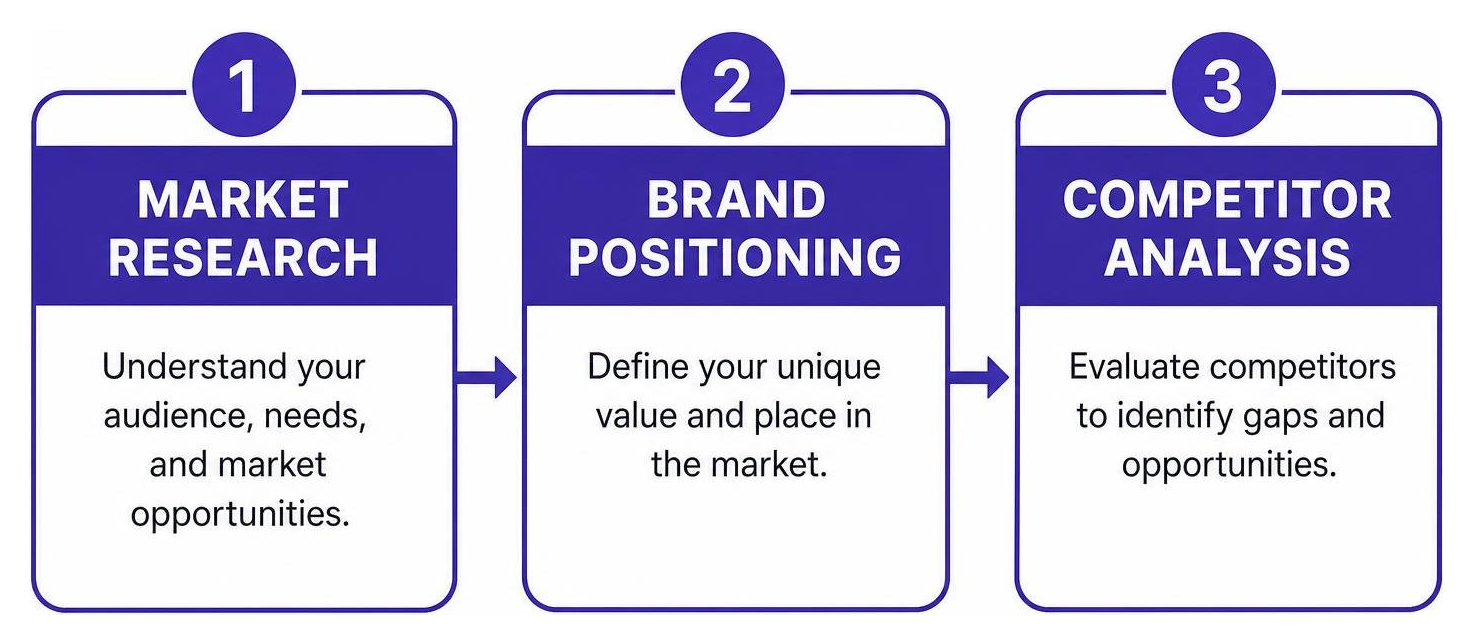
Let us break down how to execute each of these pillars:
1. Market Research & Target Audience Identification
You cannot build a brand strategy around who you think your audience is. Substituting personal taste for audience research is an expensive mistake.
To identify your true target audience, you must look beyond basic demographic data (like age, location, or job title). You need to understand their circumstances, daily frustrations, and the exact problems they are trying to solve.
One of the most effective, unbiased ways to capture this is through a process called review mining. By analyzing client emails, industry forums, help desk tickets, and even online reviews of industry books or competitor services, you can extract the exact language your target clients use to describe their pain points.
Using real customer language in your messaging can have a massive impact. In one notable case study, a company updated its website messaging using copy extracted directly from a customer review, which resulted in a 400% increase in button clicks and a 20% increase in form submissions. People respond when they see their own experiences reflected back to them in plain English.
2. Competitor Analysis
To stand out, you must know what your competitors are promising. Conduct a SWOT analysis (Strengths, Weaknesses, Opportunities, and Threats) on your top three direct and indirect competitors.
- What are their core claims?
- How do they talk about their services?
- What gaps are they leaving unfilled?
For example, if you are an industrial manufacturer, you might find that every competitor is talking about “quality parts.” If everyone claims quality, then “quality” is no longer a differentiator — it is simply the price of entry. Your opportunity might lie in positioning your brand around rapid prototyping, custom engineering collaboration, or supply chain reliability.
For more insights on structuring these foundational steps, you can explore the frameworks outlined in Brand Development Strategy for Enterprise Growth.
Local Connections and Global Reach
Whether we are working with a local business down the road from Lake Tapawingo or helping a historic enterprise near the Lake Tapawingo Development Co – Missouri, we apply these same rigorous strategic standards. A local service provider in Missouri needs a distinct, research-backed position just as much as a multinational B2B brand does.
How Content Marketing Drives Brand Development
Once your positioning is defined, content marketing becomes the engine that drives your brand’s visibility and reputation simultaneously. For B2B and professional services firms, high-quality content is how you prove your expertise before a prospect ever hops on a call.
Rather than publishing generic blog posts or social media updates, focus on high-value thought leadership. This includes:
- Original, proprietary research reports.
- In-depth technical guides explaining complex regulatory frameworks (such as FedRAMP or FISMA compliance).
- Case studies detailing how you solved a highly specific problem for a client.
By sharing valuable insights, you build trust and establish your firm as an authority. This thought leadership also fuels your search engine visibility. However, in July 2026, search visibility is no longer just about traditional Google rankings. With the rise of AI-driven search engines like ChatGPT and Perplexity, your brand must be optimized for AI search visibility (Generative Engine Optimization, or GEO). This means publishing clear, structured, and highly authoritative content that AI models can easily cite when answering user queries.
This educational content also feeds your direct-response marketing. To understand how to turn this attention into long-term client relationships, read about the 6 Reasons Why Email Marketing Will Grow Your Online Brand. Email marketing allows you to nurture leads over long sales cycles by delivering consistent, valuable insights straight to their inboxes.
Measuring the ROI of Brand Development
One of the most common mistakes businesses make is treating brand development as a vague, unmeasurable creative expense. In reality, a well-executed brand strategy drives highly quantifiable business outcomes.
To track the success of your efforts, you should monitor a balanced scorecard of key performance indicators (KPIs):
- Brand Awareness & Visibility: Track organic search traffic, brand search volume (people typing your company name directly into search engines), and AI search mentions.
- Conversion Rates: Monitor how many website visitors turn into qualified leads or clients.
- Client Lifetime Value (LTV): A strong brand builds deeper emotional connections, which leads to higher retention, repeat business, and a higher LTV.
- Pricing Power: Are you able to command a premium for your specialized services, or are you constantly forced to discount your prices to win deals?
The Heller Consulting Case Study
To see the real-world impact of strategic brand development, look at the technology consulting firm Heller Consulting. After undergoing a comprehensive brand development process — which included deep target client research, a refined brand positioning strategy, and a complete digital overhaul — the firm experienced a 400% increase in website conversions and a 50% increase in organic search traffic over a two-year period.
Your website is the single most important brand development tool in your arsenal. It is the digital storefront where prospects go to verify your reputation. If you are ready to turn your online presence into a high-performance, lead-generating asset, you can learn more about our approach to custom Website Development.
Executing Your Brand Identity and Positioning
Once your strategic foundation is secure, it is time to translate those ideas into a cohesive visual and verbal identity.

This execution phase involves crafting three critical elements:
1. The Brand Positioning Statement
A brand positioning statement is an internal, 4-to-6 sentence guide that defines exactly who you serve, what you do, and why you are different. It should be grounded in your current capabilities but include achievable aspirational goals.
A simple framework to follow is:
“For [Target Audience] who [Statement of Need], [Your Brand] is the [Category/Specialization] that [Core Benefit/USP]. Unlike [Competitors], we [Primary Differentiator].”
2. The Unique Selling Proposition (USP)
Your USP is the single, clear promise that sets you apart. It is not a list of features; it is the ultimate result you deliver. For example, a global courier’s USP isn’t “we have thousands of airplanes”; it is “when it absolutely, positively has to be there overnight.”
3. Brand Voice and Visual Identity
Your brand voice is how you speak. Are you authoritative and precise, or warm and conversational? Once your voice is set, you can begin designing your visual identity (logo, color palette, and typography).
When designing these visual elements, simplicity and consistency are key. While a consumer forms a first impression of a brand’s logo within 10 seconds, it takes 5 to 7 impressions for them to actually remember it. If your visual style is constantly shifting, you reset that counter to zero every time.
For a deeper dive into organizing these steps, you can read The Essential 7-Step Brand Development Playbook.
Maintaining Brand Consistency Across All Touchpoints
The greatest threat to brand equity is fragmentation. It is incredibly common for a business to invest in a beautiful brand strategy, only for “Sandra from Sales” to stretch the logo on a presentation slide, or “Evan from Events” to change a flyer’s color scheme to orange and pink because they felt like it.
These small, well-meaning changes dilute your brand and erode customer trust. Inconsistent messaging across your website, social media, sales decks, and client portals actively signals a lack of professional coordination.
To prevent this, you must establish clear, accessible brand guidelines. Rather than creating a static PDF manual that gets lost in an email thread, we recommend using digital, “living” brand guidelines and asset management hubs.
Additionally, implementing a system of lockable templates allows your design team to lock down critical brand elements (such as logos, fonts, margins, and core messaging) while giving other departments the flexibility to update the text or images they need for daily operations.
Your website must serve as the ultimate anchor for this consistency. If you want to ensure your digital presence remains perfectly aligned with your brand guidelines while delivering a flawless user experience, explore our Professional Web Design Services in Kansas City.
Frequently Asked Questions
How does brand strategy differ from execution?
Brand strategy is the planning and positioning phase. It defines your target audience, core values, competitive differentiators, and brand voice. Execution (often referred to as brand management or branding) is the physical application of that strategy — such as designing your logo, building your website, writing copy, and launching marketing campaigns. Strategy is the map; execution is the journey.
What is the typical timeline for brand building?
For a mid-sized business or professional services firm, the initial research, strategy, and brand identity phases typically take 3 to 6 months to complete. However, building meaningful brand awareness, trust, and equity in your target market is a long-term play that requires 1 to 3 years of consistent execution.
How do you conduct target audience research without bias?
To avoid bias, do not rely on internal assumptions or general demographic data. Instead, use a mix of qualitative and quantitative methods:
- Review Mining: Extract exact customer phrases from public reviews, forums, and social media.
- One-on-One Interviews: Speak directly with your best existing clients to understand why they chose you and what problems you solved for them.
- Behavioral Data: Analyze Google Analytics and search query data to see what topics your audience is actively searching for online.
Conclusion
Developing a strong, resilient brand is not a one-off marketing project; it is a continuous, strategic business capability. When you align your business objectives with deep audience research, clear positioning, and relentless consistency, you build an asset that drives long-term profitability, client loyalty, and enterprise value.
At CreatiVertical, we do not believe in templated, one-size-fits-all solutions. We operate as an ongoing growth partner, delivering complete, performance-focused digital systems — from custom web development and SEO to AI search visibility and strategic branding.
Whether you are a corporate law firm in the Caribbean, an industrial manufacturer in the Midwest, or a local business right here in Kansas City, we are here to help you chart your course and scale your business with confidence.
If you are ready to build a brand that commands authority, explores new markets, and drives measurable growth, let us start the conversation. Explore our specialized Brand Development Services today.