
What a B2B Manufacturing Case Study Actually Does for Your Sales Pipeline
A well-built B2B manufacturing case study is one of the most direct ways to turn a skeptical procurement engineer into a signed purchase order — but most manufacturers either don’t have them or don’t know how to use them.
Here’s a quick snapshot of what a strong B2B manufacturing case study includes and why it matters:
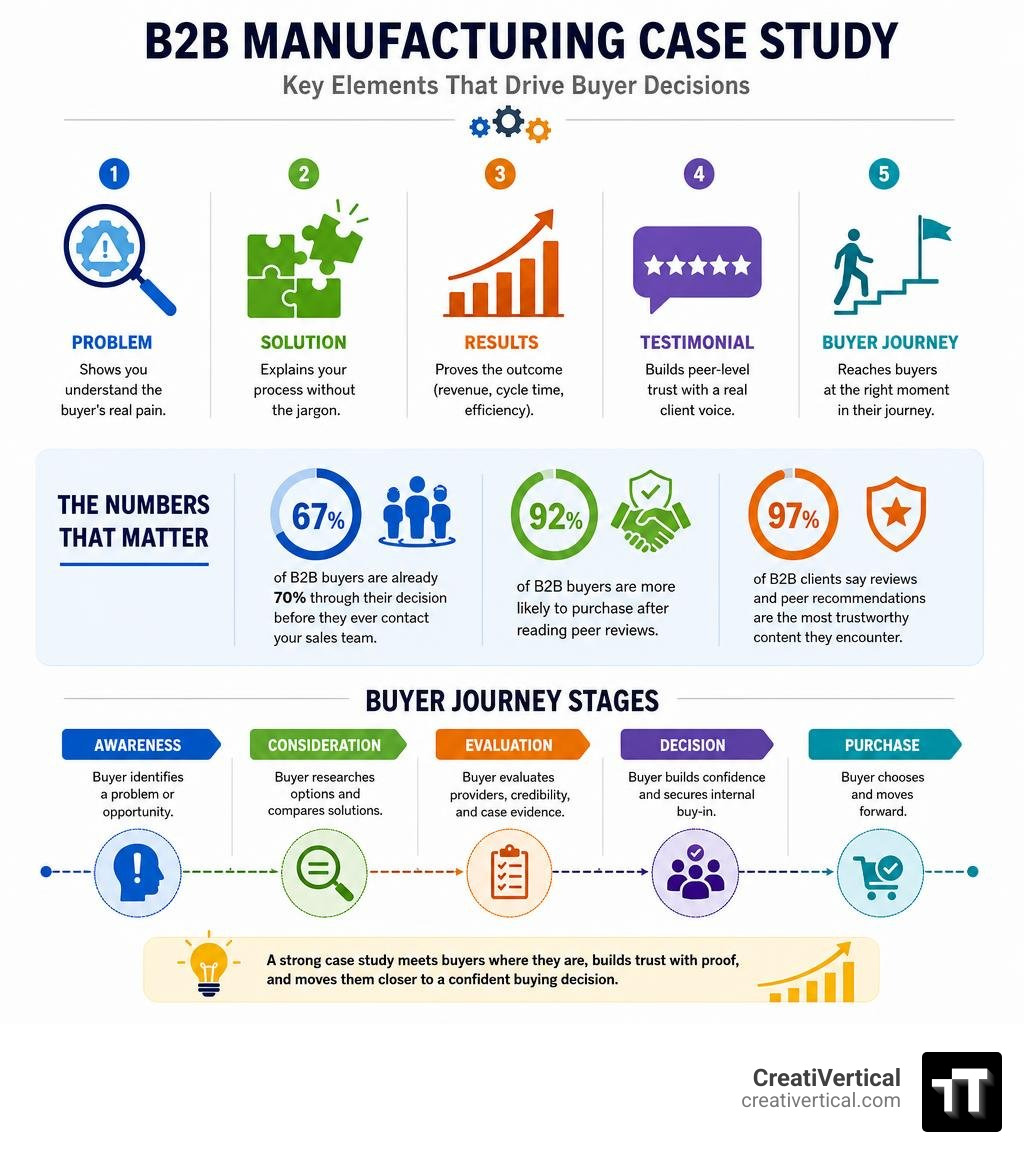
| Element | What It Does |
|---|---|
| Problem statement | Shows you understand the buyer’s real pain |
| Solution overview | Explains your process without the jargon |
| Quantifiable results | Proves the outcome (revenue, cycle time, efficiency) |
| Client testimonial | Builds peer-level trust |
| Buyer’s journey alignment | Reaches buyers at the right moment |
A few numbers worth knowing:
- 67% of B2B buyers are already 70% through their decision before they ever contact your sales team.
- 92% of B2B buyers are more likely to purchase after reading peer reviews.
- 97% of B2B clients say reviews and peer recommendations are the most trustworthy content they encounter.
That means by the time a procurement manager or engineering buyer calls you, they’ve already been reading about you — or your competitors. A case study is what they’re looking for.
The challenge is that manufacturing firms have historically underinvested in this kind of content. As recently as 2015, only 8% of B2B manufacturers had a dedicated marketing team. Many still rely on trade shows and word of mouth. That gap is real — and it’s also an opportunity, because the bar for standing out isn’t as high as it is in other sectors.
This guide walks you through how to build, structure, and distribute B2B manufacturing case studies that actually move buyers toward a decision — not just sit in a PDF nobody reads.
I’m Nicholas Cunha, founder of CreatiVertical, and I’ve spent over twenty years building digital strategies for industrial, government, and offshore clients — including hands-on work with B2B manufacturers on web presence, SEO, and AI-driven sales visibility; the B2B manufacturing case study frameworks in this article come directly from that applied experience. Let’s get into it.
The Unique Hurdles of Modernizing B2B Manufacturing Marketing
Modernizing a marketing strategy in the B2B manufacturing sector comes with unique friction points that simply do not exist in software or consumer goods. For decades, the industry relied entirely on physical trade shows, distributor networks, and manual relationship-building. Marketing was often viewed as a cost center rather than a growth engine.
This historical approach shows in the numbers: in 2020, only 5% of manufacturing marketers rated their marketing as “sophisticated.” While that number has slowly improved, many firms still struggle to document their efforts. In 2019, only 21% of manufacturing organizations documented their content marketing performance, though that figure grew to 41% in 2020.
The core challenge is a deep-seated cultural division between sales, engineering, and marketing. In a typical manufacturing plant, the engineering team lives in a world of tolerances, material specifications, and rigorous testing. Sales reps live in their CRMs and on the road. Marketing often sits on the sidelines, trying to translate highly technical processes into readable content without losing the precision that engineering buyers demand.
To bridge this gap, we must focus our marketing content on the four critical factors that actually influence B2B manufacturing customer satisfaction and purchasing decisions:
- Quality: Proving your components meet exact tolerances and performance standards.
- Customer Service: Demonstrating responsiveness, engineering support, and reliable lead times.
- Value: Showing how your solution reduces total cost of ownership (TCO) or improves production throughput.
- Price: Presenting clear, competitive pricing structures that align with procurement expectations.
| Traditional B2B Manufacturing Tactics | Modernized, Data-Driven Tactics |
|---|---|
| Trade-show-only lead generation | Multi-channel digital inbound systems |
| Paper brochures and physical spec sheets | Search-optimized, interactive digital portfolios |
| Manual, spreadsheet-based quote tracking | Integrated CRM and ERP automated pipelines |
| Relationship-based “gut feel” selling | Case studies backed by quantifiable operational metrics |
Overcoming the Traditional Trade-Show-Only Limitation
Relying solely on annual trade shows for pipeline generation is an outdated model. While face-to-face handshakes still hold value, they are no longer sufficient to sustain predictable growth. Buyers today expect seamless digital integration, online e-commerce portals, and immediate access to technical documentation.
By 2020, 80% of distributors and manufacturers in the United States already planned to increase their spending on e-commerce solutions. This digital shift isn’t just about adding a shopping cart to your website; it is about enabling deep customer collaboration. Modern buyers want to upload CAD models, view real-time production capacity, and interact with engineering teams directly through online portals.
According to the Bryant University research on B2B manufacturing sales, small manufacturers can successfully transition from legacy models by adopting structured digital research and e-commerce tactics. This shift is particularly crucial for mid-sized and small firms competing against massive global players. When a buyer can easily verify your domestic sourcing, U.S.-made product compliance, and production capacity online, you bypass the traditional geographic and size limitations that used to keep smaller shops out of major enterprise contracts.
Aligning Sales and Engineering to Accelerate Quotes
One of the most persistent bottlenecks in B2B manufacturing is the quote-to-close cycle. A field sales representative receives a complex Request for Quote (RFQ), emails it to the engineering team, and then waits. Because engineers are focused on active production and complex custom configurations, routine quotes can sit in a queue for days—or even weeks.
In competitive bidding, speed is often the deciding factor. If your competitor delivers an accurate, certified quote in 48 hours while your team takes 8 business days, you are likely to lose the deal before your engineers even open the file.
This bottleneck can be solved through strategic workflow automation. For example, as highlighted in the Treetop case study on AI sales enablement, a mid-market industrial component manufacturer successfully compressed its sales cycle from 38 days to 23 days. By implementing automated spec analysis workflows, the company reduced its average quote turnaround time from 7–9 business days down to just 2–3 days, resulting in a 40% faster closing rate and an 18% increase in quarterly revenue.
By automating the routine 80% of quotes using pre-built pricing logic and technical databases, sales teams can generate accurate pricing instantly, freeing up sales engineers to focus their valuable time on the highly custom 20% of projects that require deep human expertise.
Mapping Your B2B Manufacturing Case Study to the Buyer’s Journey
To write an effective B2B manufacturing case study, you must align your content with the exact stage of the buyer’s journey. Because 67% of B2B buyers are already 70% through their decision-making process before reaching out to sales, your website must do the heavy lifting of educating, validating, and converting these self-directed researchers.
Strategic positioning separates successful B2B marketing campaigns from forgettable ones. Instead of trying to make a single case study speak to every buyer at every moment, you should build a library of targeted assets mapped to the three distinct phases of the B2B buying process.
Crafting an Awareness-Stage B2B Manufacturing Case Study
At the beginning of their journey, your target buyer—often a plant manager, procurement officer, or design engineer—is not looking for a specific vendor. They are looking for a solution to a frustrating operational problem. Perhaps their current supplier is experiencing frequent quality control failures, or their internal production line is hitting a capacity bottleneck.
An awareness-stage case study should focus heavily on these common industry challenges. The goal is to match the exact search intent of buyers typing technical queries into search engines.
Instead of titling your piece “Our Custom Machining Capabilities,” frame it around the problem: “How to Eliminate Micro-Cracking in High-Tolerance Aerospace Alloys.” By focusing on educational content and explaining why these technical issues occur, you build immediate authority with researchers who are still defining their requirements.
Designing Consideration and Decision-Stage Proof
Once a buyer understands their problem and begins evaluating potential partners, they transition into the consideration and decision stages. Here, the buyer’s focus shifts to technical specifications, equipment capabilities, and peer validation.
This is where detailed technical specifications and peer reviews become your strongest assets. In a sector where a single bad batch of components can halt an entire assembly line and cost millions of dollars, buyers are incredibly risk-averse. They need to see that you have successfully executed similar projects for other reputable companies.
To see how this works in practice, you can explore the Gorilla 76 industrial marketing case studies. These real-world examples demonstrate how structuring your content around deep technical proof, material certifications, and precise performance data helps build the trust required to win high-value industrial contracts.
The Anatomy of a High-Converting Industrial Case Study
A high-converting industrial case study must read like a technical project report, not a generic marketing brochure. It should follow a logical, structured format that speaks directly to the analytical mindset of engineers and procurement managers.

Every strong B2B manufacturing case study should include these core components:
- Executive Summary: A brief, high-level overview of the client, the challenge, and the ultimate business outcome.
- Problem Statement: A detailed explanation of the client’s operational bottleneck, quality issues, or capacity constraints.
- The Solution: A step-by-step breakdown of your engineering approach, the specific machinery or materials used, and why this path was chosen.
- Quantifiable Results: Hard data showing the exact improvements in cycle times, scrap rates, cost savings, or production volume.
- Client Testimonial: A direct quote from the client’s engineering or procurement lead validating your team’s expertise and customer service.
Showcasing Quantifiable Metrics and Technical Proof
If your case study says you “improved efficiency” or “provided great quality,” it will be ignored. Analytical buyers want to see hard, verifiable numbers. You need to showcase exact metrics: percentage increases in production throughput, dollar amounts saved in annual maintenance, or reductions in lead times.
For example, look at the results achieved in the Optifai industrial manufacturer CRM case study. By replacing manual, fragmented lead-scoring processes with an automated, data-driven system, a 15-person industrial manufacturer grew its revenue by 20% (from $8.5M to $10.2M ARR) and cut its sales cycle by 46% (from 52 days to 28 days) in just five months.
When you present your success stories with that level of mathematical precision, you eliminate the skepticism that typically derails B2B sales conversations.
Leveraging AI Search Visibility for Your B2B Manufacturing Case Study
In 2026, the way buyers find manufacturers has fundamentally changed. Today, 84% of enterprise B2B buyers use AI tools for vendor discovery, up from just 24% twelve months prior. If a procurement manager asks ChatGPT, Claude, or Perplexity to “find a midwest manufacturer specializing in tight-tolerance CNC machining for aerospace components,” your case studies need to be structured so these AI engines can find, synthesize, and cite them.
This is where AI search visibility (also known as Generative Engine Optimization, or GEO) becomes essential. To ensure your case studies are easily digested by AI search models, we implement technical SEO best practices, including:
- Structured Data and Schema Markup: Clearly labeling your case studies as “TechArticle” or “HowTo” in your website’s code.
- Clear, Semantic Headings: Using logical H2 and H3 structures that directly answer common buyer questions.
- Data-Rich Content: Including dense, factual tables and bulleted lists of technical specifications rather than fluffy marketing copy.
By optimizing your digital assets for both human readers and AI crawlers, you ensure your business is recommended at the very moment a buyer is sourcing new vendors.
Distributing and Promoting Your Case Studies for Maximum Reach
Creating a brilliant case study is only half the battle; you must also get it in front of the right decision-makers. A multi-channel distribution strategy ensures your content reaches buyers across the web, in their inboxes, and on social channels.
An effective distribution plan includes:
- Website Integration: Featuring relevant case studies directly on your core service and product capability pages.
- Email Marketing: Sending targeted success stories to segments of your database based on their specific industry or past RFQ history.
- Social Media Promotion: Sharing technical breakdowns, video walk-throughs, and key metrics on professional networks like LinkedIn.
- Content Repurposing: Turning a single long-form case study into a short video, a technical blog post, and a downloadable PDF for your field sales team.
Integrating Case Studies into Your Digital Ecosystem
Your case studies should not live in isolation on a hidden blog page. They need to be deeply integrated into your entire digital ecosystem, including your CRM and ERP systems. When a sales rep identifies a lead in a specific industry, your CRM should automatically suggest relevant case studies to include in the follow-up email.
This level of digital integration is a massive competitive advantage. For instance, as detailed in the Emergent global industrial equipment manufacturer CRM case study, a global manufacturer with over 3,000 employees replaced an expensive, underutilized enterprise CRM contract with a custom-built, agile solution. By unifying their dealer networks, production scheduling, and after-sales service data into a single, accessible system, they eliminated data silos and allowed their commercial teams to leverage real-time customer success data instantly.
At CreatiVertical, we specialize in building these kinds of unified digital systems. You can read more about how we design, promote, and maintain high-performance websites and custom tools by exploring our Projects page.
Driving Conversions with Targeted Paid Media and SEO
To maximize the ROI of your content, you must combine organic search engine optimization with highly targeted paid media campaigns.
B2B manufacturing SEO is not about chasing massive search volume; it is about targeting high-intent, technical keywords that procurement engineers actually use when sourcing partners. If you rank number one for a broad term like “machining,” you will get thousands of unqualified visitors. But if you rank on page one for a highly specific query like “large-scale 3D metal printing for defense components,” every single visitor is a potential multi-million-dollar contract.
By mapping your case studies to these specific, high-intent keywords and supporting them with targeted PPC campaigns on Google and LinkedIn, you capture buyers at the exact moment they are looking to purchase. To see how we have helped businesses across highly specialized niches achieve this kind of predictable growth, take a look at our Success page.
Frequently Asked Questions About B2B Manufacturing Case Studies
How can small manufacturers use affordable customer research to improve sales?
You do not need a six-figure research budget to gather actionable customer data. Small B2B manufacturing businesses can bootstrap their customer research using a simple, two-step methodology:
- In-Depth Qualitative Interviews: Call your top five to ten customers and ask them open-ended questions about why they chose you, what operational problems your products solved, and where your competitors fall short.
- Quantitative Online Surveys: Use affordable digital survey tools to send a structured questionnaire to your broader customer list. Focus your questions on the four critical decision factors: quality, customer service, business value, and price.
Analyzing this feedback allows you to make immediate, data-driven improvements to your marketing mix, inventory management, and customer service workflows without wasting resources on guesswork.
What four critical factors most influence B2B manufacturing customer decisions?
B2B manufacturing buyers are highly analytical and risk-averse. Their purchasing decisions and long-term customer satisfaction are almost entirely driven by:
- Product Quality: Consistently meeting exact technical tolerances, material specifications, and regulatory standards.
- Customer Service: Responsive communication, proactive engineering support, and reliable lead times.
- Business Value: Proving how your component or machinery reduces their total cost of ownership (TCO) or increases their production efficiency.
- Competitive Pricing: Offering clear, fair, and structured pricing models that align with their procurement guidelines.
How do competitive pressures and U.S.-made preferences impact marketing strategies?
Domestic manufacturers face intense competitive pressures from lower-cost overseas suppliers. To win in this environment, your marketing and brand positioning must shift the conversation away from unit price and toward total value and supply chain reliability.
Highlighting U.S.-made product preferences is a powerful differentiator. In your case studies, emphasize how domestic sourcing eliminates shipping delays, bypasses complex customs regulations, ensures strict compliance with federal standards, and allows for rapid engineering collaboration. By proving that domestic sourcing reduces operational risk and total cost of ownership, you make the higher upfront unit price a logical, safer investment for procurement buyers.
Conclusion
A B2B manufacturing case study is not just a marketing asset; it is a critical piece of sales enablement that builds trust, proves technical capability, and directly accelerates your quote-to-close cycle. By aligning your success stories with the buyer’s journey, focusing on quantifiable metrics, and optimizing your content for modern AI search engines, you turn your factory floor achievements into a predictable engine for revenue growth.
At CreatiVertical, we are a family-run digital agency and ongoing growth partner based in Kansas City, Missouri. We specialize in building complete, performance-focused digital systems—from web design and SEO to AI search visibility and custom workflow automation—for B2B manufacturers, offshore professional services, and government-facing technology vendors.
If you are ready to stop chasing unearned leads and start showcasing your operational success with precision, let’s build something great together. Explore how we work by visiting our guide on choosing a B2B Marketing Agency in Kansas City, or reach out to our team today for a straightforward, honest conversation about your digital strategy.