
What Are Brand Development Packages — and Which One Do You Actually Need?
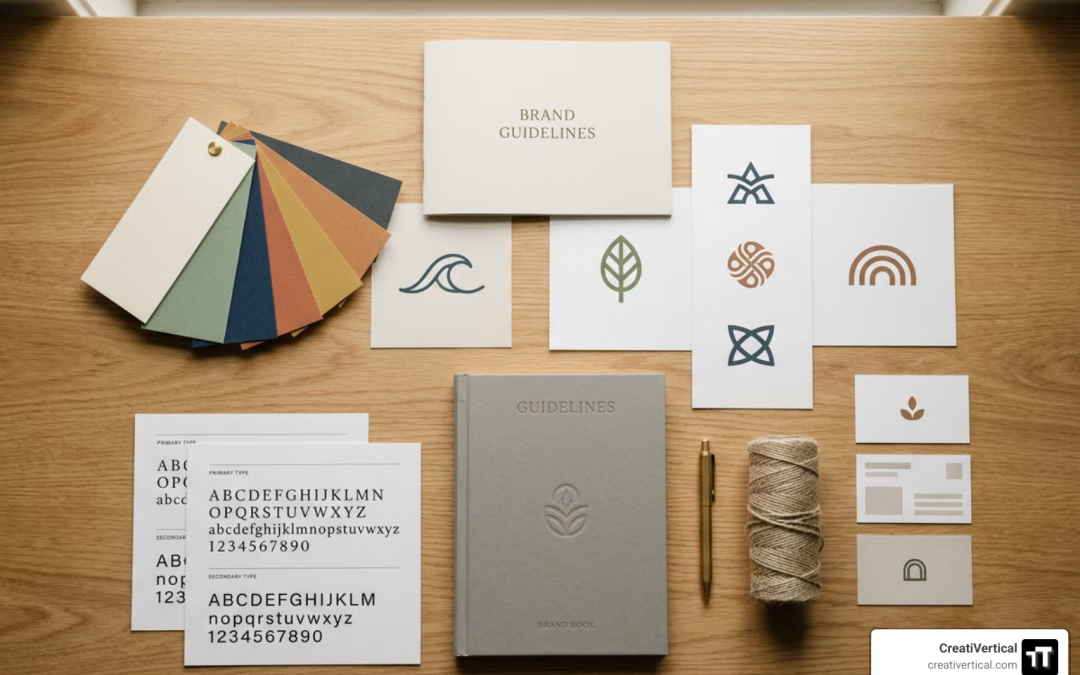
Brand development packages are bundled services that take a business from no identity (or a broken one) to a complete, consistent brand system. Most packages combine some mix of strategy, visual identity, and marketing assets.
Here’s a quick-reference breakdown of what’s typically on the market:
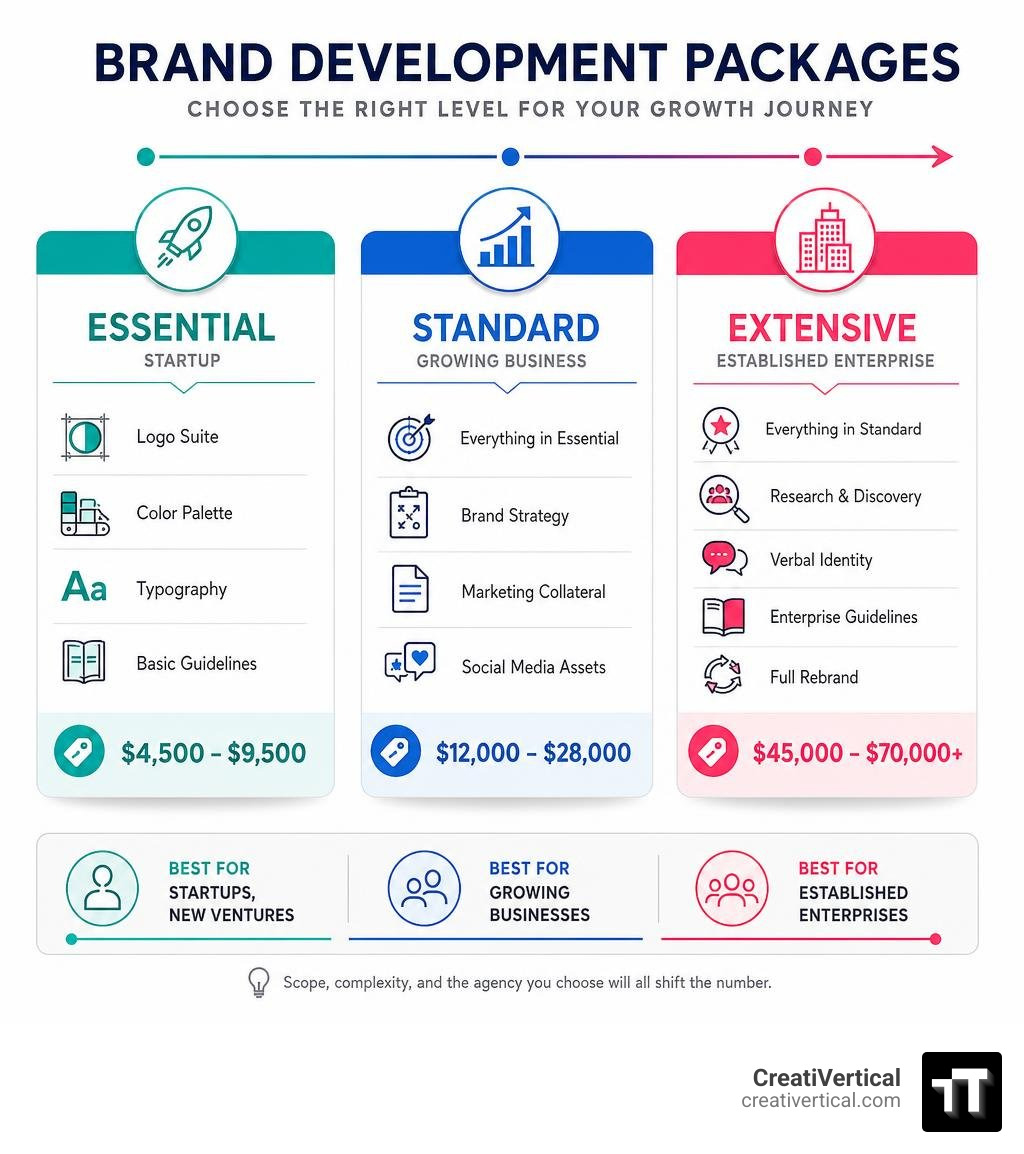
| Package Tier | Best For | What’s Usually Included | Typical Market Cost |
|---|---|---|---|
| Essential | Startups, new ventures | Logo suite, color palette, typography, basic guidelines | $4,500 – $9,500 |
| Standard | Growing businesses | Above + brand strategy, collateral, social assets | $12,000 – $28,000 |
| Extensive | Established enterprises | Full rebrand, verbal identity, research, enterprise guidelines | $45,000 – $70,000+ |
Prices above reflect general market ranges from branding agencies. Scope, complexity, and the agency you choose will all shift the number.
The decision isn’t just about budget. It’s about what stage you’re at and what you actually need to grow.
A startup preparing for its first fundraise needs something different from a mid-market manufacturer trying to win procurement contracts. And a business that just outgrew its DIY logo is in a different place than one entering a new market.
Research consistently shows the stakes are real: consistent branding across channels can increase revenue by up to 23%, and businesses with cohesive visual identities are significantly more likely to be remembered by customers.
Yet most articles on this topic either try to sell you the most expensive package or give you a generic checklist that doesn’t help you decide anything.
This guide cuts through that. We compare tiers, explain what’s worth paying for, and help you match a package to your actual situation — whether you’re a Kansas City small business, an offshore professional-services firm, or a B2B manufacturer with a technical product and a long sales cycle.
I’m Nicholas Cunha, founder of CreatiVertical — a family-run digital agency in Kansas City with over twenty years of agency experience, including hands-on work developing brand development packages for government institutions, offshore professional services firms, and B2B businesses across multiple markets. In the sections below, we’ll walk through every major decision you’ll face when evaluating branding options, so you can invest confidently.
What is a Brand Development Package and Why Does It Matter?
At its core, a brand development package is more than just a folder of logo files. It is a strategic blueprint and a visual toolkit built to work as a unified system. While many business owners think of branding as a purely aesthetic exercise, it is actually the operational foundation of how your market perceives your credibility, value, and capability.
When you invest in structured Brand Development, you are establishing a “brand foundation” — the core mission, vision, values, and distinct market positioning that direct how your business communicates.
The visual identity is the outward expression of this foundation. It includes your primary logo, secondary marks, color palettes, typographic systems, and graphic elements. When these pieces are designed to work together, they solve a massive operational headache: fragmentation.
Without a cohesive package, businesses often end up with a website designed by one vendor, business cards printed by another, and social media graphics created by an internal team member using a basic template. This disjointed approach erodes trust.
Consider the impact of professional branding on business growth:
- Builds Immediate Trust: Over 70% of small businesses that invest in professional branding report a noticeable increase in customer trust and loyalty.
- Drives Revenue: Maintaining a highly consistent brand presence across all of your marketing channels can increase revenue by up to 23%.
- Enhances Recall: Businesses with strong, cohesive visual systems are 3 times more likely to be remembered by prospective customers when they are ready to make a purchasing decision.
- Establishes Authority: Professional branding makes emerging companies look established, stable, and highly capable right out of the gate.
For specialized businesses, this credibility is non-negotiable. If you are an offshore fiduciary provider in the Cayman Islands or a precision lubricant manufacturer in Missouri, your brand must immediately signal institutional-grade reliability. A cheap, templated logo won’t survive contact with sophisticated B2B buyers or corporate partners.
Comparing Essential, Standard, and Extensive Brand Development Packages
Branding agencies structure their offerings in tiers to align with different business stages and operational goals. Understanding the boundaries between these tiers ensures you do not overpay for enterprise-level strategy you aren’t ready to use, or under-invest in a basic package that fails to address your complex market position.
Before diving into the specific tiers, it helps to understand how your brand’s position scales from a simple visual identifier to an enterprise-wide communication system.

To help you visualize where your business fits, you can also review how we approach Brand Development Positioning to align visual identity with concrete business objectives.

Essential Packages for Startups
An Essential package is designed for emerging businesses, pre-seed startups, and local service providers who need to establish a professional market presence quickly.
- What’s Included: A primary logo, a secondary logo or sub-mark (for social media icons and small-space applications), a basic color palette (with exact HEX, RGB, and CMYK codes), a typography system, and a basic style sheet.
- The Goal: To move from a placeholder or DIY identity to a clean, professional, and consistent visual foundation.
- Who It’s For: A new local business in Lake Tapawingo, MO, or a pre-revenue startup preparing for an initial seed round where the primary objective is to make investors and early adopters believe in the team’s vision.
Standard Packages for Growing Businesses
A Standard package is the sweet spot for established businesses that have outgrown their original branding and need a comprehensive system to support active marketing and sales efforts.
- What’s Included: Everything in the Essential tier, plus a formalized brand strategy (defining positioning, target audience, and core messaging), comprehensive brand guidelines, corporate stationery (business cards, letterhead, email signatures), and a suite of social media templates.
- The Goal: To unify all marketing touchpoints, arm sales teams with professional collateral, and ensure internal teams can easily produce on-brand content.
- Who It’s For: A scaling B2B service firm or a mid-sized industrial company that needs to look polished, uniform, and highly competitive across digital and print channels.
Extensive Packages for Established Enterprises
An Extensive package is a deep-dive, highly customized engagement built for market leaders, complex organizations, and companies undergoing major transitions like mergers, acquisitions, or global expansion.
- What’s Included: In-depth market and competitor research, a comprehensive verbal identity (including naming, taglines, messaging frameworks, and tone-of-voice guidelines), custom iconography, bespoke patterns or textures, packaging design templates, advanced corporate pitch decks, and extensive multi-department brand governance guidelines.
- The Goal: To align internal culture, establish authoritative market leadership, and construct an enterprise-ready brand engine that performs consistently across global offices and complex product lines.
- Who It’s For: Government contractors working under strict compliance frameworks, offshore law firms managing multi-jurisdictional clients, or established manufacturers looking to completely dominate their category.
The Real Cost of Branding: Pricing, Timelines, and Deliverables
When looking at the pricing of brand development packages, it is important to understand what actually drives those costs. Generally, pricing is influenced by:
- The Depth of Strategy: Are you paying for a designer to create visual assets, or are you paying for a strategic partner to conduct market research, run stakeholder workshops, and write your positioning framework?
- Organizational Complexity: A local business with one decision-maker can move quickly. An enterprise with a board of directors, multiple partners, and technical engineering leads requires a far more intensive, collaborative refinement process.
- Customization: Custom-drawn typography, bespoke brand patterns, and tailor-made physical packaging templates require highly specialized design hours compared to standard layouts.
Understanding these cost drivers helps you evaluate regional agency proposals and see how different providers structure their services and positioning.
Typical Timelines and Process Milestones
A professional branding project is a structured journey. While some low-cost platforms promise a logo in 24 hours, a strategic brand system built to last for years typically follows a timeline of 4 to 12 weeks:
- Phase 1: Discovery & Research (Weeks 1-2): This is where we run brand clarity sessions, review your competitors, analyze your target audience, and define the strategic foundation.
- Phase 2: Concept Development (Weeks 3-5): Designers translate the strategy into visual concepts. Agencies typically present 2 to 3 distinct visual directions, showing how they apply to real-world mockups.
- Phase 3: Revision Rounds (Weeks 6-8): Collaborative feedback loops where we refine the chosen direction. Standard professional packages typically include 2 to 3 rounds of structured revisions.
- Phase 4: Final Asset Delivery & Handover (Weeks 9-10): The creation of the final files, the writing of the comprehensive brand guidelines document, and the delivery of all source files.
Key Deliverables You Should Expect
When your package is complete, you should fully own your brand. A professional agency will deliver a complete, organized asset library including:
- Vector Source Files: Files in formats like AI, EPS, and SVG that allow you to scale your logo to any size (from a favicon to a highway billboard) without losing quality.
- High-Resolution Digital Assets: Web-ready PNG and JPG files with transparent backgrounds, optimized for digital platforms.
- A Comprehensive Brand Style Guide: A document detailing exactly how to use your logos, colors, and typography, ensuring your team can maintain consistency.
- Trademark Pre-Check Documentation: For standard and extensive packages, a preliminary review to ensure your proposed brand assets are safe to use in your target jurisdictions.
Integrating Your Brand Across Digital Channels
A brand does not live in a vacuum; it lives on the screens of your prospects. A beautiful brand system is only as good as its digital execution.
To get the most out of your visual assets, you must understand how to Build Your Brand on Social Media and implement strategies on How to Build Brand Awareness Online to turn your new identity into a customer-acquisition engine.
Aligning Brand Identity with Web Development
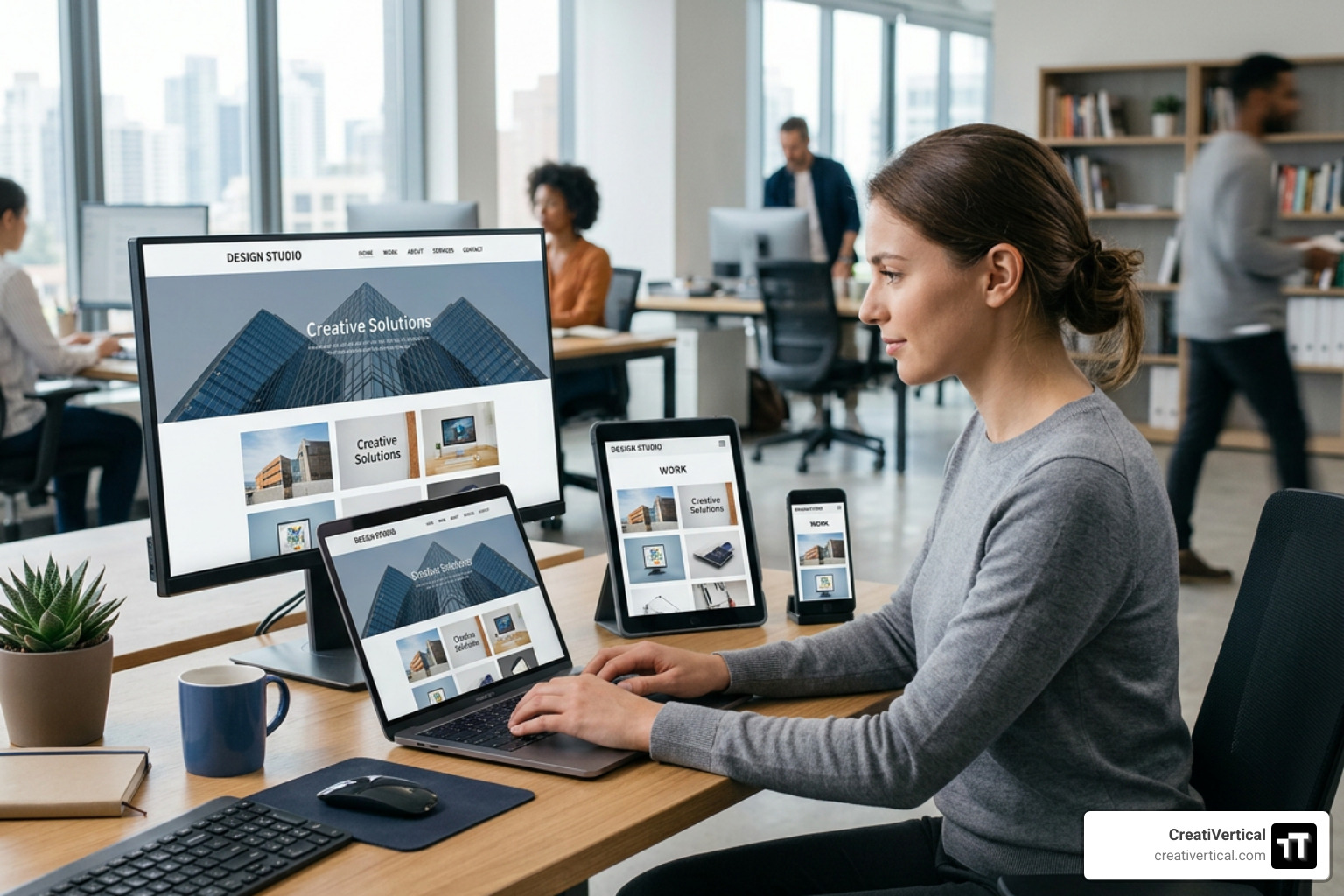
Your website is your digital flagship. When integrating your brand package with web development, the goal is to create a seamless, high-performance experience.
This integration requires careful planning across several key areas:
- Responsive Design: Your visual brand must adapt flawlessly to any device. Logos should scale down cleanly for mobile headers, and typographic hierarchies must remain highly readable on smaller screens.
- User Experience (UX): Brand colors should not just look beautiful; they should guide the user. Using primary brand colors for high-priority calls-to-action (CTAs) and secondary colors for supportive elements creates an intuitive browsing path.
- Custom Integrations: For technical B2B companies, industrial manufacturers, or professional service firms, your website often needs to connect to complex databases, inventory systems, or client portals. The design of these custom tools should feel like an organic extension of your brand identity, not a clunky third-party add-on.
Social Media and Content Marketing Assets
To maintain a professional presence online, your team needs structured assets they can deploy daily. This is where your brand package’s social media kit becomes invaluable.
By providing reusable social media templates (built in tools like Figma or Canva), your marketing team can rapidly produce high-quality posts, banners, and slides that align perfectly with your core brand. This consistency ensures that whether a prospect finds you via a LinkedIn article, a search engine, or a direct referral, they experience the exact same level of professional polish.
How to Choose the Right Agency and Package for Your Business
Selecting a branding partner is a major business decision. To find an agency that aligns with your goals, look closely at their approach, portfolio, and strategic focus.
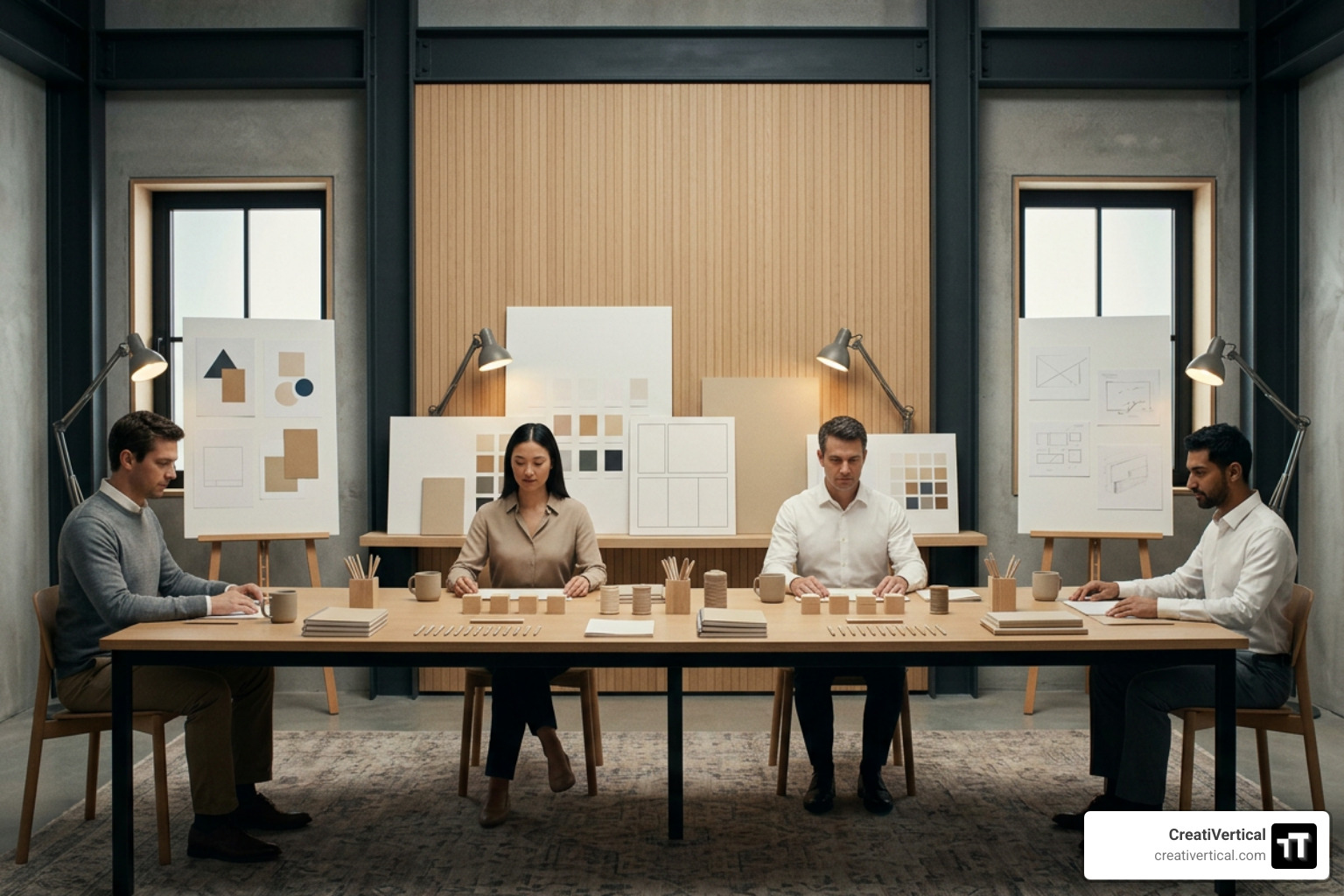
When evaluating potential partners, consider these key steps:
- Look for Strategic Alignment: Avoid agencies that jump straight into design without asking deep questions about your business goals, target audience, and market realities. A strong creative partner understands that visual design must always be anchored in clear brand strategy.
- Review Their Portfolio for Versatility: A great agency doesn’t have a single signature style; instead, their portfolio should show a diverse range of visual identities, each tailored specifically to the unique personality and industry of their clients.
- Seek Local & Specialized Expertise: If you are a business operating in Missouri, partnering with an agency that understands regional dynamics can be incredibly valuable. Whether you are a business in the heart of Kansas City, MO, or operating near Lake Tapawingo, regional knowledge matters. For municipal organizations or local entities, checking resources like the City Of Lake Tapawingo, MO: Home page can show how community identity and local presence shape public-facing communications.
- Evaluate Their Technical Capabilities: If your branding needs to live across printed materials, signage, and physical environments, look for partners who understand those mediums. Working with a team experienced in physical production ensures your digital assets translate perfectly to print, signage, and environmental design without unexpected color shifts or production issues.
- Ask About the Handover: Ensure the agency delivers complete, organized source files with full intellectual property ownership transferred to you upon project completion.
Frequently Asked Questions About Brand Development Packages
What is typically included in standard brand development packages?
A standard brand development package is built to provide a complete, ready-to-use identity system. It typically includes:
- Logo Suite: Primary logo, secondary logo, and simplified brand marks (optimized for social media profiles and small digital spaces).
- Visual Standards: A curated color palette with precise color codes (HEX, RGB, CMYK) and a defined typography hierarchy (specifying primary and secondary fonts).
- Brand Guidelines: A comprehensive style manual outlining usage rules, spacing requirements, and design best practices.
- Collateral Templates: Basic business stationery (business cards, letterheads, email signatures) and a set of customizable social media templates.
How much do professional brand development packages cost in 2026?
In 2026, professional, agency-grade branding packages generally fall into these market ranges:
- Essential/Startup Packages: $4,500 to $9,500. Best for new businesses needing a clean, professional visual foundation.
- Standard/Growth Packages: $12,000 to $28,000. Designed for established companies looking to unify their marketing and elevate their market presence.
- Extensive/Enterprise Packages: $45,000 to $70,000+. Built for large organizations, complex B2B manufacturers, or firms requiring deep research, naming services, and global brand governance.
Note: Pricing always varies based on project scope, competitive landscape, and specific business goals. These are general industry ranges for market context.
How long does it take to complete a full branding package?
A comprehensive brand development project typically takes between 4 and 12 weeks. This timeline depends entirely on the complexity of the project, the depth of research required, and the speed of the client feedback loops. A standard agency schedule allocates 2 weeks for discovery and research, 3 weeks for creative concept development, 2 to 3 weeks for revisions and refinement, and 1 to 2 weeks for final file generation and asset delivery.
Conclusion: Charting Your Course with a Growth Partner
Your brand is the launchpad for all of your marketing, sales, and growth efforts. Investing in a professional brand development package is not about buying a logo; it is about building a scalable, high-performance digital system that earns trust, commands attention, and drives long-term revenue.
At CreatiVertical, we don’t believe in transactional, one-off projects that leave you with a folder of files and no clear path forward. We operate as your ongoing growth partner, ensuring your brand strategy, web development, SEO, and AI search visibility work together as a unified system to fuel your business.
Whether you are a local Kansas City business, an offshore professional services firm, an industrial manufacturer, or a government contractor, we are here to help you design a brand system built to perform.
Ready to build a brand that drives real business outcomes? Let’s collaborate on Custom Marketing Strategies designed to scale your business. Explore our full suite of services on our Brand Development pillar page, and let’s chart a course for your business growth today.