
Why Most Manufacturers Are Losing Deals Before the First Phone Call
Manufacturing B2B marketing is the set of strategies manufacturers use to attract, engage, and convert business buyers — including OEMs, procurement officers, distributors, and engineering teams — rather than end consumers.
Here’s a quick breakdown of what it involves:
| What It Is | What It Covers |
|---|---|
| Who it targets | Procurement officers, design engineers, OEMs, distributors, C-suite buyers |
| How it differs | Longer sales cycles (6–18 months), technical audiences, multi-stakeholder decisions |
| Core channels | SEO, content marketing, LinkedIn, ABM, trade shows, email nurture |
| Key goal | Build pipeline, earn technical credibility, and shorten the buying journey |
| Biggest challenge | Proving ROI across long cycles with multiple decision-makers |
For decades, most manufacturers grew on three things: relationships, referrals, and trade show booths. That model worked — until it didn’t.
Today, buyers are doing the majority of their research before they ever contact a vendor. They’re searching capability pages, reading technical whitepapers, watching product demos on YouTube, and — increasingly — asking ChatGPT to shortlist suppliers. By the time a procurement officer picks up the phone, they’ve often already narrowed the field.
Yet a striking 66% of manufacturers say their content isn’t converting, and 64% struggle to prove ROI from their marketing efforts. Most manufacturing websites are still digital brochures. Most social media accounts post announcements nobody reads. And most marketing budgets chase tactics borrowed from SaaS companies with 90-day sales cycles — not industries where a single contract can take 18 months to close.
The gap between how manufacturers sell and how industrial buyers research has never been wider. That’s the problem this guide is built to fix.
I’m Nicholas Cunha, founder of CreatiVertical — I’ve spent over two decades doing agency work across government, industrial, and B2B sectors, including hands-on manufacturing B2B marketing for clients in precision equipment, lubricants, machined parts, and industrial chemicals. This guide reflects what actually moves the needle for technical buyers with long decision cycles — not generic digital marketing advice dressed up in industrial language.
Why Manufacturing B2B Marketing Requires a Different Blueprint
If you try to run a generic B2B SaaS playbook for a precision machining company or an industrial chemical plant, you will fail. The mechanics of the industrial buying cycle are fundamentally different. SaaS companies worry about user churn and click-through rates; manufacturers worry about production capacity, raw material price fluctuations, and whether a custom battery pack will fail in the field.
To build a marketing system that actually fuels your sales pipeline, you must first understand the unique constraints of the industrial buyer’s world.

The Industrial Buyer’s Reality
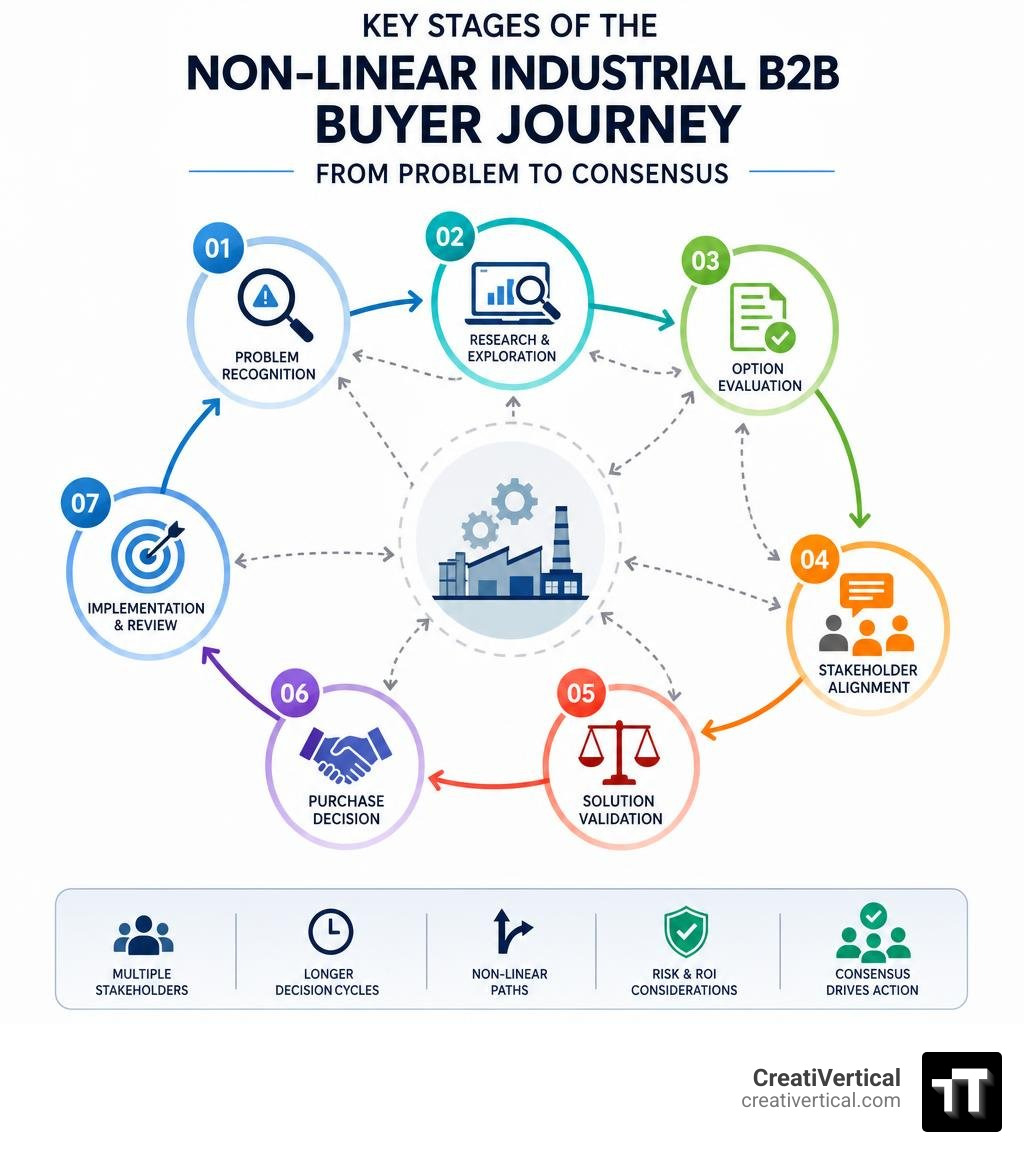
In consumer retail or software, the gap between “I want this” and “I bought this” can be measured in minutes or days. In manufacturing, that gap is often six to eighteen months. Why? Because the stakes are incredibly high.
If a software tool doesn’t work out, the customer cancels their subscription. If an industrial lubricant fails, a multi-million dollar production line grinds to a halt, or a fleet of heavy equipment suffers catastrophic engine failure. The risk is physical, financial, and operational.
To illustrate these differences, let’s look at how manufacturing marketing compares to SaaS:
| Marketing Dimension | B2B SaaS | B2B Manufacturing |
|---|---|---|
| Sales Cycle Length | 30 to 90 days | 6 to 18 months |
| Buying Committee | 3 to 6 stakeholders | 8 to 12 stakeholders |
| Primary Risk | Wasted software budget | Physical failure, downtime, supply chain disruption |
| Content Focus | Features, benefits, software ease-of-use | Tolerances, materials, certifications, capacity |
| Discovery Channels | Google Search, software review sites | ThomasNet, capability pages, industry networks, AI search |
| Customer Lifetime Value | Moderate (high churn risk) | Extremely high (decades-long supply relationships) |
Because of this physical reality, manufacturing buyers are highly risk-averse. They do not want flashy marketing copy or generic promises of “innovation.” They want raw data, technical specifications, and proof of capability.
Navigating the Complexities of Manufacturing B2B Marketing
The buying committee for a major manufacturing contract is diverse, and each member speaks a different language. To win their trust, your marketing must address each stakeholder’s specific concerns:
- Design and Application Engineers: These are the technical gatekeepers. They don’t care about your pricing yet — they care about your tolerances, equipment lists, and material capabilities. They need CAD files, detailed datasheets, and trade-off analyses. If your website makes it hard to find your equipment specifications or custom capabilities, they will cross you off the list.
- Procurement and Sourcing Professionals: These buyers care about risk mitigation, supply chain stability, and pricing. They want to see your certifications (like ISO 9001, AS9100, or IATF 16949) and understand your capacity. They are looking for performance guarantees and transparent lead times.
- Production and Plant Managers: They want to know how your parts or equipment will integrate into their existing production lines. Will it cause downtime? What does the partner enablement and training look like?
- Executive Sponsors (CFO, COO, VP of Operations): They focus on the big-picture business impact, ROI, and total cost of ownership (TCO).
To address these distinct needs, successful industrial brands build structured digital platforms. Instead of treating your website like a static brochure, you should structure your content to serve each persona at every stage of their journey, ensuring technical specifications and commercial terms are easily accessible.
Aligning Sales and Production with Marketing Goals
One of the biggest mistakes we see in manufacturing B2B marketing is a total disconnect between the marketing department, the sales team, and the production floor.
If marketing runs a campaign that generates a massive influx of RFQs for custom machined parts, but the production floor is already at 95% capacity for the next two quarters, you have wasted your budget. Conversely, if the plant just invested in a new five-axis CNC machine that is currently sitting idle, marketing needs to know so they can target high-value accounts that require that exact capability.
This is where a Revenue Operations (RevOps) approach comes in. Your sales, marketing, and operations teams must share a single, unified view of the pipeline:
- Shared Lead Definitions: Marketing and sales must agree on what constitutes a Marketing Qualified Lead (MQL) versus a Sales Qualified Lead (SQL). In manufacturing, an MQL shouldn’t just be someone who downloaded a whitepaper — it should be a contact from an Ideal Customer Profile (ICP) company with a specific purchase trigger.
- Documented Handoff Processes: When an RFQ is submitted, how quickly does sales respond? A one-second delay in page load times can hurt your website conversion rates, but a three-day delay in responding to an RFQ will kill the deal entirely.
- Capacity-Driven Marketing: Marketing campaigns should align with actual shop floor capacity. If you have excess capacity in your industrial chemical blending division, your marketing efforts should pivot to fill that specific gap.
Overcoming the Biggest Challenges in Modern Industrial Marketing
The manufacturing sector is a massive engine of economic growth, contributing $2.3 trillion to the U.S. GDP. Yet despite this scale, many mid-size manufacturers are still running their digital engines on outdated tactics.
The digital landscape has shifted dramatically. Let’s look at the major challenges industrial marketers face today and how to solve them.
Resource Constraints and the “Invisible Supplier” Trap
According to industry data, 57% of manufacturing marketers cite lack of resources as their biggest challenge. Many marketing teams consist of a single person who is also responsible for organizing trade shows, ordering company swag, and managing internal communications.
Because of this lack of bandwidth, many manufacturers fall into the “invisible supplier” trap. They rely entirely on a few legacy clients. This client concentration is incredibly risky. If you depend on one or two major OEMs for 80% of your revenue, a single supply chain shift or corporate acquisition can wipe out your business overnight.
To break out of this trap, you must treat marketing as a strategic revenue center rather than an administrative expense. Even with limited resources, you can build a highly efficient digital system by focusing on the highest-leverage channels. To understand how to navigate these resource shifts, take a look at our guide on Digital Marketing Tips for 2025 Trends and Predictions.
Building a High-Converting Manufacturing B2B Marketing Strategy
If your content isn’t converting, it’s usually because it focuses too much on you and not enough on your customer’s problems.
Most manufacturing blogs are filled with articles about company picnics, new equipment purchases, or generic industry announcements. While it’s great that you bought a new laser cutter, your target buyer doesn’t care about the machine itself — they care about what that machine can do for their production lead times, part quality, and unit costs.
To build a content engine that actually drives pipeline, you must shift from self-promotional content to educational, point-of-view content. Your content should answer the exact questions your buyers are asking during their research:
- What are the design trade-offs between CNC machining and 3D printing for low-volume metal parts?
- How does temperature fluctuation affect the viscosity of custom lubricants in high-speed applications?
- What are the compliance requirements for manufacturing custom medical device batteries under FDA guidelines?
By answering these complex, technical questions, you build immediate credibility with the design engineers who influence the buying decision, positioning your brand as the obvious choice long before the formal RFQ process begins.
Differentiating Your Brand in a Crowded Market
Walk through any industrial trade show and you will see the same buzzwords repeated on every booth: Quality. Innovation. Reliability. Customer-First.
When everyone claims to be “quality-driven,” the word loses all meaning. To stand out, your brand positioning must be backed by specific, verifiable metrics and unique capabilities.
One of the most powerful ways to differentiate in 2026 is through supply chain transparency and sustainability reporting. Modern procurement teams are under immense pressure to track and report their Scope 3 carbon emissions and ethical sourcing metrics. If you can provide clear, audited ESG data, carbon footprint tracking, and material traceability reports, you aren’t just a supplier anymore — you are a strategic partner that helps them meet corporate compliance goals.
Core Pillars of a Modern Industrial Marketing Strategy
To build a reliable digital pipeline, you must move beyond disconnected marketing tactics and build a unified, performance-focused system. Here are the core pillars that drive growth for industrial and B2B manufacturers.

1. Technical SEO and Capability-Page Optimization
Your website is your digital factory floor. If it is slow, hard to navigate, or lacks technical substance, buyers will leave within seconds.
Traditional B2B SEO focuses on high-volume, generic keywords. In manufacturing, you want to target high-intent, technical long-tail keywords. A buyer searching for “machined parts” is likely just researching; a buyer searching for “AS9100 certified titanium CNC machining Kansas City” is ready to send an RFQ.
To capture these high-value buyers, your capability pages must be structured with technical depth:
- Detailed Equipment Lists: Don’t just say you have CNC machines. List the make, model, axis capabilities, and bed sizes of your equipment.
- Tolerance Tables: Clearly state the tolerances your shop can consistently hold across different materials.
- Materials Lists: List every material you regularly run, from aerospace-grade titanium to specialized engineering plastics.
- Certifications: Place your ISO, AS, IATF, or ITAR certifications prominently on every page, with downloadable PDF copies of your certificates.
- Simplified RFQ Forms: A complex, 15-field form can kill conversions. Use a streamlined, 4-field RFQ form that allows buyers to quickly upload their CAD files and spec sheets.
For more insights on structuring high-performing digital frameworks, check out our analysis of the Best Marketing Strategies in 2024.
2. Generative Engine Optimization (GEO)
In 2026, the way buyers find information has fundamentally changed. Procurement officers and design engineers are no longer just scrolling through pages of Google search results. They are using AI-powered search engines like ChatGPT, Perplexity, and Google AI Overviews to do their initial market research.
A buyer might ask an AI tool: “Which custom battery manufacturers in the Midwest have experience with medical-grade lithium-ion packs and hold ISO 13485 certifications?”
If your digital footprint isn’t optimized for these generative engines, your company won’t even make the AI’s shortlist. Generative Engine Optimization (GEO) is the practice of structuring your website’s content, metadata, and schema so that AI models can easily crawl, understand, and cite your brand. This involves:
- Clear, Declarative Language: Use precise, factual statements on your website instead of vague marketing jargon.
- Structured Data and Schema Markup: Clearly label your products, capabilities, locations, and certifications so AI algorithms can parse them instantly.
- Thought Leadership and Citations: Publish original research, detailed technical guides, and whitepapers that other industry sites link to, establishing your brand as an authority in the AI’s training data.
3. Immersive Digital Experiences and Video Demos
Because manufacturing deals with physical products, showing beats telling every single time. If a buyer cannot physically visit your facility, you must bring your facility to them.
- 3D Product Configurators: If you sell modular equipment or highly customizable components, an interactive 3D configurator is a game-changer. It allows engineers to customize parts, view them from every angle, and download the exact CAD files they need for their designs. Industrial sites with interactive configurators can generate up to three times more qualified inquiries than those with static product pages.
- Technical Video Demos: Video is the preferred format for technical education. Create high-definition machine walkthroughs, QA testing footage, and micro-training videos. If you sell custom machinery, show it in action, running at full speed, with clear explanations of its technical advantages.
- Virtual Factory Tours: Showcase your facility’s cleanliness, organization, and advanced robotics through high-quality virtual tours. It builds immediate trust with international or out-of-state buyers who want to verify your operational excellence.
Account-Based Marketing (ABM) for High-Value Contracts
If your business relies on landing large, multi-million dollar OEM contracts, broad demand generation campaigns can be highly inefficient. Instead, you should focus your resources on a highly targeted Account-Based Marketing (ABM) strategy.
ABM is like a laser-focused spotlight rather than a broad floodlight. You identify a small list of high-value target accounts (typically 25 to 100 companies) and build highly personalized marketing and outreach campaigns tailored specifically to them.
Here is how to structure a manufacturing ABM program:
- Tier Your Accounts: Divide your target list by Account Value (ACV) potential. Your top-tier accounts (potential $1M+ contracts) get highly personalized, 1:1 outreach. Mid-tier accounts ($300K to $1M) get vertical-specific, 1:few campaigns.
- Map the Buying Committee: Identify the key decision-makers within each target account — from the VP of Operations to the lead design engineer.
- Monitor Buying Signals: Use intent data tools to track when target accounts are researching specific topics, hiring new operations leaders, or announcing domestic expansion plans.
- Create Personalized Content: Build custom landing pages, send personalized technical teardowns, or offer custom engineering workshops tailored specifically to the target account’s unique operational challenges.
Leveraging LinkedIn and Social Media for Industrial Authority
Many manufacturers dismiss social media because they assume their buyers aren’t hanging out on platforms like TikTok or Instagram. They’re right. But those same buyers are on LinkedIn, and they are using it as a primary research channel.
While 95% of manufacturers use social media, only 39% report strong results. That’s because most companies use LinkedIn to post dry corporate announcements or generic sales pitches.
To win on LinkedIn, you must leverage employee advocacy and thought leadership. Posts from named experts — like your head of engineering, plant manager, or CEO — routinely outperform corporate company pages by 6 to 10 times in reach and engagement.
Encourage your technical leaders to share their hands-on expertise, discuss complex engineering challenges, and post behind-the-scenes footage of interesting production runs. By putting a human face on your technical expertise, you build a powerful, trusted brand that stays top-of-mind when buying opportunities arise.
Frequently Asked Questions About Manufacturing Marketing
How do we measure marketing ROI with a 12-month sales cycle?
Proving ROI across a long, multi-stakeholder sales cycle is notoriously difficult. If you only track immediate form submissions, your marketing efforts will always look underfunded and underperforming.
To accurately measure ROI, you must track pipeline velocity and offline conversions:
- First-Touch and Multi-Touch Attribution: Use advanced CRM integrations to track every touchpoint a buyer has with your brand — from the first time they read a technical blog post to the moment they download a CAD file, visit your booth at FABTECH, and finally submit an RFQ.
- Offline Conversion Imports: Import your CRM sales stages back into your advertising platforms (like Google Ads). This allows smart bidding algorithms to optimize for actual qualified opportunities and closed-won revenue, rather than just raw, low-value form submissions.
- Track Leading Indicators: Monitor metrics that indicate future pipeline growth, such as increase in high-intent organic search traffic, downloads of technical datasheets, and engagement from target ABM accounts.
What is Generative Engine Optimization (GEO) and why does it matter?
Generative Engine Optimization (GEO) is the process of optimizing your digital presence so that AI-powered search engines (like ChatGPT, Perplexity, and Google’s Gemini-powered search) find, understand, and recommend your company as a preferred supplier.
It matters because the traditional search engine results page (SERP) is changing. Instead of clicking through ten blue links, buyers are increasingly reading AI-generated summaries that synthesize information from across the web. If your capability pages, certifications, and technical expertise are not structured in a way that these AI models can easily cite, your brand will remain invisible to a massive portion of the modern buying market.
Should we build an in-house marketing team or partner with an agency?
There is no one-size-fits-all answer, but for most mid-size manufacturers, a hybrid model works best.
Building a fully in-house team that has expertise in technical writing, SEO, web development, paid search, and video production is incredibly expensive and difficult to scale. Conversely, hiring a generic marketing agency that doesn’t understand the difference between CNC milling and injection molding will lead to shallow, ineffective campaigns that fail to earn technical credibility.
A hybrid approach allows you to keep your core industry knowledge in-house while leveraging specialized partners for execution:
- In-House Role: Keep your internal subject matter experts (like your engineers and sales leaders) focused on defining your unique value proposition, sharing technical insights, and nurturing relationships.
- Agency Partner Role: Use an experienced digital agency to handle technical SEO, GEO, web development, paid search management, and system integrations.
To help evaluate your options, read our guide on What You Should Consider Hiring a Digital Marketing Agency.
Conclusion: Fueling Your Industrial Growth Engine
The era of the “invisible supplier” is over. Operational excellence and traditional relationships are no longer enough to guarantee sustainable growth in a highly competitive, digital-first industrial market.
To win the high-value contracts that sustain your business for decades, you must transition from an invisible manufacturer to a trusted, highly visible technical authority. You need a digital system that works in parallel with your sales team, educating buyers, capturing high-intent search traffic, and building pipeline even when your sales team is asleep.
At CreatiVertical, we don’t build generic marketing campaigns. We design, promote, and maintain complete, performance-focused digital systems built specifically for industrial and B2B manufacturers. Whether you produce precision equipment, custom lubricants, machined parts, batteries, or industrial chemicals, we act as your ongoing growth partner to help you scale your B2B pipeline.
Ready to stop running boring blogs and start building a high-converting digital engine? Let’s chart a course for your brand’s growth. Connect with us at our B2B Marketing Agency in Kansas City to start a conversation.