

Why Offshore Corporate Services Marketing Requires a Different Playbook
Offshore corporate services marketing sits at a rare intersection: technically complex, heavily regulated, and built entirely on trust. If you’re a law firm, fiduciary provider, or company-formation agent in a jurisdiction like the BVI, Cayman Islands, or Jersey, you already know that getting found by the right international buyers — and converting them — is a different challenge than almost any other B2B category.
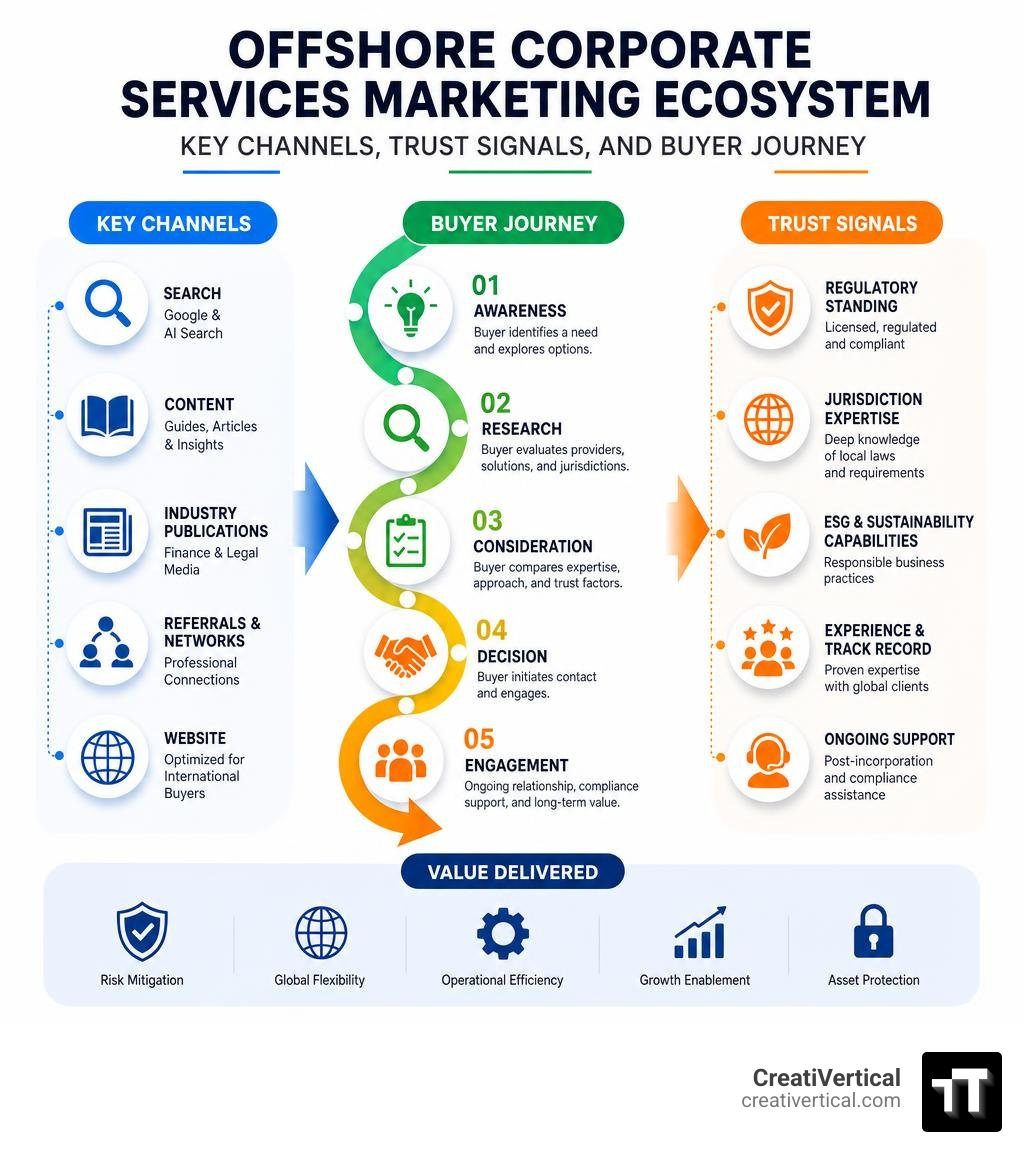
Here’s a quick map of what effective offshore corporate services marketing actually involves:
- Credibility-first positioning — Your buyers (asset managers, family offices, private equity firms, UHNWIs) are sophisticated. They vet providers carefully before making contact.
- Compliance-aware messaging — Marketing language must stay inside legal-advertising boundaries. One wrong claim creates real liability.
- Search visibility in the right channels — International buyers research offshore options on Google, AI tools like ChatGPT and Perplexity, and specialist finance publications — not social media feeds.
- Trust signals at every touchpoint — Regulatory standing, jurisdiction expertise, ESG capabilities, and post-incorporation support all factor into a buyer’s decision.
- Content that answers real questions — Buyers want to understand structures, risks, and compliance obligations before they call you.
The global corporate services market was estimated at $11.9 billion in 2025 and is projected to reach $18.4 billion by 2032, growing at a 6.5% CAGR. That growth is being driven by rising regulatory complexity, demand for cross-border structuring, and the expansion of ESG advisory as a core service line — not by price competition alone.
Getting visible to the right buyers in this market takes more than a polished website. It takes a marketing approach built specifically for regulated, trust-sensitive professional services — and most generic digital agencies don’t know how to do it.
I’m Nicholas Cunha, founder of CreatiVertical, and I spent fifteen years running a digital agency in the British Virgin Islands serving government bodies and major institutions before building our current practice around offshore corporate services marketing and other specialized B2B verticals. That experience in a small offshore market informs everything we cover below.
Understanding the Offshore Corporate Services Landscape
To market offshore corporate services effectively, we must first understand the fundamental value they deliver to global businesses. In today’s interconnected economy, cross-border corporate structures are not about hiding resources; they are about operational efficiency, risk mitigation, and structural flexibility.
Offshore corporate services encompass company formation, registered agent representation, statutory compliance, tax planning, asset protection, and administrative support in jurisdictions outside the client’s home country. For multinational entities, these services are essential tools to achieve:
- Asset Protection: Isolating operational liabilities from holding assets through secure, multi-layered corporate structures.
- Tax Efficiency: Legally minimizing tax obligations by utilizing favorable local tax regimes, double taxation treaties, and specialized frameworks.
- Global Expansion: Establishing neutral, stable, and highly recognized corporate vehicles that simplify international trade, investment, and cross-border transactions.
Providers like Opal Offshore emphasize that successful cross-border structuring requires more than simple incorporation. It demands complete operational readiness, which includes aligning documentation with the rigorous expectations of international banks and payment service providers (PSPs). When marketing these services, the narrative must shift from “easy setup” to “long-term structural resilience and banking-readiness.” For a deeper look at how to position complex offerings, see our guide on How to Approach Financial Services Marketing.
Key Jurisdictions and Client Profiles
The offshore landscape is diverse, with different jurisdictions catering to specific client needs. Leading international finance centers (IFCs) like the British Virgin Islands (BVI), the Cayman Islands, and Jersey have built decades of trust by maintaining robust regulatory frameworks and political stability.
- The Cayman Islands: The premier jurisdiction for investment funds, Web3 foundations, token issuers, and digital asset investment structures.
- The British Virgin Islands (BVI): Widely favored for holding companies, joint ventures, and versatile Business Companies (BCs).
- Jersey: Highly regarded for its enduring political and economic stability, hosting over 14,000 skilled finance professionals and 19 international banks. It is a destination of choice for complex, cross-border, multi-jurisdictional corporate business.
The target buyers of these services are not average consumers. They are highly sophisticated institutional and private clients, including:
- Asset Managers and Private Equity Firms establishing fund vehicles.
- Family Offices and Ultra-High-Net-Worth Individuals (UHNWIs) seeking wealth preservation and succession planning.
- Public Limited Companies (PLCs) structuring cross-border mergers, acquisitions, or off-balance-sheet investments.
Understanding these profiles is critical because generic marketing messages fail to resonate with institutional decision-makers. They require precise, expert-level communication that directly addresses their operational realities. If your current outreach is falling flat, read our analysis on Why Legal Marketing Campaigns Fail and What Works Instead.
Core Offerings and Specialized Structures in Leading Jurisdictions
Offshore corporate service providers offer a broad suite of administrative, fiduciary, and advisory solutions. Marketing campaigns must highlight these core capabilities while demonstrating deep technical expertise in specialized structures.
According to data from Jersey Finance, the primary corporate services demanded by international clients include:
- Company Formation & Administration: Rapid incorporation (often under 24 hours via urgent services) and ongoing maintenance of corporate registries.
- Special Purpose Vehicles (SPVs): Establishing independent legal entities for specific acquisitions, securitizing assets, or managing off-balance-sheet investments.
- Fund Administration: Providing accounting, reporting, and investor relations support for complex fund structures.
- Corporate Secretarial & Governance: Ensuring the entity complies with local statutory filings, maintains records, and coordinates board meetings.
Compliance, ESG, and Sharia-Compliant Structuring
The modern offshore market is heavily shaped by specialized structuring requirements. Providers can no longer market themselves as simple administrative clerks; they must position themselves as strategic partners capable of handling complex global mandates.
- ESG Reporting and Compliance: Institutional investors increasingly demand robust Environmental, Social, and Governance (ESG) data. Offshore providers must help clients collect and report this data in alignment with global frameworks like the Sustainable Finance Disclosure Regulation (SFDR) and the Task Force on Climate-related Financial Disclosures (TCFD).
- Sharia-Compliant Structuring: Jurisdictions like Jersey have adapted their legal frameworks to facilitate Islamic finance. Independent SPVs governed by local corporate laws are regularly used to structure Sharia-compliant capital market transactions, such as Sukuk issuances.
Marketing these specialized services requires high-level thought leadership. By publishing detailed insights on compliance evolution, providers build the institutional trust necessary to win premium clients. For practical strategies on showcasing this expertise, see our resource on Great Legal Marketing Advice.
Modern Strategies for Offshore Corporate Services Marketing

Marketing offshore corporate services in 2026 requires moving away from outdated, brochure-style websites and transitioning toward performance-focused digital systems. Because the buyer journey is highly research-driven, your digital presence must act as a credible, educational hub.
An effective digital marketing system for offshore providers consists of three core pillars:
- High-Authority Brand Development: Establishing a clear visual identity and messaging architecture that conveys institutional trust and regulatory compliance.
- Strategic Content Marketing: Creating deep-dive whitepapers, jurisdiction guides, and compliance updates that answer the precise technical questions your buyers are searching for.
- Search Engine & Generative Engine Optimization: Ensuring your brand is highly visible when prospects search on traditional search engines or ask conversational AI tools for recommendations.
To build a cohesive foundation for these efforts, explore our approach to Brand Development.
Why Trust and Compliance Dominate Offshore Corporate Services Marketing
In a highly regulated sector, compliance is not just an operational requirement; it is your strongest marketing asset. Offshore marketing campaigns must navigate strict regulatory environments, such as the Cayman Islands Monetary Authority (CIMA) frameworks and the Virtual Asset (Service Providers) Act (VASP Act).
To build trust in this environment:
- Highlight Regulatory Standing: Clearly display your licenses, registered agent references, and compliance with anti-money laundering (AML) and know-your-customer (KYC) requirements.
- Avoid Promotional Hype: Use precise, objective language. Avoid making aggressive tax-reduction promises or guaranteeing banking approvals.
- Lead with Thought Leadership: Publish expert commentary on regulatory changes (such as updates to economic substance laws). This positions your firm as an active, compliant authority.
By integrating these trust signals into your digital presence, you naturally attract high-value clients who prioritize compliance over shortcuts. Learn more about establishing this digital authority with our guide on How to Build Brand Awareness Online.
Leveraging AI Search and GEO in Offshore Corporate Services Marketing
The way B2B buyers find professional services has fundamentally changed. While traditional SEO remains vital, buyers are increasingly using conversational AI engines like ChatGPT, Perplexity, and Google Gemini to research jurisdictions and find reputable corporate service providers.
To capture this high-intent traffic, providers must optimize for Generative Engine Optimization (GEO):
- Target High-Intent B2B Keywords: Focus on specific, complex search queries rather than broad terms. For example, instead of targeting “offshore company,” optimize for “BVI holding company structure for UK real estate” or “Cayman VASP licensing process.”
- Format Content for AI Extraction: Structure your articles with clear headings, bulleted lists, and direct answers to complex regulatory questions. AI engines pull information from highly structured, authoritative sources.
- Build Digital Citations: Ensure your brand is mentioned across reputable industry directories, legal publications, and review platforms. Positive visibility on platforms like Clutch helps AI models associate your firm with trust and capability.
Selecting the Right Provider: Criteria and Common Pitfalls
For businesses looking to establish an offshore presence, choosing the right corporate service provider (CSP) is a critical decision. A poor choice can lead to regulatory penalties, operational delays, and structural collapse.
When advising prospects on provider selection, we emphasize five key criteria:
- Deep Local Expertise: The provider must have physical offices and a proven track record in the target jurisdiction.
- Comprehensive Post-Incorporation Support: Company formation is only the first step. Ongoing compliance, annual filings, and corporate secretarial support are vital.
- Transparent Pricing: Reputable providers like Avid Corporate Services advocate for clear, value-driven pricing structures with no hidden fees, ensuring businesses can plan their operational costs accurately.
- Strong Compliance Capabilities: The provider must have rigorous AML/KYC procedures to protect the integrity of the structures they manage.
- Banking-Readiness Support: A corporate structure is useless without functional payment infrastructure.
Common Mistakes in Provider Selection
Many businesses make critical mistakes when selecting an offshore corporate service provider. Highlighting these pitfalls in your marketing content is an excellent way to demonstrate empathy and position your firm as a protective guide.
- Focusing Solely on Cost Over Quality: Choosing the cheapest provider often results in subpar administrative support, missed filing deadlines, and inadequate compliance oversight, which can lead to severe legal penalties.
- Ignoring Post-Incorporation Support: Some providers offer cheap, automated formation services but disappear when the client requires ongoing governance, statutory filings, or structural modifications.
- Neglecting Banking-Readiness: This is the most common bottleneck in the offshore industry. Many structures fail because the provider did not prepare the documentation to meet the strict compliance requirements of international banks and payment processors.
Outsourcing vs. In-House and Nearshore Alternatives
When expanding globally, businesses must decide whether to build an in-house offshore team, outsource to a specialized offshore corporate service provider, or leverage nearshore alternatives.
| Criteria | Offshore Outsourcing | In-House Offshore Team | Nearshore Alternatives |
|---|---|---|---|
| Setup Cost | Low (Pay-as-you-go service fees) | High (Recruitment, physical offices, local overhead) | Moderate (Lower labor costs than domestic hires) |
| Operational Control | Indirect (Managed via SLAs) | Direct (Fully integrated employees) | Direct (Embedded remote team members) |
| Time-to-Market | Immediate (Leverages existing infrastructure) | Slow (Requires local entity setup and hiring) | Fast (Leverages specialized nearshore staffing) |
| Compliance Risk | Low (Managed by local licensed experts) | High (Requires internal local legal expertise) | Low to Moderate (Depends on the service model) |
| Time Zone Alignment | Variable (Can lead to communication delays) | Variable (Depends on the chosen location) | High (Often shares similar time zones with the US) |
For businesses looking to optimize their marketing and operational outreach, combining these models can yield exceptional results. For example, domestic firms in the United States often partner with a local agency for strategic oversight while utilizing nearshore talent for execution. If you are exploring domestic expertise with global capabilities, check out our Digital Marketing Services in Kansas City.
Cost and Operational Dynamics
The financial and operational dynamics of nearshoring have made jurisdictions like Latin America highly attractive for US-based businesses. According to industry hiring data:
- Significant Cost Savings: US companies save an average of $35,000 to $64,000 annually per hire when building teams in Latin America compared to hiring domestic remote workers. This represents up to a 70% reduction in labor costs for specialized roles like SEO specialists, content writers, and digital marketing managers.
- Time Zone Alignment: Unlike traditional offshore hubs in Asia, Latin American talent operates in US time zones, allowing for seamless, real-time collaboration and eliminating the 12-to-24-hour decision delays common with far-offshore teams.
- High-Value Placement: Marketing is the second most common department companies look to fill with Latin American talent, representing 16% of all hiring inquiries.
By partnering with an agency that understands both local dynamics and international structuring, businesses can scale their operations efficiently. Learn how we support businesses from our Missouri base by visiting our page on our B2B Marketing Agency in Kansas City.
Frequently Asked Questions about Offshore Corporate Services
What are the primary benefits of offshore corporate services?
Offshore corporate services provide businesses with structural flexibility, asset protection, and tax efficiency. By establishing entities in stable, well-regulated international finance centers, companies can legally protect their assets from operational liabilities, optimize their global tax positions through double taxation treaties, and simplify cross-border trade and investment.
How does banking-readiness impact offshore company formation?
Banking-readiness is the most critical factor in offshore success. Many businesses successfully incorporate an offshore entity only to fail at the account layer because their documentation does not align with the compliance standards of modern financial institutions. Reputable providers build a comprehensive “readiness pack” upfront, ensuring the corporate narrative, ownership structure, and operational scope are presented clearly to secure corporate bank accounts and payment processing solutions.
Why is ESG reporting becoming essential for offshore entities?
Global regulatory shifts and institutional investor demands have made Environmental, Social, and Governance (ESG) reporting a core requirement for cross-border structures. Offshore entities must comply with international transparency frameworks like the Sustainable Finance Disclosure Regulation (SFDR). Service providers play a vital role in collecting, managing, and reporting this sustainability data to maintain the entity’s compliance and attract institutional capital.
Conclusion

Navigating offshore corporate services marketing requires a careful balance of technical accuracy, regulatory compliance, and high-authority digital positioning. Whether you are a law firm in the Cayman Islands, a trust company in Jersey, or an international business looking to establish a resilient global structure, generic marketing strategies simply will not cut it.
At CreatiVertical, we don’t treat digital marketing as a series of one-off projects. We operate as an ongoing growth partner, delivering complete, performance-focused digital systems — from secure web development and brand alignment to advanced AI search visibility and targeted B2B lead generation. From our roots in Kansas City to our deep understanding of Caribbean and global professional services, we help complex businesses chart a clear course to sustained growth.
Ready to elevate your digital authority and attract premium global clients? Let’s design a system built for your ambition. Discover how we can help by exploring our Digital Marketing Services in Kansas City.